

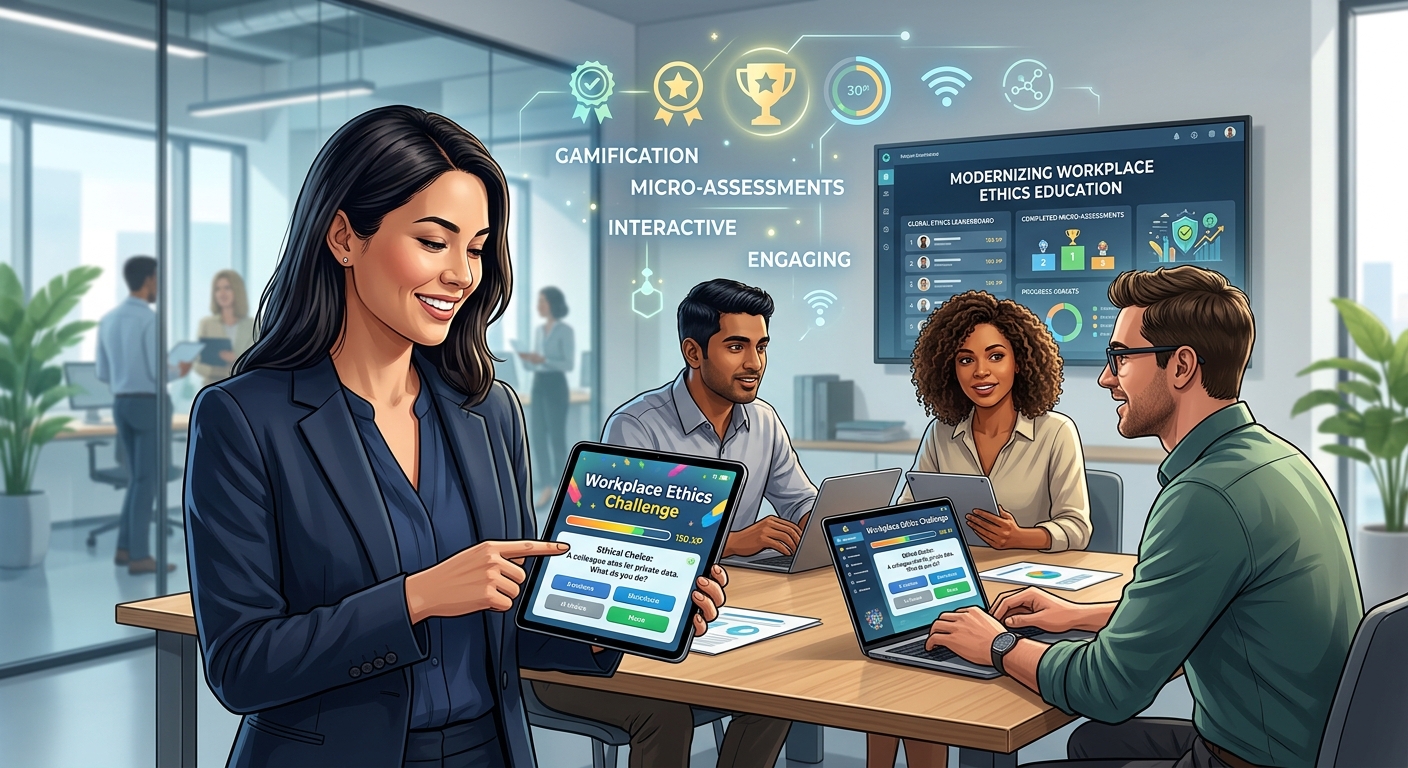
Gamification and Micro-Assessments: Modernizing Workplace Ethics Education
In today’s rapidly evolving business landscape, ethical conduct is not merely a legal requirement; it's the bedrock of a company's reputation, trust, and long-term sustainability. For Vice Presidents, Directors, Senior Managers, and Managers of Learning & Development (L&D), ensuring a robust and effective ethics education program is paramount. However, traditional, often didactic, approaches frequently fall short in engaging modern workforces across diverse industries like Compliance, Sales, Banking, Finance, Insurance, Retail, Pharma, Healthcare, Hospitality, Oil and Gas, and Mining. The solution? A dynamic blend of gamification and micro-assessments, leveraging cutting-edge eLearning technologies to create a truly impactful and memorable learning experience.
The Shifting Paradigm: Why Traditional Ethics Training Falls Short
For decades, workplace ethics training often consisted of lengthy presentations, dense policy documents, and infrequent, mandatory lectures. While well-intentioned, these methods frequently suffered from critical drawbacks:
- Lack of Engagement: Passive learning environments struggle to capture and retain learner attention, especially on complex or seemingly dry topics.
- Information Overload: Too much information delivered at once leads to cognitive fatigue and poor retention.
- Irrelevance: Generic scenarios often fail to resonate with employees facing specific, real-world ethical dilemmas in their roles.
- Compliance-Focused, Not Application-Focused: Traditional training often emphasizes rules without adequately preparing employees to apply ethical principles in ambiguous situations.
- Difficulty in Measuring Effectiveness: Beyond completion rates, it's challenging to gauge actual understanding, behavioral change, or the ability to make sound ethical judgments.
In an era demanding agility and continuous learning, L&D leaders recognize the urgent need to move beyond check-the-box training towards solutions that foster genuine ethical intelligence and cultivate a culture of integrity.
Gamification: Making Ethics Engaging and Experiential
What is Gamification?
Gamification is the application of game-design elements and game principles in non-game contexts. It transforms learning from a passive reception of information into an active, interactive experience. Elements like points, badges, leaderboards, progress bars, challenges, quests, and narrative storylines are integrated into the learning process.
Benefits of Gamification in Ethics Education
Applying gamification to ethics training can revolutionize its effectiveness:
- Increased Engagement and Motivation: By introducing elements of fun and competition, learners are more motivated to participate, complete modules, and strive for mastery. This is particularly effective when integrated into a Gamified LMS.
- Improved Retention and Understanding: Interactive scenarios allow learners to practice ethical decision-making in a safe, consequence-free environment, reinforcing learning through experience rather than rote memorization.
- Safe Environment for Practice: Learners can explore the ramifications of different ethical choices without real-world repercussions, fostering critical thinking and problem-solving skills.
- Promotes Critical Thinking: Ethics is rarely black and white. Gamified scenarios encourage learners to analyze complex situations, weigh options, and understand the nuances of ethical dilemmas.
- Instant Feedback Loops: Games are built on immediate feedback, allowing learners to understand the correctness of their decisions instantly and adjust their approach.
Micro-Assessments: Pinpointing Knowledge Gaps and Reinforcing Learning
What are Micro-Assessments?
Micro-assessments are short, targeted evaluations designed to quickly gauge understanding of specific concepts or skills. Unlike lengthy traditional tests, they are typically brief, often consisting of one to five questions, and can take various forms such as quizzes, polls, short simulations, or decision-point scenarios. These are ideally delivered through a Microlearning LMS.
Advantages of Micro-Assessments in Ethics Training
When strategically incorporated into ethics education, micro-assessments offer significant benefits:
- Immediate Feedback: Learners receive instant validation or correction, solidifying correct understanding and correcting misconceptions before they become entrenched.
- Identifies Specific Areas for Improvement: Their granular nature allows L&D professionals to pinpoint exact knowledge gaps, enabling targeted follow-up or Adaptive Learning paths.
- Supports Spaced Repetition: Regularly spaced, short assessments help combat the forgetting curve, reinforcing key ethical principles over time without overwhelming the learner.
- Reduces Cognitive Load: By breaking down assessment into smaller, manageable chunks, learners experience less anxiety and are more likely to engage consistently.
- Data-Driven Insights: Aggregate data from micro-assessments provides invaluable insights into organizational ethical understanding, informing future training development, especially when using an LMS.
The Synergistic Power: Gamification Meets Micro-Assessments
The true power emerges when gamification and micro-assessments are integrated. Imagine an ethics course where learners navigate interactive scenarios, making decisions that lead to immediate consequences (gamification). Along their journey, they encounter quick, embedded micro-assessments that test their understanding of specific ethical principles relevant to the scenario. Successfully completing these assessments might unlock new levels, earn points, or contribute to their leaderboard score. This creates a highly engaging and effective learning loop:
- Interactive Scenarios with Immediate Feedback: Gamified elements drive engagement, while micro-assessments provide immediate, specific feedback at critical junctures.
- Personalized Learning Paths: Performance on micro-assessments can trigger Adaptive Learning pathways, directing learners to remedial content or more advanced challenges, ensuring everyone receives the right training at the right time.
- Continuous Engagement: The iterative nature of micro-assessments embedded within a gamified journey keeps learners actively involved throughout the entire training program, not just during periodic testing.
- Building Ethical Muscle Memory: Regular exposure to ethical dilemmas and immediate feedback helps employees build an intuitive understanding of ethical conduct.
Leveraging Advanced Learning Technologies
Implementing such modern ethics education demands robust learning technology. A comprehensive learning management system (LMS) is essential, serving as the backbone for content delivery, learner tracking, and reporting. Look for platforms that support Microlearning LMS capabilities for bite-sized content, Gamified LMS features to enhance engagement, and tools that facilitate Adaptive Learning. The ability to create dynamic and relevant content is also crucial, often supported by an AI Powered Authoring Tool. For industries with high stakes, focusing on Risk-focused Training within these systems can be particularly beneficial.
AI & The Future of Ethics Training: Addressing Key Questions
Artificial Intelligence is poised to further transform how organizations approach ethics education. L&D leaders frequently ponder AI's potential:
How can Artificial Intelligence enhance personalized ethical learning experiences online?
AI plays a pivotal role in tailoring learning. By analyzing a learner's past performance, interactions within a cloud based learning management system, and even their behavioral patterns in simulations, AI can dynamically adjust the learning path. It can recommend specific modules, provide targeted feedback, and adapt the difficulty of ethical dilemmas to each individual's proficiency. This ensures that every employee receives highly relevant, effective online ethical education that caters to their unique needs and learning style.
What role can AI play in ensuring ethical compliance training meets diverse global standards?
For multinational corporations, navigating varied legal and cultural ethical standards is a huge challenge. AI can ingest vast amounts of international compliance regulations, industry-specific guidelines, and cultural nuances. It can then generate ethical training content that is sensitive to geographical differences and ensures that global ethical instruction is consistent yet locally relevant. This allows a MaxLearn LMS, or any enterprise learning management system, to deliver globally compliant and culturally appropriate ethics programs, bridging geographical and cultural gaps in ethics understanding.
How might AI contribute to identifying and addressing specific ethical knowledge gaps within an organization?
AI's analytical capabilities can process assessment results, engagement data, and performance in gamified scenarios to identify patterns and pinpoint collective or individual ethical knowledge gaps. For instance, if many employees struggle with scenarios involving conflict of interest, AI can highlight this as a systemic weakness. It can then recommend specific, targeted training interventions, LCMS content, or even new policies to address these areas proactively, leading to a more ethically robust organization and improved overall integrity.
Implementing Modern Ethics Education: A Roadmap for L&D Leaders
For L&D leaders ready to modernize their ethics training, here’s a practical roadmap:
- Assess Current State: Identify pain points with existing ethics training and key areas for improvement.
- Define Learning Objectives: Clearly articulate the ethical behaviors and decision-making skills you want to cultivate.
- Pilot Programs: Start with a pilot group to test gamified and micro-assessment approaches, gathering feedback for iteration.
- Choose the Right Technology Partner: Invest in a robust MaxLearn LMS or a comprehensive learning content management system that supports gamification, microlearning, and adaptive pathways. Ensure your chosen learning management software can handle the scale of your organization. Many look for a top-tier lms learning management system to meet their needs.
- Develop Engaging Content: Utilize an AI Powered Authoring Tool to create rich, interactive scenarios and precise micro-assessments.
- Measure Impact: Track key metrics beyond completion rates, such as engagement levels, assessment scores, and ultimately, real-world behavioral changes and reduction in ethical infractions. This is where learning management solutions truly shine.
The time for static, uninspired ethics training is over. By embracing the power of gamification and micro-assessments, coupled with intelligent learning technologies, L&D leaders can build an ethical framework that is not only compliant but deeply embedded in the organizational culture, fostering integrity, trust, and sustainable growth across all sectors.
.jpg)


