

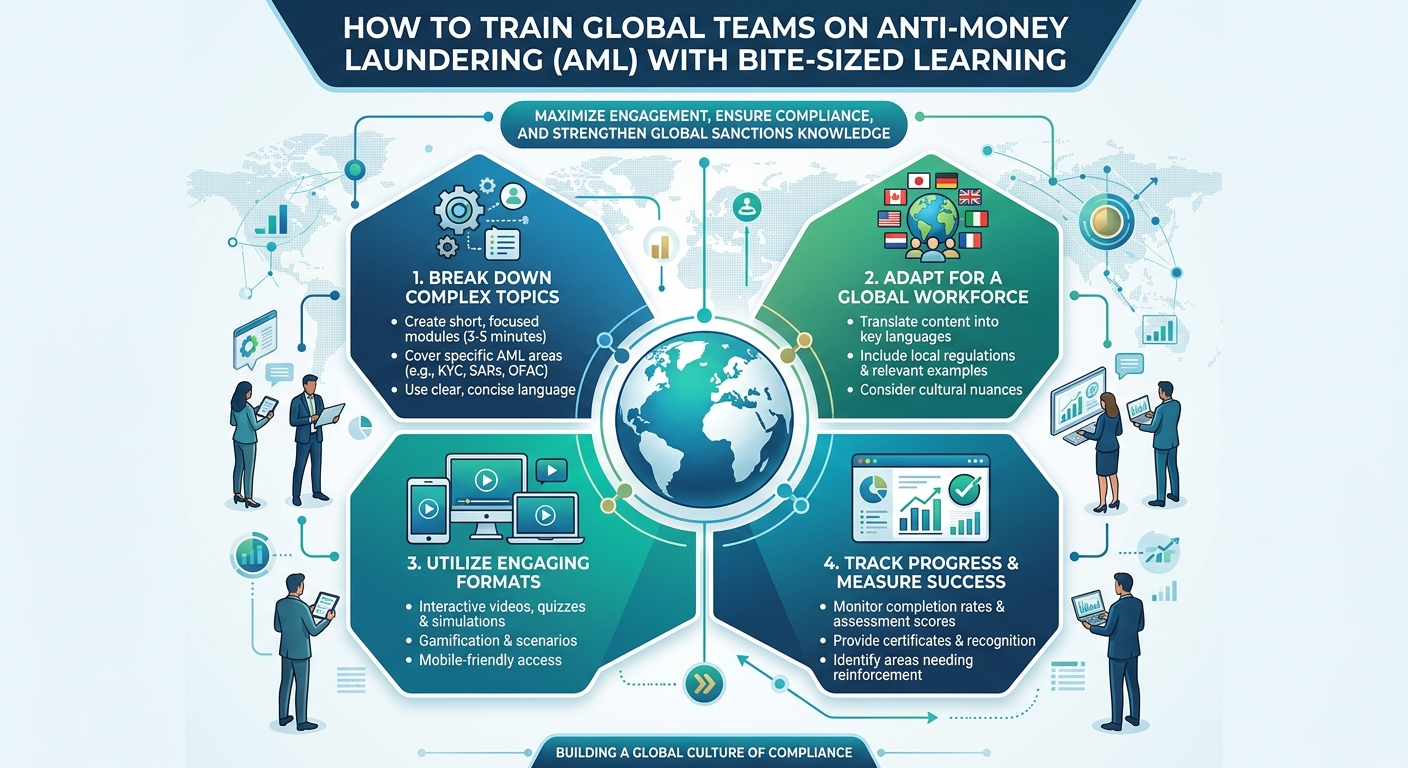
How to Train Global Teams on Anti-Money Laundering (AML) with Bite-Sized Learning
In today's interconnected global economy, the fight against financial crime has never been more critical. Anti-Money Laundering (AML) compliance is not just a regulatory obligation; it's a fundamental pillar of trust and integrity for any organization operating internationally. However, training diverse, globally dispersed teams on complex AML regulations presents a unique set of challenges for Learning & Development (L&D) leaders. From varying regulatory landscapes to cultural nuances and language barriers, ensuring consistent, effective, and engaging AML education can feel like an uphill battle. This is where bite-sized learning, powered by innovative eLearning solutions, emerges as a strategic imperative.
The Global AML Training Conundrum
Global teams face a labyrinth of AML regulations, which can differ significantly from one jurisdiction to another. What constitutes a suspicious transaction in one country might be standard practice elsewhere. Beyond legal complexities, L&D professionals grapple with:
- Information Overload: Traditional, lengthy training modules often lead to cognitive overload and poor retention, especially when dealing with dense legal information.
- Engagement Deficit: Monotonous, one-size-fits-all training fails to resonate with a diverse workforce, leading to disinterest and non-compliance.
- Logistical Hurdles: Coordinating live training across multiple time zones and locations is expensive, inefficient, and disruptive to operations.
- Measurement Gaps: Tracking comprehension and compliance effectiveness across a global team using traditional methods is notoriously difficult.
The stakes are incredibly high. Non-compliance can result in astronomical fines, reputational damage, and even criminal charges. L&D leaders must find a way to make AML training not just mandatory, but truly effective, engaging, and digestible for every employee, everywhere.
Why Bite-Sized Learning is the Game Changer for Global AML
Bite-sized learning, also known as microlearning, delivers content in short, focused bursts – typically 2-10 minutes in length. This approach is perfectly suited for complex subjects like AML, offering numerous advantages:
- Enhanced Retention: Smaller chunks of information are easier to process, understand, and recall, preventing the "forgetting curve" often seen with longer modules.
- Improved Engagement: Short, dynamic content, often incorporating videos, quizzes, and interactive elements, captures and holds learner attention far more effectively.
- Flexibility and Accessibility: Learners can access training on demand, on any device, during natural breaks in their workday, minimizing disruption and maximizing convenience.
- Targeted Learning: Modules can be highly specific, allowing teams to focus only on the regulations and risks relevant to their role and region.
Leveraging a Modern Microlearning LMS for Global AML
Implementing bite-sized AML training effectively requires a robust LMS. A specialized Microlearning LMS provides the infrastructure to deliver, manage, and track these short learning modules. Look for a cloud based learning management system that offers:
- Centralized Content Management: An advanced learning content management system (LCMS) ensures all AML content is organized, up-to-date, and easily accessible globally.
- Mobile-First Design: Crucial for global teams who may be on the go or accessing training from various devices.
- Analytics and Reporting: Comprehensive dashboards to track completion rates, comprehension scores, and identify knowledge gaps across regions and roles. This helps measure the true impact of your enterprise learning management initiatives.
- Scalability: The ability to effortlessly onboard thousands of employees across different countries and languages.
To further boost engagement, a Gamified LMS can transform mandatory AML training into an enjoyable and competitive experience. Leaderboards, badges, and points can motivate learners, foster healthy competition, and improve knowledge retention.
The Power of AI in Revolutionizing AML Training
The true potential of bite-sized AML training is unleashed when integrated with artificial intelligence (AI). AI can personalize, optimize, and automate the learning experience, addressing the unique challenges of global teams.
Intelligent Content Creation and Understanding
How can artificial intelligence help in optimizing the creation and understanding of economic concepts related to AML risk? AI-powered tools can significantly streamline the development of bite-sized AML content. An AI Powered Authoring Tool can:
- Suggest relevant content based on global regulatory updates.
- Automatically generate quiz questions and scenarios.
- Translate content into multiple languages with contextual accuracy.
- Analyze existing long-form content and break it down into microlearning modules, highlighting key points and compliance requirements.
This not only accelerates content development but also ensures the economic nuances of AML, such as understanding illicit financial flows and beneficial ownership, are communicated clearly and effectively.
Expanding Global Reach and Personalization
How can artificial intelligence enhance the global distribution and individual tailoring of AML education? For global teams, personalization is paramount. Adaptive Learning platforms, driven by AI, can:
- Assess a learner's existing knowledge and role-specific requirements.
- Automatically create personalized learning paths, delivering only the micro-modules relevant to their regional regulations, job function, and demonstrated understanding.
- Provide real-time feedback and recommend additional resources based on performance.
- Localize content dynamically, offering training in native languages and accounting for cultural sensitivities.
This ensures that employees in different countries or departments (e.g., retail banking vs. corporate finance) receive highly relevant training, enhancing engagement and effectiveness.
Automating Intelligent Learning Delivery
How can artificial intelligence automate and coordinate the sophisticated delivery of AML training programs? AI can transform how training is delivered and managed, making it more efficient and impactful:
- Automated Reminders and Nudging: AI can schedule and send personalized reminders to learners based on their progress and deadlines, ensuring timely completion.
- Performance Prediction: By analyzing learner data, AI can identify individuals or teams at higher risk of non-compliance and proactively recommend additional training or support.
- Intelligent Reporting: AI can process vast amounts of learning data to generate actionable insights for L&D leaders, highlighting areas of strength and weakness across the global workforce.
Furthermore, an AI-driven approach facilitates Risk-focused Training. Instead of a generic approach, AI can help identify high-risk roles or regions based on organizational data and deliver targeted microlearning modules that address those specific vulnerabilities, ensuring resources are allocated where they are needed most.
Key Benefits for L&D Leaders
Adopting bite-sized, AI-enhanced AML training provides tangible benefits for L&D Vice Presidents, Directors, and Managers:
- Improved Compliance Rates: More engaged and knowledgeable employees lead to fewer compliance breaches.
- Reduced Training Costs: Less reliance on costly in-person training, travel, and logistics.
- Higher Employee Engagement and Satisfaction: Relevant, flexible, and interactive training fosters a positive learning culture.
- Measurable Impact: Robust analytics from the learning management software provide clear data on training effectiveness and ROI.
- Future-Proofing: An agile learning management system, capable of quick content updates, ensures teams are always current with evolving AML regulations.
Choosing the Right Learning Platform
When evaluating learning management solutions, prioritize platforms that offer a comprehensive suite of features supporting global AML training. The ideal LMS should combine microlearning capabilities with powerful AI integration. For example, a system like MaxLearn LMS is designed to meet these exact needs, providing a seamless experience for both learners and administrators. Look for ease of use, strong reporting, and robust security features to protect sensitive training data.
Conclusion
Training global teams on Anti-Money Laundering is a complex, continuous challenge. However, by embracing the strategic advantages of bite-sized learning, supercharged by artificial intelligence, L&D leaders can transform their approach. This modern methodology not only simplifies complex information but also personalizes the learning journey, enhances engagement, and ultimately strengthens an organization's defense against financial crime across all industries – from banking and insurance to retail, healthcare, and oil and gas. Investing in an advanced learning management system that supports these innovations is not just a training decision; it's a critical business imperative for global compliance and sustained growth.
.jpg)


