

Boosting Engagement: Transforming Mandatory Health and Safety Training from Drab to Dynamic
For L&D leaders across industries – from the meticulous world of Microlearning LMS in finance and banking to the high-stakes environments of oil & gas and healthcare – mandatory health and safety training often feels like a necessary evil. It’s critical for compliance, risk mitigation, and employee well-being, yet it frequently suffers from low engagement, poor retention, and a perception of being "boring." This sentiment is a significant barrier to effective learning and can leave organizations vulnerable. But what if we could flip the script, transforming these vital sessions into compelling, even enjoyable experiences that employees not only participate in but actively embrace?
This article explores innovative strategies and technological advancements, particularly within the eLearning space, to elevate employee participation in even the driest of compliance subjects. It’s time to move beyond check-the-box training and cultivate a culture of proactive safety awareness.
The Engagement Gap: Why Mandatory Training Falls Flat
The traditional approach to health and safety training often involves lengthy presentations, dense manuals, and a one-size-fits-all delivery. While the intent is good, the execution often misses the mark. Employees, often juggling demanding workloads, see these sessions as an interruption rather than an opportunity. The result? Dwindling attention spans, minimal knowledge retention, and a missed chance to truly embed a safety-first mindset.
Common Pitfalls Leading to Low Participation:
- Information Overload: Too much content delivered in a single sitting overwhelms learners.
- Lack of Relevance: Generic content fails to connect with an employee’s specific role or daily tasks.
- Passive Learning: Lectures and slide decks don't encourage active involvement or critical thinking.
- Repetitive Content: Annual refreshers often present the exact same material, leading to disinterest.
- Inconvenient Scheduling: Fixed, long training blocks disrupt work schedules and cause frustration.
Recognizing these challenges is the first step. The next is to actively seek and implement solutions that leverage modern learning science and cutting-edge technology.
Revolutionizing Engagement with Modern eLearning Strategies
The solution isn't to make safety less important, but to make the learning process more effective, more appealing, and more integrated into the daily workflow. This requires a strategic shift in how organizations conceptualize, design, and deliver compliance training.
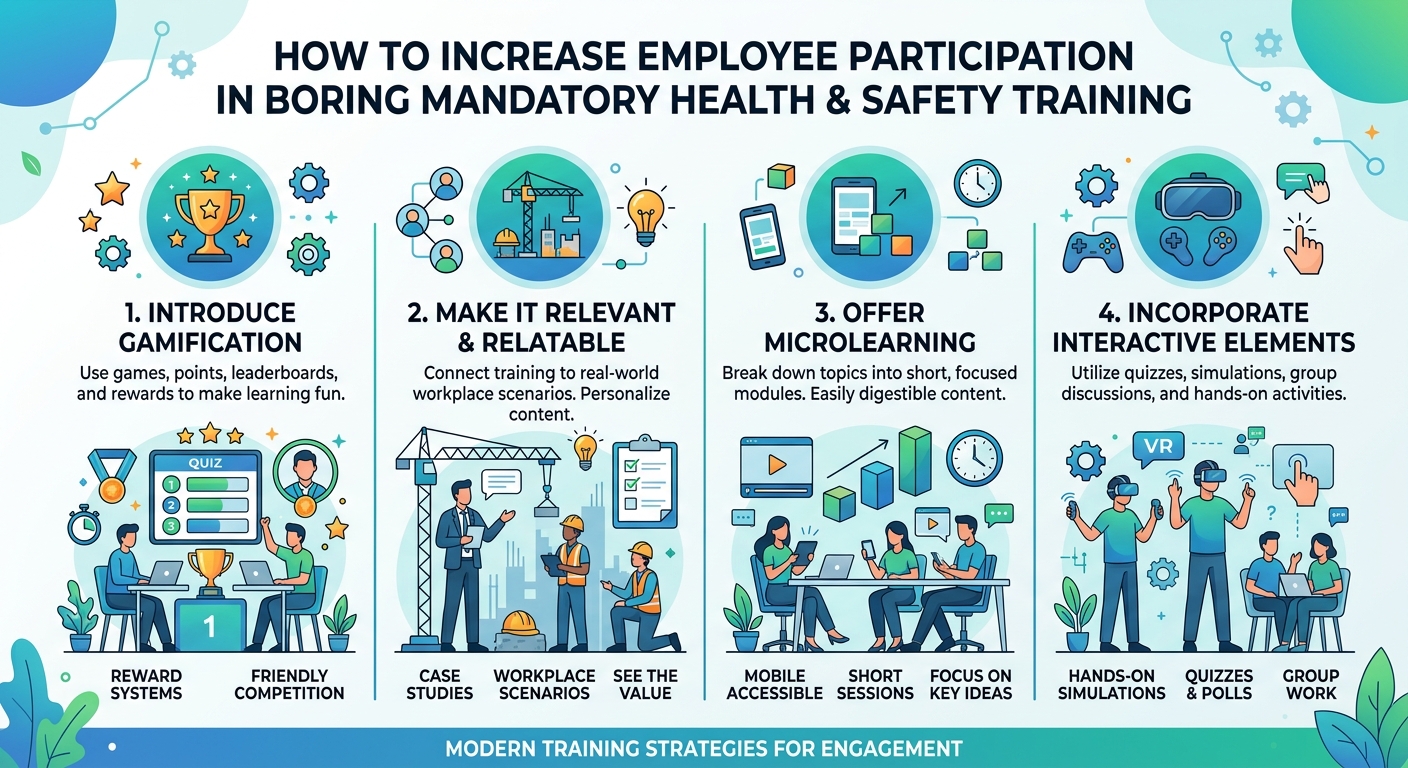
1. Embrace Microlearning and Bite-Sized Content
What's the optimal approach to making complex safety procedures digestible and memorable? The answer lies in breaking down information into short, focused modules. Microlearning LMS platforms are designed for this exact purpose. Instead of a two-hour session on lockout/tagout procedures, consider 5-7 minute modules covering specific aspects. This approach caters to shorter attention spans and allows employees to learn at their own pace, integrating training into brief moments throughout their day rather than dedicating large, disruptive blocks of time.
- Present core concepts in small, digestible chunks.
- Use engaging formats: short videos, interactive quizzes, infographics.
- Focus on one learning objective per module.
2. Gamify the Learning Experience
Where are the most effective strategies for boosting motivation in mandatory training? Introducing elements of game design into non-game contexts is a powerful motivator. A Gamified LMS can transform monotonous tasks into engaging challenges. Leaderboards, points, badges, and progress tracking can foster healthy competition and a sense of achievement. Imagine employees earning 'Safety Hero' badges for completing modules or accumulating points for correctly identifying hazards in simulated scenarios. This approach taps into intrinsic motivators, making learning feel less like a chore and more like an achievement.
- Incorporate points, badges, levels, and leaderboards.
- Create scenario-based challenges and simulations.
- Offer rewards for completion and high scores.
3. Implement Adaptive Learning Paths
How can training be tailored to individual employee needs and existing knowledge? Not all employees start with the same level of knowledge or require the same depth of training. An Adaptive Learning system uses data to personalize the learning journey. If an employee demonstrates proficiency in a particular area, the system can skip redundant modules, focusing instead on areas where they need more development. This not only saves time but also keeps learners engaged by providing content that is relevant and challenging, but not overwhelming. It's about delivering the right training to the right person at the right time.
- Assess prior knowledge to customize content delivery.
- Offer different paths based on role, department, or skill level.
- Provide immediate feedback and targeted remediation.
4. Leverage AI for Content Creation and Personalization
What are the cutting-edge tools for rapidly developing dynamic and personalized compliance content? The advent of an AI Powered Authoring Tool is a game-changer for L&D departments. These tools can assist in generating diverse content formats, suggesting optimal learning paths, and even identifying areas where employees are struggling. Imagine an AI generating realistic scenarios for retail safety training, or quickly adapting pharmaceutical compliance modules based on the latest regulatory changes. This significantly reduces the burden on L&D teams while enhancing the quality and relevance of training materials.
- Automate content generation and updates.
- Use AI to analyze learner data and suggest improvements.
- Create intelligent chatbots for instant query resolution.
5. Focus on Risk-Based Training
What's the most effective strategy for making safety training resonate with real-world impact? Instead of generic training, focus on the specific risks employees face in their day-to-day roles. Risk-focused Training identifies the most critical hazards and delivers targeted content to mitigate those risks. For example, a healthcare worker might receive intensive training on pathogen exposure and sterile procedures, while an oil and gas field technician would focus on confined spaces and equipment lockout. This targeted approach makes the training immediately relevant and highlights its direct impact on personal safety and operational continuity.
- Identify the most prevalent risks for each role/department.
- Develop scenarios that mirror real-life workplace hazards.
- Emphasize the consequences of non-compliance and the benefits of safety.
The Role of a Robust Learning Management System (LMS)
Implementing these strategies effectively requires a powerful foundation: a modern LMS. An enterprise learning management system serves as the central hub for all training activities, from content delivery to progress tracking and reporting. A cloud based learning management system offers flexibility and scalability, crucial for diverse and geographically dispersed workforces found in industries like mining and hospitality.
Look for a learning management software that offers:
- Seamless integration of microlearning modules.
- Robust gamification features.
- Analytics for tracking engagement and knowledge retention.
- Support for various content formats (video, interactive, VR/AR).
- Easy access for employees via desktop and mobile devices.
- Capabilities as a Learning content management system (LCMS) for dynamic content updates.
A sophisticated learning management solutions provider like MaxLearn LMS understands the nuances of compliance training across highly regulated sectors. Investing in the right lms learning management system is not just about technology; it's about investing in a safer, more engaged, and ultimately more productive workforce.
Cultivating a Culture of Continuous Safety Learning
Increasing employee participation in mandatory health and safety training goes beyond simply redesigning content. It’s about fostering an organizational culture where safety is seen as a continuous journey, not an annual event. Encourage open communication about safety concerns, recognize proactive safety behaviors, and integrate learning into regular team meetings and daily operations.
By transforming 'boring' into 'brilliant' through innovative eLearning strategies, L&D leaders can significantly enhance engagement, improve knowledge retention, and build a truly resilient safety culture. The benefits extend far beyond compliance, contributing to reduced incidents, lower costs, and a more confident, productive workforce across all industries.
.jpg)


