

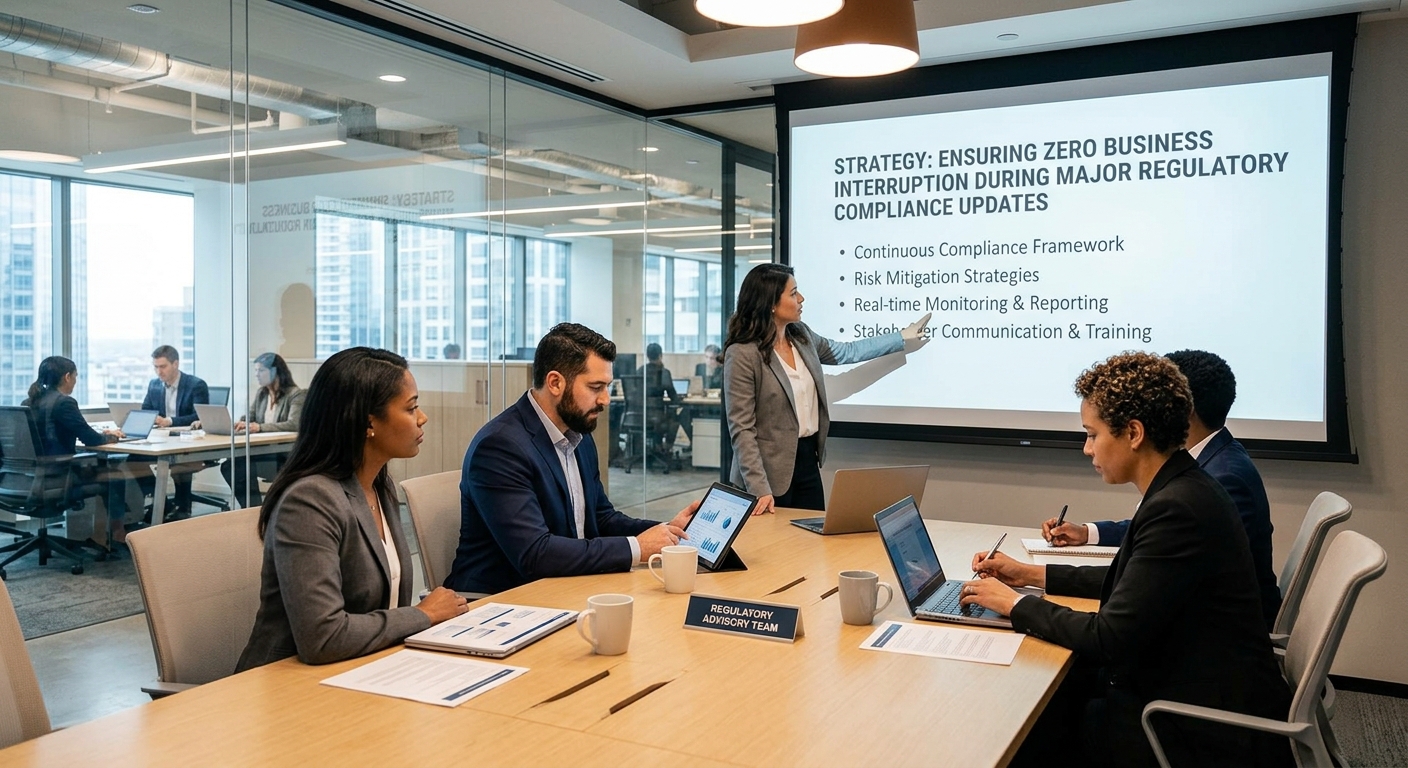
Ensuring Zero Business Interruption During Major Regulatory Compliance Updates
For Vice Presidents, Directors, and Senior Managers in Learning & Development across high-stakes industries like banking, finance, healthcare, and pharmaceuticals, the phrase "regulatory compliance update" often conjures images of disruption, costly downtime, and the looming specter of penalties. Yet, in today's rapidly evolving business landscape, staying compliant isn't just about avoiding fines; it's about maintaining trust, operational continuity, and market leadership. The challenge lies in integrating these critical updates without skipping a beat – achieving zero business interruption.
Major regulatory shifts, whether driven by new legislation, technological advancements, or global economic changes, demand immediate and comprehensive understanding across an organization. From front-line staff to executive leadership, everyone must be aligned. The traditional, often manual, approach to compliance training is no longer sustainable. It's time for a strategic pivot towards modern, technology-driven solutions that can transform a potential crisis into a seamless transition.
The High Stakes of Compliance Updates
The cost of non-compliance extends far beyond monetary fines. It can include reputational damage, loss of customer trust, operational inefficiencies, legal battles, and even criminal charges. For industries like finance and healthcare, a single misstep can have catastrophic consequences. When new regulations are introduced, businesses face immense pressure to:
- Quickly understand the nuances of the new rules.
- Identify all affected processes, roles, and systems.
- Train thousands of employees effectively and consistently.
- Prove compliance through robust documentation and reporting.
- Ensure continuous adherence post-training.
Failure in any of these areas leads directly to business interruption, impacting productivity, customer service, and ultimately, profitability. The goal is not just compliance, but frictionless, proactive compliance that fortifies the business rather than hinders it.
Traditional Approaches vs. Modern Needs
Historically, compliance training involved lengthy classroom sessions, bulky manuals, and one-size-fits-all online modules. While these methods had their place, they often fall short in an era of rapid change:
- They are time-consuming and expensive to develop and deliver.
- They lead to low engagement and retention rates.
- They struggle to adapt quickly to new or evolving regulations.
- They offer limited personalization, failing to address specific roles or knowledge gaps.
- They make it difficult to track individual proficiency and overall organizational readiness in real-time.
Modern organizations require a more agile, scalable, and intelligent approach – one that leverages cutting-edge eLearning technologies and a robust Microlearning LMS to ensure uninterrupted business operations.
Leveraging eLearning for Seamless Transitions
A sophisticated learning management system (LMS) is no longer just a training tool; it's a strategic asset for regulatory compliance. By centralizing content, streamlining delivery, and providing powerful analytics, an LMS acts as the backbone for an effective compliance strategy.
Strategic Planning for Compliance Training
The journey to zero interruption begins long before a new regulation is finalized. It involves proactive planning:
- Regulatory Intelligence: Staying abreast of proposed changes and their potential impact.
- Impact Assessment: Identifying which departments, roles, and systems will be affected.
- Content Strategy: Planning the development of modular, digestible training content.
- Technology Adoption: Ensuring your chosen learning content management system can handle rapid updates and diverse learning needs.
Agile Content Development and Delivery
Once regulations are firm, the speed and accuracy of content development and delivery become paramount. This is where modern learning management solutions shine. They allow for:
- Rapid creation and deployment of targeted training modules.
- Updates to content in real-time across all platforms.
- Delivery of training directly to employees' preferred devices, ensuring accessibility.
- Integration with HR systems to automate enrollment and track progress.
Such agility helps ensure that every employee receives the right training at the right time, minimizing knowledge gaps and the associated risks of non-compliance.
The AI Advantage in Compliance Training
Artificial intelligence (AI) is revolutionizing how organizations approach compliance, offering unprecedented capabilities for automation, personalization, and foresight. For L&D leaders, understanding AI's role is crucial for future-proofing their compliance strategies.
Intelligent Automation for Compliance Workflow
Question: How can artificial intelligence ensure compliance processes run flawlessly, even during major overhauls?
Answer: Smart systems can automate the enforcement of compliance rules within operational workflows. Imagine an AI agent reviewing transactions for adherence to new financial regulations in real-time, flagging anomalies, and even preventing non-compliant actions before they occur. This goes beyond just training; it embeds compliance into the very fabric of daily operations. For the training aspect, AI can automatically assign specific training modules based on an employee's role, past performance, or identified knowledge gaps, ensuring that the right learning reaches the right person without manual intervention. A modern MaxLearn LMS, particularly a cloud based learning management system, can integrate such intelligent automation to maintain continuous operational excellence and drastically reduce the potential for human error during regulatory transitions. This creates a proactive rather than reactive compliance environment, minimizing business interruption.
Dynamic Learning Experiences for Regulatory Shifts
Question: In what ways can smart systems revolutionize how employees learn and adapt to new compliance rules?
Answer: AI enables highly personalized and engaging learning experiences. Instead of generic modules, an AI-driven Gamified LMS can analyze an individual's learning style, existing knowledge, and job role to deliver precisely the content they need, when they need it. This could involve interactive simulations, case studies tailored to their specific department, or even AI-powered chatbots to answer real-time compliance questions. Technologies like Adaptive Learning ensure that learners spend time on new or difficult concepts, rather than reviewing what they already know. This targeted approach not only improves comprehension and retention but also makes compliance training more efficient and less burdensome, thereby accelerating the workforce's adaptation to new regulations and preventing operational lags. This personalized, engaging approach, often delivered through a Microlearning LMS, minimizes the learning curve and ensures quick application of new rules.
Predictive Insights for Proactive Compliance
Question: How can advanced analytics and machine learning help identify potential compliance risks before they impact business?
Answer: AI can sift through vast amounts of data – from training completion rates and assessment scores to incident reports and operational data – to identify patterns and predict future compliance risks. For example, if a specific department consistently scores lower on certain compliance topics, or if certain types of errors frequently occur, AI can flag these as high-risk areas. This predictive capability allows L&D and compliance teams to intervene proactively with targeted training or policy reinforcement, preventing issues before they escalate into major disruptions. An AI Powered Authoring Tool within an enterprise learning management system can even suggest content updates or new modules based on these insights. This approach leads to truly Risk-focused Training, transforming compliance from a reactive burden into a strategic advantage, ensuring continuous adherence, and bolstering overall business resilience. By leveraging advanced analytics, the learning management system can provide actionable intelligence to leadership, ensuring proactive compliance and uninterrupted operations.
Key Pillars for Uninterrupted Compliance
To achieve zero business interruption during regulatory compliance updates, L&D leaders must embrace these key pillars:
- Modular and On-Demand Learning: Break down complex regulations into bite-sized, easily digestible Microlearning LMS modules accessible whenever and wherever employees need them. This reduces the time away from core duties.
- Interactive and Engaging Formats: Utilize a Gamified LMS, simulations, and virtual reality to make compliance training compelling, leading to better retention and faster application of new rules.
- Personalized Learning Paths: Employ Adaptive Learning to tailor content to individual roles, prior knowledge, and performance, optimizing learning efficiency.
- Robust Tracking and Reporting: Implement a learning management software with comprehensive analytics to monitor completion rates, assessment scores, and proficiency levels in real-time, providing an auditable trail for regulatory bodies. A robust LCMS can provide detailed insights.
- Continuous Updates and Feedback Loops: Ensure that your lms learning management system allows for quick content updates and integrates feedback mechanisms to continuously improve training efficacy.
Choosing the Right Learning Solution
Selecting the appropriate learning management solutions is paramount. Look for a platform that is:
- Scalable: Capable of supporting thousands of users across diverse locations and departments.
- User-Friendly: Intuitive for both administrators and learners.
- Feature-Rich: Offering robust capabilities like AI Powered Authoring Tool, gamification, and advanced analytics.
- Secure: Meeting stringent data privacy and security standards, especially critical for sensitive industries.
- Integrated: Able to seamlessly connect with existing HRIS, CRM, and other enterprise systems.
A sophisticated enterprise learning management system like MaxLearn LMS can be a game-changer, providing the tools necessary to navigate complex regulatory landscapes with confidence and efficiency.
Conclusion
For L&D leaders, the era of fearing major regulatory compliance updates is over. By strategically embracing advanced eLearning technologies, especially those powered by AI, organizations can transform these critical moments from potential disruptions into opportunities for reinforcing operational excellence and competitive advantage. The future of compliance lies in intelligent, engaging, and proactive training solutions that ensure not just compliance, but zero business interruption, safeguarding your operations, reputation, and bottom line. The investment in a modern learning management system is an investment in your organization's resilience and future success.
.jpg)


