

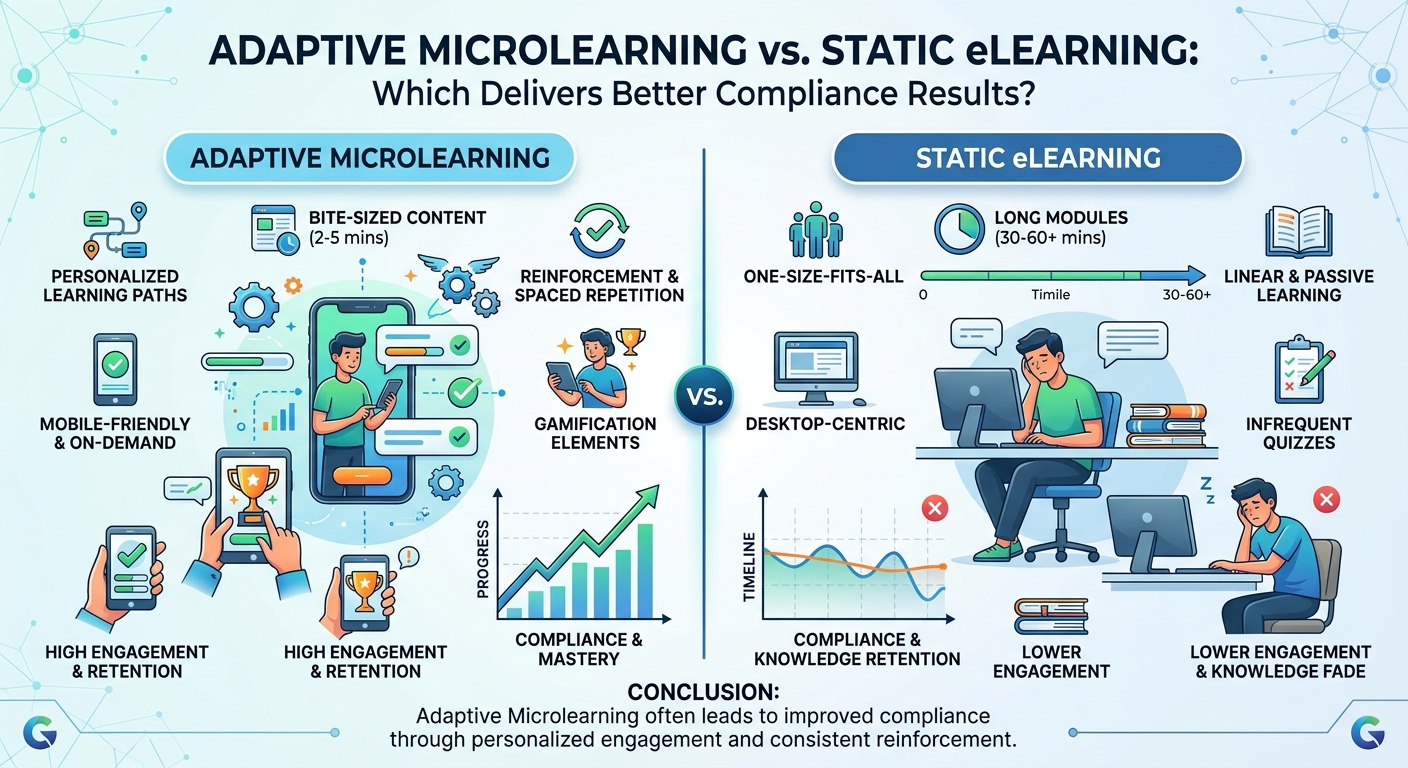
Adaptive Microlearning vs. Static eLearning: Which Delivers Better Compliance Results?
For Vice Presidents, Directors, and Managers in Learning & Development, ensuring robust compliance across an organization is not just a regulatory obligation; it's a strategic imperative. In industries ranging from Banking and Finance to Pharma and Oil and Gas, the cost of non-compliance can be catastrophic, impacting reputation, financial stability, and legal standing. As L&D leaders, the perennial challenge lies in making compliance training not only effective but also engaging and measurable.
Historically, organizations have relied heavily on static eLearning modules – the traditional, one-size-fits-all approach. However, a new paradigm is emerging: adaptive microlearning. This dynamic methodology promises to revolutionize how employees interact with crucial compliance content. The question for forward-thinking L&D professionals isn't if training is necessary, but rather, which approach genuinely delivers superior compliance outcomes: the familiar static model or the intelligent, personalized path of adaptive microlearning?
Understanding Static eLearning: The Traditional Approach
Static eLearning refers to the conventional method of delivering digital training. Learners are presented with a fixed set of content – modules, videos, quizzes – that all participants consume in the same sequence and manner. Think of it as a digital textbook with interactive elements, where the path is predetermined, and the pace is often self-directed but not self-optimized.
While static eLearning offers apparent advantages, such as ease of initial deployment and cost-effectiveness for mass training, its limitations in the high-stakes world of compliance are becoming increasingly evident:
- Engagement Deficit: Monotonous content and lengthy modules often lead to disengagement, with learners "clicking through" rather than absorbing information.
- Information Overload: Presenting all information to all learners, regardless of their existing knowledge, can overwhelm participants and dilute critical messages.
- Poor Retention: Without personalization or spaced repetition, knowledge retention rates plummet quickly after the training concludes.
- Lack of Relevance: Content may not directly address an individual's specific role, prior experience, or knowledge gaps, leading to wasted time and frustration.
- Limited Insight: While completion rates can be tracked, static platforms offer minimal insight into true comprehension or individual risk areas.
In environments where compliance adherence is paramount, these drawbacks translate directly into increased organizational risk.
Embracing Adaptive Microlearning: The Modern Paradigm
Adaptive microlearning represents a fundamental shift. It’s a personalized, data-driven approach that tailors the learning experience to each individual's needs, knowledge level, and learning style. At its core, it leverages technology to deliver bite-sized, focused content (microlearning) that dynamically adjusts based on learner interaction, performance, and preferences (adaptive learning).
Key characteristics of adaptive microlearning include:
- Personalized Paths: Content is presented based on pre-assessments, past performance, and role, skipping what’s already known and focusing on what needs to be learned.
- Bite-sized Modules: Information is broken down into short, digestible chunks (typically 3-5 minutes), making it easier to consume, retain, and fit into busy schedules.
- Frequent Assessments & Feedback: Short quizzes and interactive challenges are integrated throughout, providing immediate feedback and reinforcing learning.
- Spaced Repetition: Algorithms automatically reintroduce content at optimal intervals to bolster long-term memory retention.
- Performance-driven: The system continuously analyzes learner data to refine the learning path, ensuring maximum efficiency and effectiveness.
The Core Difference: Personalization and Engagement
The starkest contrast between the two methodologies lies in their approach to personalization and engagement. Static eLearning treats all learners as a single homogenous group, delivering content passively. In contrast, adaptive microlearning recognizes and caters to individual differences, transforming learning into an active, dynamic, and highly relevant experience.
This dynamic engagement is crucial for compliance training. It shifts the focus from simply "completing" a module to genuinely "understanding" and "applying" critical regulations. When training is relevant and personalized, learners are more invested, leading to significantly better comprehension and retention of complex compliance rules.
Why Adaptive Microlearning Excels in Compliance
For L&D leaders seeking tangible improvements in compliance results, adaptive microlearning offers compelling advantages:
- Improved Knowledge Retention: The combination of bite-sized content, frequent checks for understanding, and spaced repetition directly combats the forgetting curve. Learners remember crucial information longer, translating into sustained compliance adherence.
- Real-time Relevance: As regulations evolve, an adaptive system can quickly update and re-deliver only the necessary new information to specific individuals or groups, ensuring an always up-to-date workforce. Explore the power of Adaptive Learning to keep your training evergreen.
- Enhanced Learner Engagement: The interactive, personalized nature of this training, often augmented by elements found in a Gamified LMS, captivates learners. When training feels like a personalized journey rather than a mandatory chore, engagement soars, and so does effectiveness.
- Efficient Learning Paths: By identifying and targeting specific knowledge gaps, adaptive microlearning reduces the time employees spend on redundant training. This efficiency is a win for both the learner and the organization’s productivity.
- Actionable Insights & Risk Mitigation: A robust Microlearning LMS provides detailed analytics on individual and collective performance, highlighting areas of weakness, common misconceptions, and overall compliance readiness. This data allows L&D teams to implement targeted interventions and proactively mitigate risks.
Addressing Key L&D Concerns with Intelligent Systems
How can we ensure employees genuinely understand and apply complex compliance regulations, rather than just clicking through modules?
Traditional methods often fall short in fostering true comprehension. Intelligent training systems overcome this by continuously assessing learner knowledge and tailoring content delivery. If a learner struggles with a specific concept, the system can provide additional resources, different explanations, or more practice questions until mastery is achieved. This ensures that training isn't just consumed, but truly understood and internalized. Furthermore, with an AI Powered Authoring Tool, content creation becomes smarter, enabling dynamic content generation that targets specific learning objectives and adapts to real-time performance data.
What's the best way to proactively identify and address compliance risks across diverse teams and regions before they become critical issues?
The power of data analytics in modern training solutions is unparalleled. Adaptive platforms gather granular data on every learner's performance, identifying specific topics or regulations where understanding is low. This allows L&D leaders to pinpoint high-risk individuals, departments, or geographical regions that require additional focus. By leveraging this intelligence, organizations can deploy Risk-focused Training interventions precisely where they are needed most, transforming reactive compliance measures into proactive risk mitigation strategies.
How can we optimize our training resources and budget while ensuring comprehensive compliance coverage for our entire workforce?
Efficiency is a cornerstone of adaptive microlearning. By focusing training only on what each learner needs, it significantly reduces the overall time spent on mandatory courses. This translates into less downtime for employees, allowing them to focus on core responsibilities. Additionally, the ability to rapidly update and deploy new content to targeted audiences minimizes content development costs and maximizes the shelf-life of training materials. The rich analytics provided by these platforms also offer a clear return on investment (ROI) by demonstrating improved compliance rates and reduced incident potential.
Implementation Considerations for L&D Leaders
Transitioning from static to adaptive microlearning requires strategic planning. It involves an initial investment in a robust platform and a shift in content development methodology. However, the long-term gains in compliance effectiveness, risk reduction, learner engagement, and operational efficiency far outweigh the initial outlay. When evaluating solutions, L&D leaders should look for platforms that offer intuitive authoring tools, powerful adaptive algorithms, comprehensive analytics, and seamless integration capabilities.
Conclusion
In the evolving landscape of corporate compliance, relying solely on static eLearning is akin to using a compass when GPS is available. While it might get you there, it's inefficient, prone to error, and doesn't provide the optimal path. Adaptive microlearning, with its personalized, engaging, and data-driven approach, stands out as the superior solution for achieving and maintaining robust compliance across all industries, from Retail to Health Care.
For L&D Vice Presidents, Directors, and Managers, the choice is clear: embrace the future of learning to build a more compliant, knowledgeable, and resilient workforce. The benefits extend beyond mere regulatory fulfillment; they contribute directly to an organization's sustained success, reputation, and competitive edge in an increasingly complex global environment.
.jpg)


