

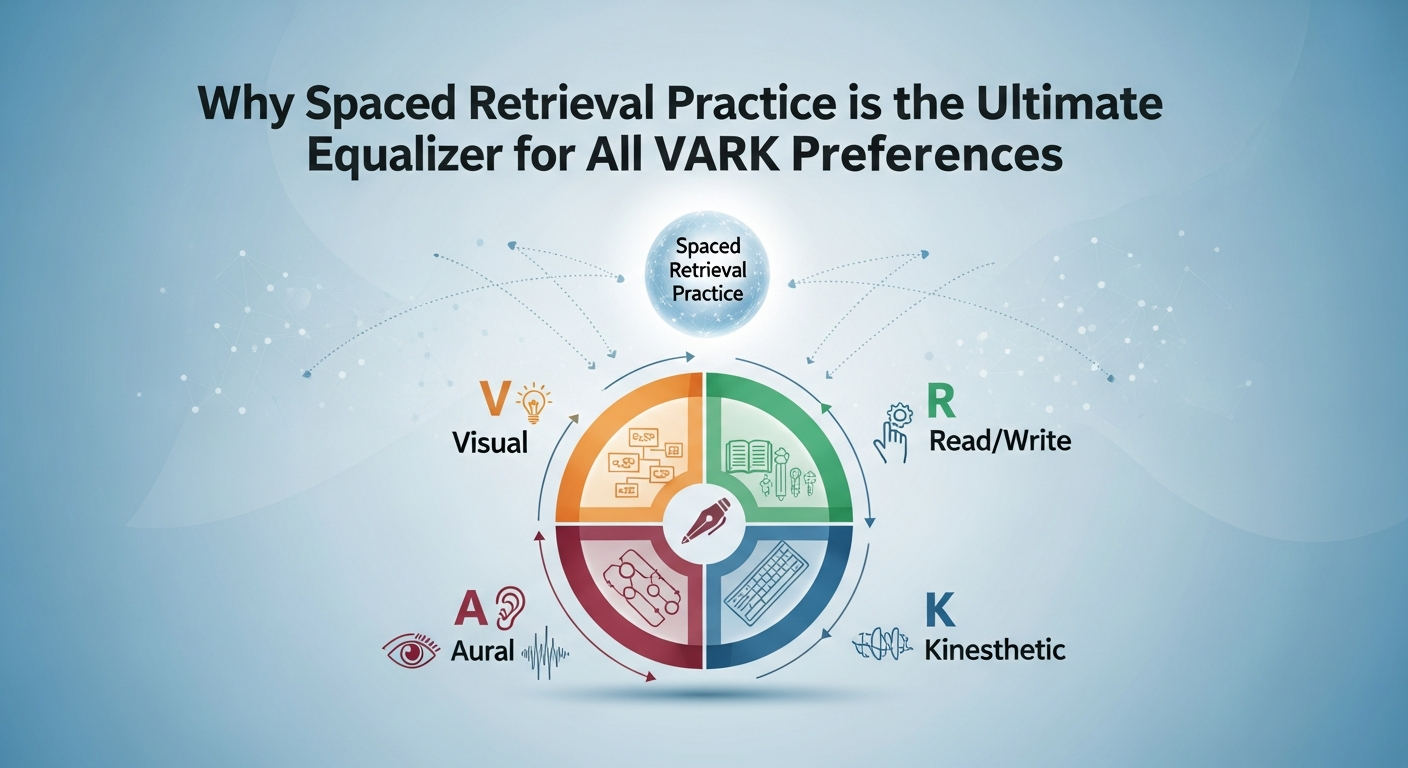
Why Spaced Retrieval Practice is the Ultimate Equalizer for All VARK Preferences
In the dynamic world of corporate learning and development, the challenge of creating effective training programs that resonate with every employee is a persistent one. L&D leaders, VPs, Directors, and Managers are constantly seeking methodologies that transcend individual learning preferences, ensuring maximum engagement and, critically, long-term retention. While the VARK model (Visual, Auditory, Read/Write, Kinesthetic) offers valuable insights into how individuals prefer to consume information, relying solely on it can lead to fragmented strategies and inconsistent outcomes. Enter Spaced Retrieval Practice – a scientifically validated learning technique that doesn't just cater to preferences but optimizes learning for everyone, making it the ultimate equalizer.
For organizations across sectors like Compliance, Sales, Banking, Finance, Insurance, Retail, Pharma, Health care, Hospitality, Oil and Gas, and Mining, the stakes are incredibly high. From mastering complex regulatory requirements to internalizing product knowledge or refining critical safety protocols, effective learning is directly tied to performance, compliance, and competitive advantage. This is where the power of an intelligent learning strategy, anchored by a robust Microlearning LMS, truly shines.
Understanding VARK: A Foundation, Not a Fix-All
The VARK model categorizes learners based on their sensory preferences for information intake:
- Visual (V): Learners who prefer to see information, often through diagrams, charts, videos, and demonstrations.
- Auditory (A): Those who learn best by hearing, such as lectures, discussions, podcasts, and verbal instructions.
- Read/Write (R): Individuals who prefer to learn through text, reading manuals, taking notes, and writing summaries.
- Kinesthetic (K): Learners who thrive on doing, experiencing, and hands-on activities, simulations, or practice.
While understanding these preferences helps in the initial design of learning content, the reality is that most people exhibit a blend of preferences, and effective learning often requires engaging multiple senses. The true goal isn't just to present information in a preferred format, but to ensure that information is not only understood but deeply ingrained and readily retrievable when needed. This is the gap that Spaced Retrieval Practice effectively bridges, making it a cornerstone for any modern learning management system.
The Science of Spaced Retrieval Practice: Building Indelible Knowledge
Spaced Retrieval Practice (SRP), also known as Spaced Repetition or the Spacing Effect, is a powerful learning strategy where learners actively recall information at increasing intervals over time. It leverages two critical cognitive principles:
- The Testing Effect (Active Recall): The act of retrieving information from memory strengthens the memory trace itself, making it easier to recall in the future. It's not just about what you put in, but how you pull it out.
- The Spacing Effect: Distributing learning over time, rather than cramming it into a single session, leads to much better long-term retention.
When combined, these principles create a powerful learning loop. Each successful retrieval session reinforces the memory, and by spacing these sessions out, the brain is forced to work harder to recall, making the memory even stronger. This leads to a deeper, more resilient understanding of the subject matter, critical for sustained performance in roles demanding high accuracy and timely knowledge application.
How Spaced Retrieval Practice Levels the Playing Field for Each VARK Preference
The genius of Spaced Retrieval Practice lies in its ability to transcend the initial intake preference and focus on the universal mechanism of memory consolidation. It transforms passive consumption into active mastery.
For Visual Learners
While visual learners might initially benefit from diagrams or videos, SRP challenges them to recall those visuals, reconstruct mental images, or explain the relationships shown in a chart without looking at it. The act of mentally reconstructing a process or recalling a visual concept actively strengthens their visual memory, making it more robust than simply re-watching a video.
For Auditory Learners
Auditory learners thrive on hearing information. SRP prompts them to actively recall lectures, articulate concepts aloud, or mentally "replay" discussions. This internal monologue or verbalization during retrieval reinforces their understanding, allowing them to internalize and reproduce information as if giving a mini-lecture themselves. Modern learning management solutions can even incorporate voice-to-text features for practice.
For Read/Write Learners
These learners excel with written material. SRP encourages them to summarize information in their own words, answer open-ended questions, or write down key definitions and principles from memory. This active writing or mental articulation of text-based information forces deeper processing and solidifies the knowledge beyond mere recognition, creating a durable memory trace that is highly beneficial for compliance documents and procedural adherence.
For Kinesthetic Learners
Kinesthetic learners learn by doing. SRP, while not always involving physical action, can challenge them to mentally walk through a procedure, simulate a scenario, or recall the steps of a task they've performed. The cognitive "doing" of retrieving and applying knowledge, even mentally, provides a similar benefit to actual hands-on practice, preparing them for real-world application, which is vital in industries like healthcare or mining where practical skills are paramount.
In essence, Spaced Retrieval Practice doesn't care *how* you initially learned; it cares that you *can retrieve* what you learned. This active engagement is the universal mechanism that benefits all learners, regardless of their preferred input method. It moves beyond accommodating preferences to optimizing the fundamental process of memory formation and recall, a core function of any effective learning content management system.
Integrating SRP into Modern eLearning with a Powerful LMS
The good news for L&D professionals is that implementing Spaced Retrieval Practice is highly feasible with modern eLearning platforms. A sophisticated lms learning management system acts as the ideal engine to automate and optimize this powerful methodology.
- Automated Quizzes and Flashcards: An advanced cloud based learning management system can generate and schedule short, targeted quizzes, flashcards, or scenario-based questions at optimal intervals for each learner.
- Adaptive Learning Paths: Platforms equipped with Adaptive Learning capabilities can dynamically adjust the spacing and content of retrieval practice based on individual performance, focusing on areas where a learner struggled and reinforcing concepts they found easier.
- Gamification for Engagement: A Gamified LMS can make retrieval practice engaging and less like a chore, using points, badges, leaderboards, and challenges to motivate learners to participate in scheduled review sessions.
- Microlearning Integration: SRP pairs perfectly with microlearning, delivering small, digestible chunks of information followed by immediate and spaced retrieval challenges. This approach is highly effective for busy professionals, ensuring knowledge stickiness without overwhelming them.
For organizations seeking an enterprise learning management solution, a platform like MaxLearn LMS is designed to bake these principles into its core, ensuring maximum impact across all training initiatives.
The Strategic Advantage for High-Stakes Industries
In industries such as Compliance, Finance, Pharma, and Healthcare, where mistakes can have significant financial, legal, or even life-threatening consequences, ensuring that critical knowledge is retained is not just beneficial, it's mandatory. Spaced Retrieval Practice, powered by an effective learning management software, offers a direct pathway to mitigate risks and enhance performance.
- Compliance: Regular, spaced recall of regulatory updates ensures employees remain current, reducing the likelihood of costly non-compliance. This is the essence of effective Risk-focused Training.
- Sales: Spaced practice of product features, benefits, and objection handling techniques means sales teams are always ready with accurate information, improving conversion rates.
- Healthcare: Consistent retrieval practice for medical protocols, drug interactions, and patient safety procedures can directly impact patient outcomes and reduce errors.
- Manufacturing/Oil & Gas: Reinforcing safety procedures and operational guidelines through spaced retrieval can prevent accidents and ensure operational efficiency.
The return on investment for implementing an LCMS that prioritizes SRP is evident in reduced errors, increased productivity, and a more knowledgeable, confident workforce.
Leveraging AI for Enhanced Spaced Retrieval
Artificial intelligence is taking Spaced Retrieval Practice to the next level. AI algorithms can analyze learner performance data to precisely determine the optimal timing for each individual's review sessions, moving far beyond generic schedules. An AI Powered Authoring Tool can even help L&D teams rapidly create varied retrieval questions and scenarios, ensuring a rich and diverse practice experience.
Intelligent Learning System Queries
Query: How can a smart learning platform automatically adjust review intervals for each employee?
Response: Intelligent systems utilize algorithms that track an employee's performance on retrieval practice. If an employee answers questions correctly, the system extends the time until the next review of that specific concept. If they struggle, the interval shortens, ensuring timely reinforcement precisely where it's needed.
Query: What are the advantages of using automated software for memory reinforcement across a global team?
Response: Automated solutions provide consistent, personalized learning experiences irrespective of location or time zone. They ensure equitable knowledge retention across diverse teams, streamline content delivery, and provide real-time analytics on collective and individual learning progress, making it easy to identify and address knowledge gaps efficiently.
Query: Can a computer-based system truly personalize learning content for every user?
Response: Yes, advanced computer-based learning platforms leverage data science to personalize not just the timing of review but also the content and format of retrieval questions. For instance, if data shows a user benefits more from scenario-based questions in a particular topic, the system can prioritize those for their practice sessions, making the learning experience highly relevant and effective.
Conclusion
In the quest to maximize learning effectiveness and ensure robust knowledge retention across diverse workforces, Spaced Retrieval Practice emerges as the ultimate equalizer. It moves beyond the limitations of individual learning preferences, tapping into the fundamental cognitive mechanisms that govern long-term memory. By actively engaging learners in the retrieval process, and optimizing that process with intelligent spacing, organizations can build a foundation of deep, accessible knowledge.
For L&D leaders aiming to future-proof their training programs and achieve measurable results in areas ranging from compliance to sales enablement, embracing SRP within a powerful learning management system is not just an option, but a strategic imperative. Platforms like MaxLearn LMS provide the technological backbone to implement this scientifically proven methodology, transforming learning outcomes and driving business success.
Invest in Spaced Retrieval Practice, and empower every learner, regardless of their VARK preference, to achieve their full potential.
.jpg)


