

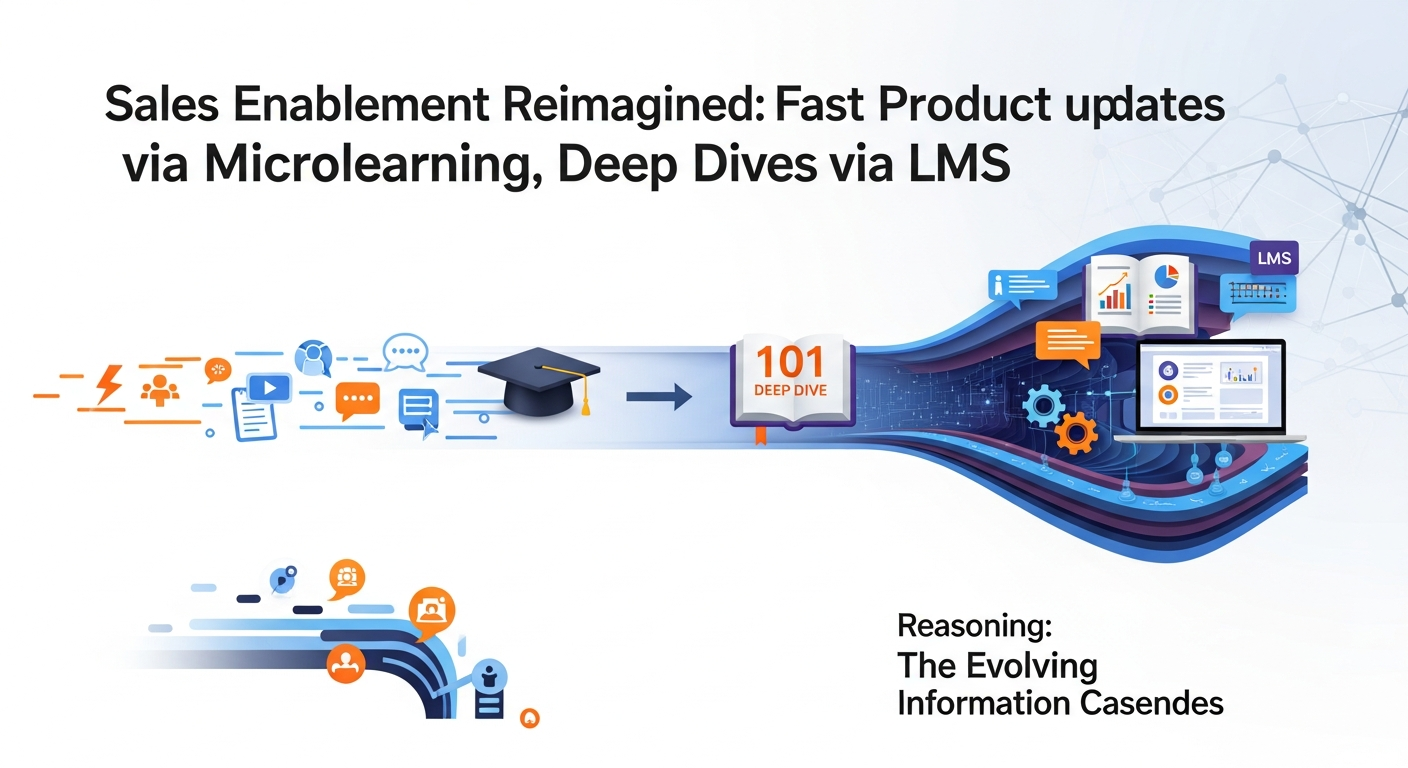
Sales Enablement Reimagined: Fast Product Updates via Microlearning, Deep Dives via LMS
In today's hyper-competitive and rapidly evolving marketplace, the sales landscape demands more than just traditional training. Product lifecycles are shrinking, new features are rolled out weekly, and market dynamics shift almost daily. For Vice Presidents, Directors, and Senior Managers in Learning & Development, the challenge isn't just delivering training; it's delivering the right training, at the right time, in the right format, to empower sales teams to excel. This means rethinking sales enablement. The future lies in a strategic blend: leveraging microlearning for rapid, agile product updates and utilizing a robust Microlearning LMS for comprehensive, in-depth knowledge acquisition.
The Evolving Landscape of Sales Enablement
Sales professionals are often the first point of contact for customers, making their product knowledge and communication skills paramount. However, keeping them abreast of every new product launch, service update, compliance regulation, or market shift is a monumental task. Traditional, lengthy training sessions often lead to information overload, poor retention, and significant time away from selling. Industries from Banking and Finance to Pharma and Retail, and even Oil and Gas and Mining, face the same dilemma: how to efficiently arm their sales force with cutting-edge information without disrupting productivity. A modern Learning content management system is no longer a luxury but a necessity to navigate these complexities.
The imperative for continuous learning is higher than ever. Whether it’s understanding new healthcare regulations, financial products, insurance policies, or complex manufacturing processes, sales teams need immediate access to accurate, digestible information. This is where the synergy of microlearning and a powerful learning management software truly shines.
The Power of Microlearning for Rapid Updates
Microlearning, by definition, delivers bite-sized, focused learning content designed for quick consumption and immediate application. Think 3-5 minute videos, interactive quizzes, infographics, or short simulations. This approach is tailor-made for the fast pace of product updates.
- Instant Knowledge Transfer: When a new feature is launched or a pricing model changes, sales teams can get the essential updates in minutes, not hours.
- Higher Retention: Short bursts of information are easier for the brain to process and retain, leading to better recall during customer interactions.
- On-Demand Accessibility: Sales professionals can access relevant information precisely when they need it – perhaps right before a crucial client meeting.
- Agility and Scalability: L&D teams can quickly create and deploy microlearning modules, ensuring that information is current and reaches everyone, everywhere.
Imagine a new compliance guideline for a financial product. Instead of a day-long workshop, sales associates can complete a 5-minute interactive module on the specific change, followed by a quick knowledge check. This efficiency is why a dedicated Microlearning LMS is becoming indispensable.
How can intelligent systems enhance quick learning delivery?
Intelligent platforms leverage data to understand learning patterns and deliver content that is most relevant and impactful at the moment of need. By analyzing engagement, completion rates, and sales performance, these systems can automatically push targeted microlearning modules to sales professionals who need specific product refreshers or competitive insights, ensuring timely and effective updates.
Deep Dives and Comprehensive Knowledge via the Learning Management System
While microlearning excels at rapid updates, it's not designed for foundational knowledge or complex skill development. This is where the traditional strengths of a robust learning management solutions come into play. A comprehensive learning management system serves as the bedrock for structured learning paths, offering:
- Foundational Product Knowledge: Detailed courses on product architecture, underlying technology, market positioning, and value propositions.
- Advanced Sales Methodologies: In-depth training on negotiation techniques, objection handling, complex deal closing, and customer relationship management.
- Scenario-Based Training: Immersive simulations that allow sales reps to practice skills in a safe environment, mimicking real-world customer interactions.
- Compliance and Regulatory Training: Comprehensive modules that track completion and understanding of critical compliance requirements across industries like Banking, Insurance, and Healthcare.
- Performance Analytics and Reporting: The enterprise learning management system provides powerful insights into learner progress, skill gaps, and the effectiveness of training programs.
For instance, a new complex pharmaceutical product requires extensive training on its scientific basis, clinical trials, and regulatory landscape. This necessitates the structured environment of a cloud based learning management system, complete with rich media, assessments, and certifications. To enhance engagement in these longer courses, many organizations are turning to a Gamified LMS to keep learners motivated and invested in their development.
How do sophisticated platforms tailor learning to individual needs globally?
Modern learning platforms, part of the extensive LMS ecosystem, can analyze a learner's role, experience, geographic location, and performance data to create personalized learning paths. This ensures that a sales manager in Europe receives content relevant to their market, while a sales associate in Asia receives localized product information and compliance training, all managed from a central LCMS.
Synergy: Microlearning and LMS Working Together
The true power of sales enablement reimagined lies in integrating these two approaches. Think of it as a dynamic duo: microlearning handles the sprints (fast updates), while the lms learning management system manages the marathons (deep knowledge and skill development).
Consider a new product launch in the retail sector:
- Before Launch (LMS): Sales teams complete comprehensive modules on the product’s core technology, target demographics, competitive landscape, and brand messaging.
- Launch Day (Microlearning): Short videos introduce key selling points, FAQs, and common objections.
- Post-Launch Updates (Microlearning): As customer feedback comes in or minor feature tweaks are made, bite-sized updates keep sales reps current without requiring them to re-do entire courses.
- Ongoing Development (LMS): Advanced training on cross-selling techniques or managing complex customer service scenarios is provided through the structured learning platform.
This integrated strategy ensures that sales professionals always have both the foundational expertise and the most current information, critical for maintaining an edge in competitive markets like Hospitality, or ensuring safety and efficiency in Oil and Gas or Mining operations.
Leveraging AI for Personalized and Efficient Learning
The advent of artificial intelligence is revolutionizing how we approach learning and development. Within the context of sales enablement, AI offers unparalleled opportunities for personalization and efficiency across both microlearning and the broader learning management system.
- Personalized Learning Paths: AI can analyze a sales professional's existing knowledge, performance data, and career goals to recommend relevant microlearning modules and full LMS courses. This ensures that every learner receives content tailored to their specific needs, enhancing engagement and effectiveness through Adaptive Learning.
- Content Curation and Recommendation: AI algorithms can sift through vast amounts of information to identify and recommend the most pertinent learning content, whether it's a new product spec sheet or an advanced sales technique video.
- Predictive Analytics: By monitoring learner engagement and assessment scores, AI can predict potential knowledge gaps or areas where a sales professional might struggle, allowing L&D to intervene proactively with targeted training.
- Automated Content Creation Support: Tools like an AI Powered Authoring Tool significantly reduce the time and resources required to develop high-quality learning materials, from microlearning snippets to full course modules.
What role does advanced digital intelligence play in creating impactful learning content?
Advanced digital intelligence streamlines content creation by automating repetitive tasks, generating initial drafts, and suggesting improvements based on learning principles and target audience analysis. It can also help segment and tag content within an LCMS, making it easier for L&D professionals to manage and for learners to find. This means L&D teams can focus on strategic content design and pedagogical effectiveness, drastically improving the impact and speed of content delivery.
Impact Across Industries
This reimagined approach to sales enablement is not confined to one sector; its principles are universally applicable:
- Compliance: Rapid updates on new regulations via microlearning, deep dives into legal frameworks via LMS. Critical for Banking, Finance, Insurance, and Healthcare. Leveraging Risk-focused Training is paramount here.
- Sales: Instant product feature updates, comprehensive training on sales methodologies. Relevant for every industry.
- Pharma & Healthcare: Quick dissemination of drug updates or new medical device features, extensive training on patient care protocols and ethical guidelines.
- Retail & Hospitality: Fast updates on seasonal promotions or new service offerings, deep training on customer experience and brand standards.
- Oil and Gas & Mining: Swift communication of new safety protocols, in-depth training on complex machinery operation and environmental regulations.
The MaxLearn LMS is designed to facilitate this dual approach, empowering L&D leaders to build resilient, knowledgeable, and agile sales teams ready to tackle any market challenge.
Conclusion
The future of sales enablement is here, and it's dynamic, personalized, and intelligent. By strategically combining the agility of microlearning for rapid product updates with the foundational depth of a robust learning management system, L&D leaders can transform their sales training programs. This integrated approach not only boosts sales performance and productivity but also ensures compliance, enhances employee engagement, and fosters a culture of continuous learning. It's time to reimagine sales enablement, providing your teams with the precise knowledge they need, exactly when they need it, to drive unparalleled business growth.
.jpg)


