

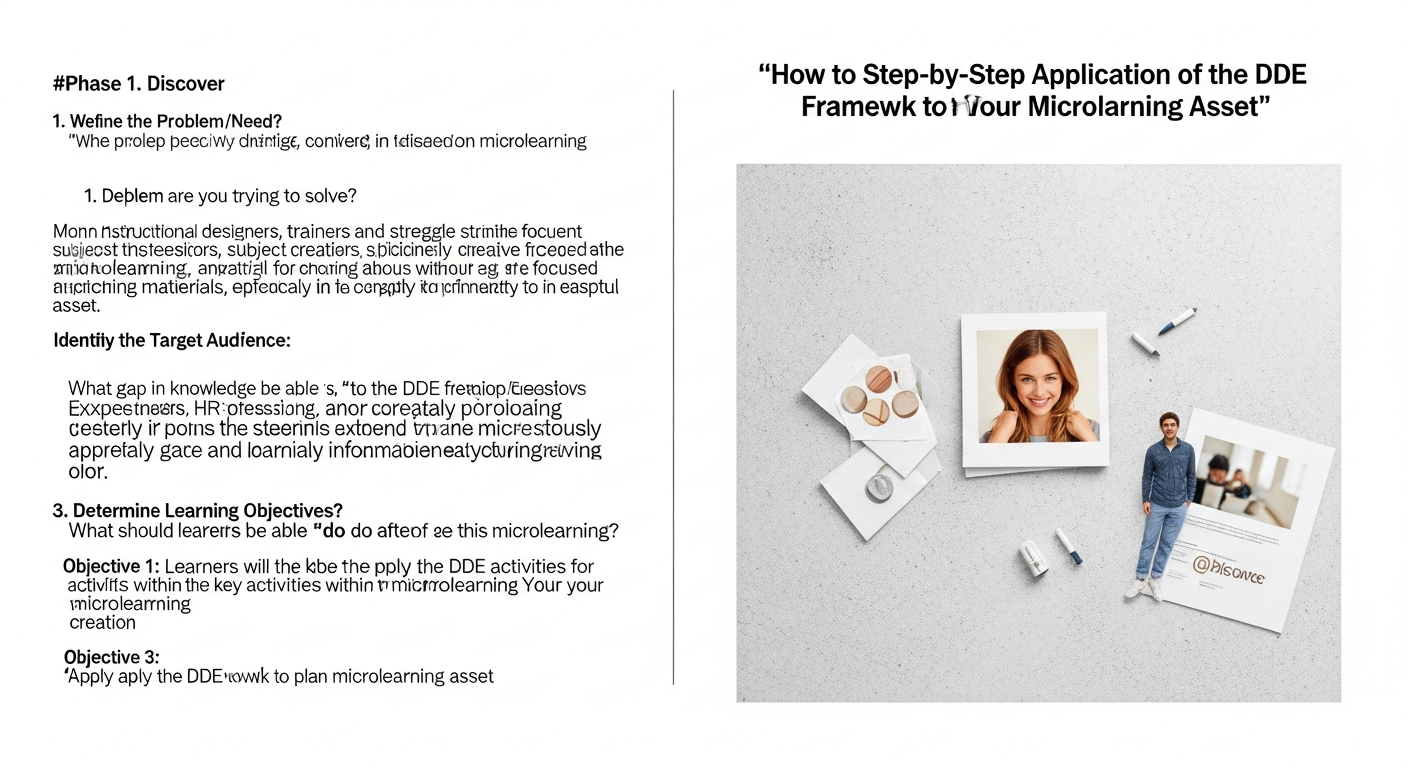
How to Step-by-Step Apply the DDE Framework to Your Next Microlearning Asset
As leaders in Learning & Development, you're constantly seeking agile and impactful strategies to elevate your workforce. The modern learning landscape demands efficiency, relevance, and measurable outcomes. This is particularly true for microlearning – bite-sized, focused content designed for specific learning objectives. But how do you ensure these compact assets truly hit the mark? The Discover, Design, Evaluate (DDE) framework offers a robust, systematic approach to building highly effective microlearning, from critical compliance training in banking to product knowledge for retail sales teams.
This article will guide you through applying the DDE framework to your next microlearning initiative, ensuring your efforts drive real performance improvements across diverse industries like Pharma, Health care, Hospitality, Oil and Gas, and Mining.
Understanding the DDE Framework for L&D Excellence
The DDE framework is a continuous improvement model, emphasizing iterative development and data-driven decisions. Unlike linear models, DDE encourages constant feedback and refinement, making it perfectly suited for the dynamic nature of microlearning and the rapid pace of business change.
- Discover: This initial phase focuses on thoroughly understanding the learning needs, target audience, existing knowledge gaps, and desired business outcomes. It's about asking the right questions before any content is created.
- Design: Here, you craft the learning experience based on your discoveries. This involves defining clear objectives, structuring content, selecting appropriate modalities, and integrating engagement strategies.
- Evaluate: The final, yet ongoing, phase measures the effectiveness of the microlearning asset. It assesses whether learning objectives were met, performance improved, and business impact was achieved, feeding insights back into the "Discover" phase for continuous enhancement.
Why DDE is Indispensable for Microlearning
Microlearning's power lies in its ability to deliver just-in-time, just-enough learning. However, without a structured approach, it can easily devolve into fragmented content that lacks cohesion and impact. The DDE framework ensures:
- Relevance: By deeply understanding learner needs and business objectives in the Discover phase, microlearning assets are always targeted and meaningful, whether for new regulations in insurance or complex machinery operation in mining.
- Efficiency: A structured design phase prevents scope creep and ensures development efforts are focused, optimizing resources for a Microlearning LMS.
- Engagement: The iterative nature encourages incorporating feedback and refining content, leading to more engaging experiences, potentially leveraging a Gamified LMS.
- Measurable Impact: Robust evaluation provides clear data on ROI, allowing L&D leaders to demonstrate the value of training, which is crucial for Risk-focused Training in compliance-heavy industries.
Step-by-Step Application of DDE to Your Microlearning Asset
Phase 1: Discover – Unearthing the Core Needs
This is where strategic L&D leadership truly shines. Before a single learning module is considered, immerse yourself in understanding the 'why' behind the training.
- Identify Performance Gaps & Business Objectives: What specific problem are you trying to solve? Is it high error rates in financial transactions, inconsistent sales pitches, or safety protocol breaches in oil and gas? Define the desired change in behavior or knowledge.
- Audience Analysis: Who are your learners? What's their existing knowledge, preferred learning styles, technological proficiency, and daily workflow? Tailor content to their context.
- Content Inventory & Curation: Review existing training materials. Can they be repurposed, updated, or broken down into microlearning units? This often requires a robust learning content management system.
Question for L&D Leaders: How can we ensure our microlearning content truly resonates with diverse learner demographics across global operations?
Insight: By leveraging advanced analytics to pinpoint specific regional knowledge gaps and cultural nuances, L&D can tailor microlearning modules for greater impact. For instance, an enterprise learning management system might suggest content adjustments based on performance data from different geographic teams, ensuring local relevance and compliance.
Phase 2: Design – Crafting Impactful Learning
With your discoveries in hand, it's time to build. Remember, microlearning isn't just about making content shorter; it's about making it smarter.
- Define Micro-Objectives: Each microlearning asset should have one, clear, actionable learning objective. For example: "Learner can identify the three key warning signs of phishing emails" for banking staff.
- Chunking & Sequencing: Break down complex topics into digestible, self-contained units. Determine the logical flow for these units, ensuring each builds on the last.
- Engagement Strategies: How will you keep learners hooked? Use interactive elements, short quizzes, real-world scenarios, storytelling, or even game-based elements. Consider Adaptive Learning paths to personalize the experience.
- Tool Selection: Choose authoring tools that facilitate rapid content creation and an LMS learning management system that supports microlearning delivery and tracking.
Question for L&D Leaders: What strategies can L&D leaders employ to dynamically adapt microlearning pathways to individual learner progress and evolving business objectives?
Insight: An adaptive learning system powered by sophisticated algorithms can continuously assess a learner's performance and knowledge retention. This allows the platform to intelligently recommend the next best learning asset or adjust the difficulty, ensuring optimal engagement and efficient achievement of specific enterprise learning goals, whether in sales or risk management.
Phase 3: Evaluate – Measuring & Iterating for Success
Evaluation is not an afterthought; it's the core of continuous improvement. This phase validates your design choices and informs future iterations.
- Define Metrics: Beyond completion rates, what will you measure? Knowledge retention (quizzes), application of skills (simulations, manager observations), or direct business impact (reduced errors, improved customer satisfaction)?
- Gather Feedback: Use surveys, focus groups, and direct observations. A modern cloud based learning management system should offer robust analytics.
- Iterate & Refine: Based on your evaluation, make adjustments. Is the content too long? Is a specific concept unclear? Should a different format be used? This feedback loop makes the DDE framework truly powerful.
Question for L&D Leaders: Beyond completion rates, how can we quantify the real-world business impact of microlearning initiatives, especially in high-stakes sectors like finance or healthcare?
Insight: Robust learning analytics within a cloud based learning management system can correlate microlearning engagement with key performance indicators (KPIs) such as reduced error rates in compliance, improved sales conversion ratios, or faster onboarding for new hires. This provides L&D leaders with actionable insights to demonstrate ROI and refine future training strategies, transforming data into tangible business outcomes.
Leveraging Technology for DDE in Microlearning
Implementing the DDE framework for microlearning is significantly enhanced by the right technology. A dedicated learning management system built for agility and insight is key:
- A powerful Microlearning LMS simplifies content deployment, tracking, and learner management, making it an essential component of any modern learning management software strategy.
- Features like a Gamified LMS can boost engagement during the Design phase, turning mundane compliance training or product updates into exciting challenges.
- Advanced platforms often integrate Adaptive Learning capabilities, automatically tailoring pathways based on learner performance, a critical component in effective design and continuous evaluation.
- An AI Powered Authoring Tool can dramatically accelerate the Discover and Design phases by helping L&D teams rapidly generate relevant content, identify skill gaps, and suggest optimal microlearning formats. This kind of innovation helps a learning management system move beyond mere content delivery to become a strategic partner.
- For sectors like finance, healthcare, and oil and gas, utilizing the DDE framework with robust technology supports Risk-focused Training, ensuring critical knowledge transfer and behavioral change that mitigates potential threats. MaxLearn LMS, for instance, provides the tools to manage these complex training needs, acting as a comprehensive LCMS.
A sophisticated learning management system isn't just a repository; it's the engine that powers your DDE cycle, offering analytics for the Evaluate phase, enabling dynamic content delivery in the Design phase, and providing insights for the Discover phase.
Conclusion
For L&D Vice Presidents, Directors, and Managers, the DDE framework offers a structured yet flexible roadmap to maximize the impact of your microlearning investments. By diligently Discovering needs, strategically Designing engaging content, and rigorously Evaluating outcomes, you can move beyond simply delivering training to truly driving performance and achieving tangible business results across all your industry segments.
Embrace the DDE framework. It's not just a methodology; it's a commitment to continuous improvement, ensuring your microlearning assets are always relevant, engaging, and invaluable to your organization's success.
.jpg)


