

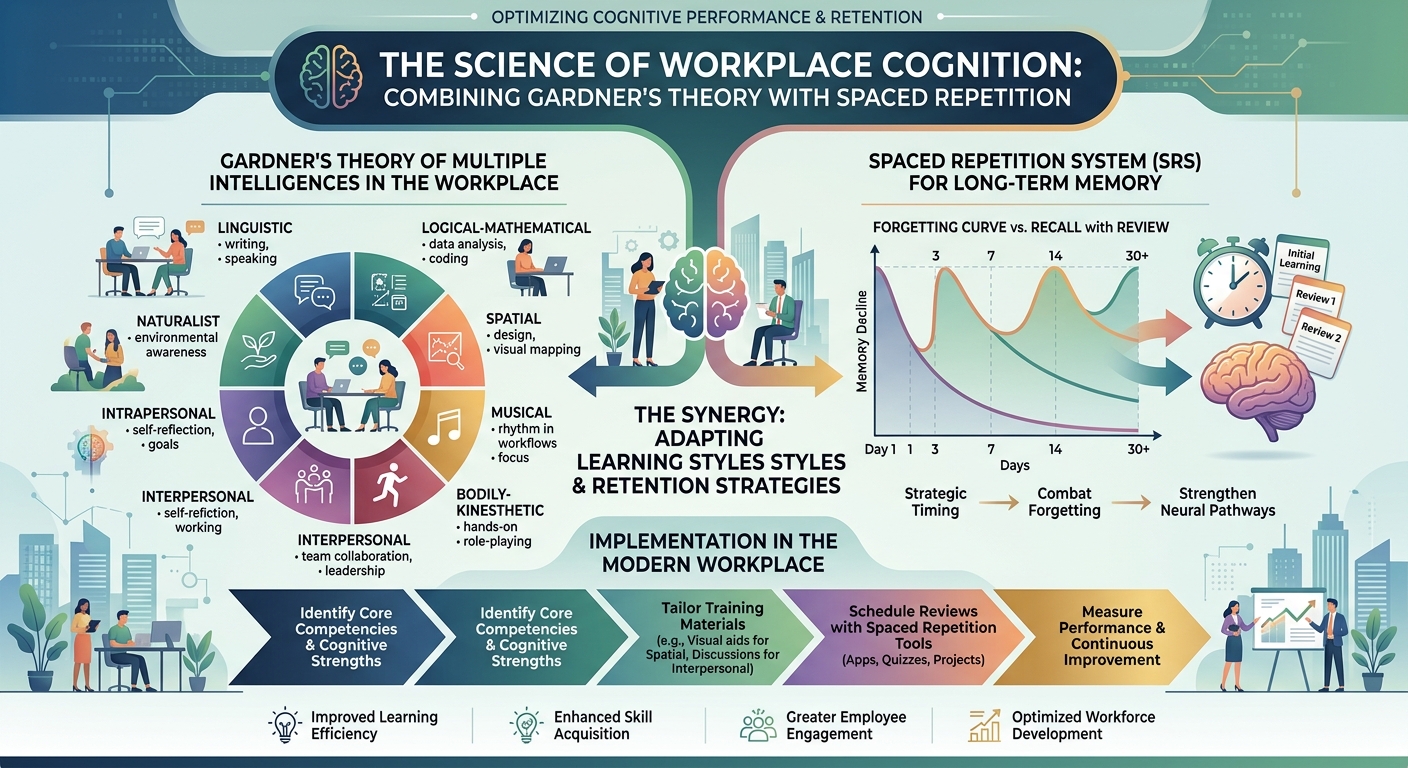
The Science of Workplace Cognition: Combining Gardner's Theory with Spaced Repetition for Transformative L&D
In the dynamic landscape of modern business, the efficacy of learning and development (L&D) programs is paramount. As Vice Presidents, Directors, and Senior Managers of L&D, you're constantly seeking innovative strategies to maximize knowledge retention, foster skill acquisition, and drive performance across your organization. The answer lies not just in new technologies, but in a deeper understanding of how the human brain learns. This article delves into the powerful synergy between Howard Gardner's Theory of Multiple Intelligences and the cognitive science principle of Spaced Repetition, offering a blueprint for a truly transformative enterprise learning management approach.
For too long, corporate training has adopted a "one-size-fits-all" mentality, often failing to account for the diverse ways individuals process and retain information. This oversight can lead to significant inefficiencies, impacting compliance training in banking, sales effectiveness in retail, critical safety protocols in oil and gas, or even complex medical procedures in health care. By integrating cognitive science principles, L&D leaders can unlock unprecedented levels of engagement and learning outcomes.
Understanding Gardner's Theory of Multiple Intelligences in the Workplace
Howard Gardner's groundbreaking Theory of Multiple Intelligences posits that human intelligence is not a singular, monolithic entity, but rather a collection of distinct intellectual strengths. While traditionally applied in educational settings, its implications for workplace learning are profound. Instead of categorizing employees as simply "smart" or "not smart," Gardner identifies at least eight different intelligences:
- Linguistic Intelligence: The ability to use words effectively, whether orally or in writing. (Ideal for documentation, communication training, legal compliance in finance).
- Logical-Mathematical Intelligence: The capacity for reasoning, problem-solving, and recognizing patterns. (Essential for data analysis, complex system operations in pharma, financial modeling).
- Spatial Intelligence: The ability to perceive the visual world accurately and re-create aspects of it. (Crucial for engineering, design, understanding architectural blueprints in hospitality, visualizing surgical procedures).
- Bodily-Kinesthetic Intelligence: Expertise in using one's body to express ideas and feelings, and facility in using hands to produce or transform things. (Vital for manufacturing, practical skills in mining, customer service role-playing in retail, medical simulations).
- Musical Intelligence: The capacity to discern, transform, and express musical forms. (Though less direct, rhythm and pattern recognition can aid memory in certain processes).
- Interpersonal Intelligence: The ability to understand and interact effectively with others. (Fundamental for sales teams, customer service, leadership development across all industries).
- Intrapersonal Intelligence: The capacity to understand oneself and one's own feelings and motivations. (Important for self-regulation, emotional intelligence, personal development).
- Naturalistic Intelligence: The ability to recognize and categorize elements of the natural world. (Relevant for environmental compliance, agricultural industries, resource management in oil and gas).
Ignoring these diverse intelligences means that a significant portion of your workforce may not be learning in their most effective mode. A learning management system that acknowledges and caters to these differences is no longer a luxury but a necessity for truly inclusive and effective training.
The Power of Spaced Repetition for Lasting Knowledge Retention
While Gardner's theory addresses the "how" of learning, Spaced Repetition tackles the "when." This evidence-based learning technique is designed to combat the "forgetting curve" – the natural decline of memory retention over time. Instead of cramming information, Spaced Repetition involves reviewing material at increasing intervals, right before the point at which it would be forgotten.
Numerous studies have demonstrated that this method significantly improves long-term memory and recall. For L&D professionals, this means designing training programs that don't just present information once, but strategically re-expose learners to key concepts. This is particularly critical in industries like compliance, where forgetting a critical regulation can have severe consequences, or in sales, where remembering product features and objection handling techniques directly impacts revenue.
Integrating Cognitive Science: The Synergistic Approach
The true power emerges when Gardner's Multiple Intelligences and Spaced Repetition are combined. Imagine a Microlearning LMS that not only delivers content in bite-sized chunks but also adapts the presentation style and review schedule based on an individual's dominant intelligences.
- For an employee strong in Linguistic Intelligence, a learning management software might emphasize detailed written case studies, policy documents, or engaging narration.
- For a Logical-Mathematical learner, the learning content management system could prioritize interactive simulations, data-driven scenarios, or problem-solving exercises.
- A Bodily-Kinesthetic individual might benefit most from virtual reality simulations, interactive drag-and-drop activities, or practical demonstrations, followed by spaced review quizzes.
- Those with high Interpersonal Intelligence could engage in collaborative projects, peer-to-peer discussions, or role-playing scenarios, with follow-up prompts for reflection.
This Adaptive Learning approach moves beyond generic content delivery, personalizing the learning journey to maximize individual engagement and retention. This is where modern learning management solutions truly shine.
Practical Applications in Diverse Industries
This combined approach has transformative potential across various segments:
- Compliance: In banking, finance, and insurance, where regulations constantly evolve, personalized, spaced reviews of policy updates (e.g., through short video explanations for spatial learners, or interactive quizzes for logical learners) ensure continuous adherence and mitigate Risk-focused Training.
- Sales: Sales professionals in retail or pharma can master product knowledge and sales techniques through a Gamified LMS that offers scenarios tailored to their interpersonal intelligence, coupled with spaced recall of product specs.
- Health Care & Pharma: Training on new medical procedures or drug protocols can utilize spatial intelligence through 3D models and simulations, reinforced with spaced quizzes and virtual patient interactions for logical or interpersonal learners.
- Hospitality: Customer service excellence can be fostered through role-playing simulations (bodily-kinesthetic, interpersonal) and spaced prompts on service standards.
- Oil and Gas & Mining: Safety training, which is critical for these industries, can employ visual hazard identification (spatial), equipment operation simulations (bodily-kinesthetic), and regular, spaced refreshers on emergency procedures.
The potential for a cloud based learning management system to deliver this level of personalized, persistent learning is immense. Imagine an LMS powered by intelligent algorithms.
The Role of AI in Personalized Cognitive Training
How can intelligent training platforms revolutionize L&D?
The advent of artificial intelligence (AI) is a game-changer for implementing these sophisticated learning models. An intelligent learning management system can analyze learner data to identify dominant intelligences, track knowledge gaps, and dynamically adjust both content presentation and the Spaced Repetition schedule. An AI Powered Authoring Tool can even help create diverse content formats catering to multiple intelligences more efficiently.
What are the global benefits of intelligent training solutions?
On a global scale, intelligent training solutions can ensure consistency and effectiveness regardless of geographical location. For multinational corporations in industries like pharma or finance, a sophisticated learning management system ensures that critical knowledge transfer is equitable and optimized for every employee, adapting to cultural nuances and individual learning preferences across continents. This leads to higher skill levels and operational excellence worldwide.
How can organizations apply cognitive science for better training outcomes?
Organizations can leverage cognitive science by investing in a robust LMS that incorporates these principles. This involves moving beyond simple content delivery to a system that truly understands and responds to the learner. A comprehensive LCMS, like MaxLearn LMS, can facilitate this by providing tools for diverse content creation, adaptive delivery, and sophisticated analytics to track learning progress and refine the training experience continuously.
This isn't just about delivering content; it's about crafting experiences that resonate deeply with each individual, embedding knowledge in a way that lasts. It's about transitioning from generic training modules to a truly personalized and persistent learning ecosystem.
Conclusion
The future of L&D lies in embracing the science of how people learn. By combining Gardner's Theory of Multiple Intelligences with the proven efficacy of Spaced Repetition, L&D leaders can design training programs that are not only more engaging and inclusive but also significantly more effective in fostering long-term knowledge retention and skill development. Investing in a modern, AI-driven Microlearning LMS that supports these cognitive principles is no longer a strategic advantage; it's a foundational requirement for driving success in the complex and rapidly evolving corporate landscape.
Empower your workforce with learning experiences that truly stick, tailored to their unique cognitive strengths, and reinforced for lasting impact. The science is clear: personalized, persistent learning is the key to unlocking your organization's full potential.
.jpg)


