

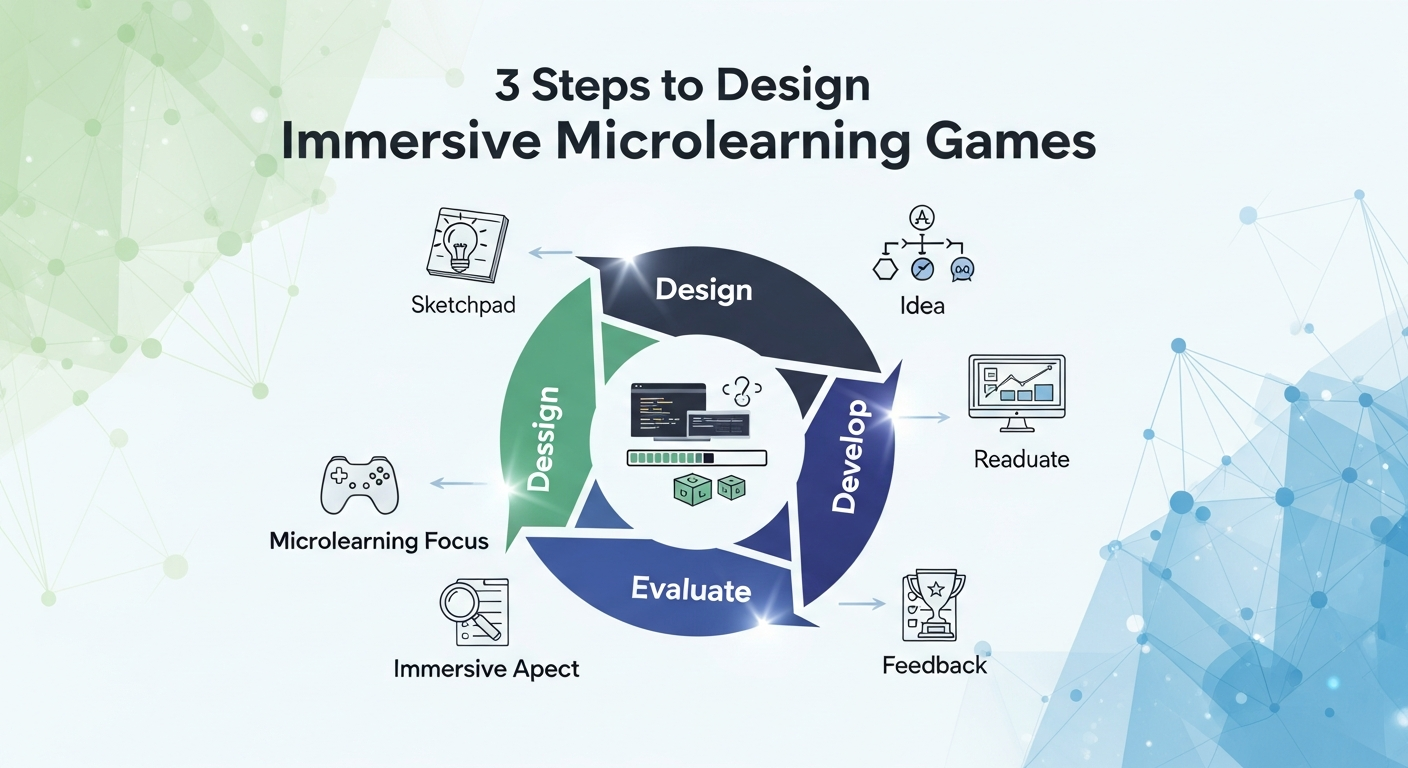
3 Steps to Design Immersive Microlearning Games Using the DDE Framework
In today's fast-paced corporate environment, traditional training methods often fall short of engaging modern learners. For Vice Presidents, Directors, and Senior Managers in Learning & Development, the challenge isn't just delivering content, but ensuring it's absorbed, retained, and applied. The answer lies in transforming mundane modules into captivating experiences. Enter microlearning games, a powerful strategy for enhancing engagement and knowledge retention, especially when built upon a robust framework like DDE (Discover, Design, Evaluate).
This article will guide L&D leaders through the three essential steps of the DDE framework, demonstrating how to craft microlearning games that resonate deeply with employees across diverse sectors, from compliance and sales to healthcare and finance. By leveraging game-based learning, you can unlock unparalleled training effectiveness and measurable business impact.
Understanding the DDE Framework for L&D
The DDE Framework – Discover, Design, Evaluate – provides a systematic, agile approach to creating impactful learning solutions. It’s particularly potent for microlearning games because it emphasizes a learner-centric, iterative process. Instead of a linear, one-and-done model, DDE encourages continuous refinement, ensuring your learning interventions remain relevant and effective.
What is the DDE framework in L&D?
The DDE framework is an instructional design model that guides the creation of learning experiences through three iterative phases: understanding needs (Discover), developing the solution (Design), and assessing its effectiveness for improvement (Evaluate).
Step 1: Discover – Unearthing Learning Needs and Opportunities
The "Discover" phase is the foundation of any successful microlearning game. It's where you meticulously identify your audience, their learning objectives, and the specific performance gaps that your game aims to address. This isn't just about what you *think* employees need; it's about what data, stakeholders, and learners themselves reveal.
Key Activities in Discover:
- Audience Analysis: Understand learner demographics, existing knowledge, preferred learning styles, and technological access. Are they frontline retail staff, banking executives, or pharmaceutical sales representatives?
- Performance Gap Identification: Pinpoint specific skills or knowledge deficits impacting business outcomes. For instance, in compliance, is it a lack of understanding of new regulations? In sales, perhaps it's overcoming specific customer objections.
- Objective Setting: Define clear, measurable learning objectives. What should learners be able to *do* after completing the microlearning game? These objectives will directly inform your game mechanics and evaluation metrics.
- Contextual Constraints: Identify any limitations such as budget, timeline, technical infrastructure, or cultural nuances of the organization. This step is crucial for realistic planning and ensures your solution can be effectively deployed on your Microlearning LMS.
How do L&D leaders identify critical training needs for microlearning game development?
L&D leaders identify critical training needs by analyzing performance data, conducting stakeholder interviews, surveying employees, observing on-the-job behaviors, and reviewing business goals to pinpoint specific knowledge or skill gaps that microlearning games can effectively address.
In industries like healthcare, understanding the precise procedural steps that often lead to errors is paramount. For oil and gas, it might involve safety protocols that require frequent, bite-sized refreshers. This initial discovery ensures your efforts are focused and yield maximum impact, often incorporating aspects of Risk-focused Training right from the start.
Step 2: Design – Crafting Immersive Experiences
With a clear understanding of your learning needs, the "Design" phase transforms insights into engaging game mechanics and compelling narratives. This is where creativity meets instructional rigor, building an immersive experience that doesn't just teach but captivates.
Key Activities in Design:
- Game Mechanics and Dynamics: Decide on the core gameplay elements. Will it be a quiz-based challenge, a branching scenario, a simulation, or a puzzle? Consider points, badges, leaderboards, levels, and progress tracking. A Gamified LMS can significantly simplify the implementation of these mechanics.
- Storyline and Scenario Development: Craft a narrative that resonates with your learners' real-world challenges. For banking, this could be a scenario about fraud detection; for hospitality, it might be customer service recovery. A compelling story increases engagement and makes learning memorable.
- Content Integration: Integrate the specific learning content into the game's challenges, feedback, and rewards. Ensure that every game interaction contributes directly to achieving the learning objectives identified in the Discover phase. This is where an AI Powered Authoring Tool can be invaluable, rapidly converting raw content into game-ready elements.
- Feedback Loops: Design immediate and constructive feedback within the game. This not only reinforces correct answers but also guides learners when they make mistakes, explaining why certain choices are better than others.
- Microlearning Principles: Break down complex topics into bite-sized, digestible chunks. Each game interaction should focus on a single concept, ensuring optimal cognitive load and making it easy for learners to complete during short breaks.
How can I ensure microlearning games are truly engaging for my diverse workforce?
To ensure engagement, focus on relevant storylines, introduce meaningful choices, provide immediate and constructive feedback, incorporate elements of challenge and reward, and personalize experiences where possible, considering the specific contexts of your different operational teams.
Consider how the design needs to adapt for different segments. For retail, visual appeal and quick decision-making challenges might be key. For pharma, precision and knowledge recall under pressure could be critical. The design phase is also where principles of Adaptive Learning can be embedded, allowing the game to adjust difficulty or content based on individual learner performance.
Step 3: Evaluate – Refining for Impact and Growth
The "Evaluate" phase closes the loop, providing crucial insights into the effectiveness of your microlearning game and guiding continuous improvement. It's not just about pass/fail; it's about understanding learner behavior, knowledge transfer, and ultimately, business impact.
Key Activities in Evaluate:
- Formative Evaluation (Testing and Iteration): Conduct pilot tests with a small group of target learners. Gather feedback on usability, engagement, clarity of instructions, and technical performance. Use this feedback to make necessary revisions *before* a full rollout.
- Summative Evaluation (Measuring Impact): Collect data on key metrics post-deployment. This includes:
- Engagement Metrics: Completion rates, time spent, number of attempts, participation in leaderboards.
- Learning Outcomes: Knowledge retention scores, quiz results, accuracy in game scenarios.
- Behavioral Change: Observe or survey for changes in on-the-job performance, adherence to procedures, or improved decision-making.
- Business Impact: Correlate game completion with tangible business results, such as reduced compliance violations, improved sales figures, or enhanced customer satisfaction scores.
- Data Analysis and Reporting: Analyze the collected data to identify trends, strengths, and areas for improvement. Present these findings to stakeholders to demonstrate ROI and justify future L&D investments. A robust learning management system (LMS) can provide comprehensive analytics for this.
- Continuous Improvement: The DDE framework is iterative. Use evaluation findings to inform the next "Discover" phase, refining existing games or identifying new learning needs.
What are the key performance indicators for successful microlearning game implementation?
Key performance indicators include learner engagement rates (e.g., completion, active participation), knowledge acquisition scores, speed to proficiency, demonstrable changes in on-the-job behavior, and ultimately, measurable improvements in business outcomes relevant to the training objectives.
For large enterprises, evaluating the impact across different geographical locations or business units requires a comprehensive enterprise learning management system capable of handling extensive data. This iterative evaluation process ensures that your investment in learning management software and game development continuously yields optimal results.
The MaxLearn Advantage: Powering Your DDE Journey
Implementing the DDE framework for microlearning games demands more than just a theoretical understanding; it requires the right tools and platform. A modern lms learning management system, especially a cloud based learning management system, is critical for seamless execution.
MaxLearn LMS offers a comprehensive suite of learning management solutions designed to support every stage of your DDE process. From an intuitive learning content management system (LCMS) that facilitates rapid content creation and management, to robust analytics that power your evaluation phase, MaxLearn empowers L&D teams to deliver high-impact training.
With MaxLearn, you gain the capabilities of a cutting-edge learning management system that simplifies the deployment, tracking, and management of your immersive microlearning games, ensuring your investment in employee development truly pays off.
Conclusion
The DDE Framework offers a strategic roadmap for L&D leaders looking to harness the power of microlearning games. By meticulously Discovering needs, creatively Designing immersive experiences, and rigorously Evaluating their impact, you can transform corporate training from a necessary chore into an engaging, effective driver of performance and growth. This systematic approach, supported by advanced platforms like a comprehensive LMS, positions your organization at the forefront of innovative employee development, fostering a culture of continuous learning and excellence across all industries.
.jpg)


