

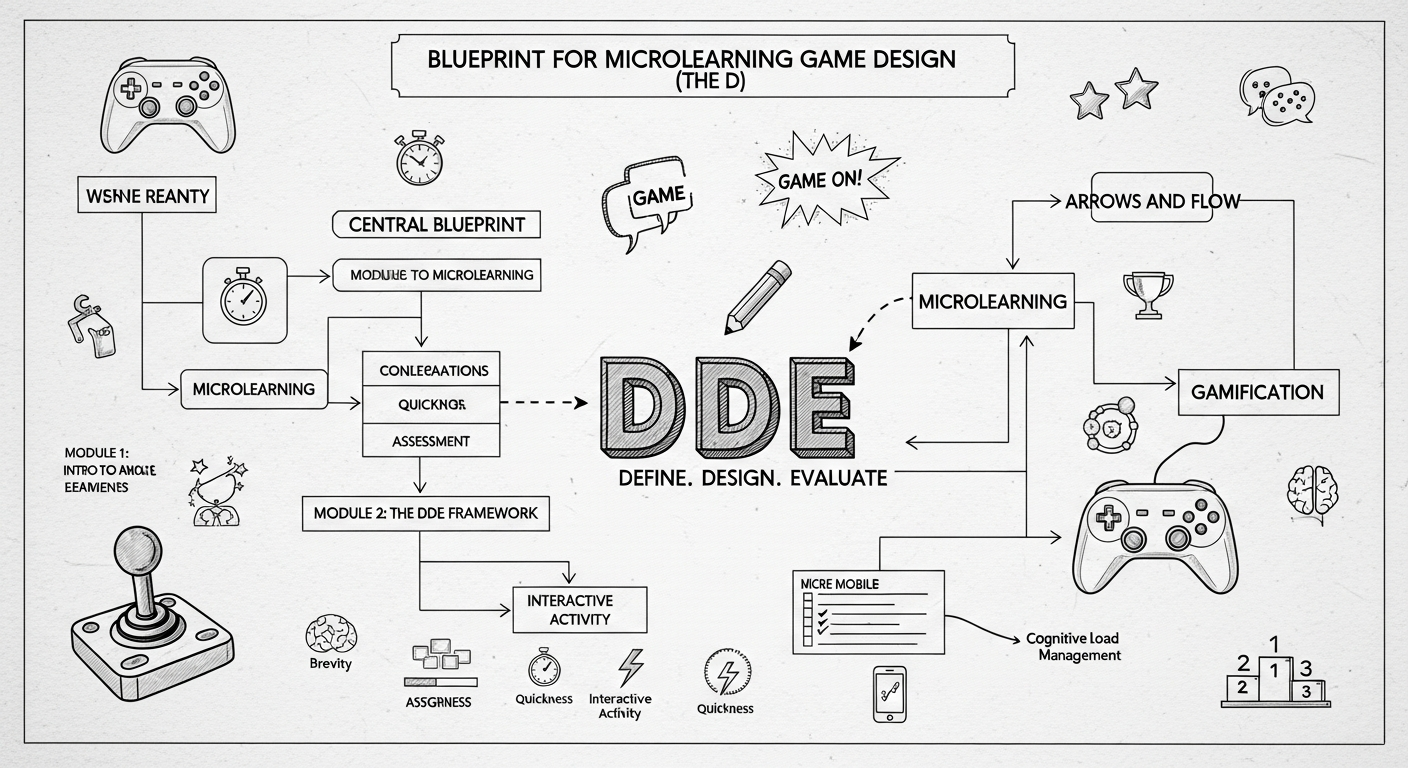
How to Build an Effective Game Blueprint for Microlearning (The DDE Way)
In today's fast-paced corporate environment, learning and development (L&D) leaders face the perpetual challenge of delivering impactful training that truly resonates with employees, drives performance, and ensures compliance. Traditional, lengthy courses often fall short, struggling with engagement and knowledge retention. This is where the powerful combination of microlearning and gamification steps in, offering a dynamic solution to these pressing issues. For Vice Presidents, Directors, and Senior Managers of L&D, understanding how to strategically design these experiences is paramount.
The secret lies in a robust game blueprint, meticulously crafted to align with organizational goals and learner needs. This article introduces "The DDE Way" – a structured approach encompassing Design, Develop, and Evaluate – to create highly effective microlearning games that transform your training landscape, whether you're in Compliance, Sales, Banking, Finance, Insurance, Retail, Pharma, Health care, Hospitality, Oil and Gas, or Mining. We'll also explore how artificial intelligence (AI) can supercharge each stage, making your learning management system (LMS) an even more potent tool.
Understanding Microlearning and Gamification for L&D Success
Microlearning breaks down complex topics into bite-sized, easily digestible modules, typically lasting 3-7 minutes. This approach perfectly aligns with the modern learner's preference for on-demand, focused content. When combined with gamification – the application of game-design elements and game principles in non-game contexts – the results are transformative. Learners are motivated by points, badges, leaderboards, and challenges, fostering a sense of achievement and healthy competition.
For L&D leaders, the benefits are clear: significantly higher engagement rates, improved knowledge retention, and a direct impact on skill application. A Microlearning LMS provides the ideal platform for delivering this type of content, making it accessible anytime, anywhere. Furthermore, a Gamified LMS specifically enhances the user experience by embedding these motivational elements directly into the learning journey, turning routine training into an exciting quest for knowledge and mastery.
The DDE Way: Design, Develop, Evaluate Your Game Blueprint
The DDE Way offers a systematic framework to ensure your microlearning game blueprint is not just fun, but strategically effective.
1. Design Phase: Laying the Strategic Foundation
The design phase is where the strategic thinking happens. It's about setting clear objectives and understanding your audience deeply.
- Define Clear Learning Objectives: What specific knowledge or skills do you want learners to acquire? How will these objectives tie into key business outcomes, such as reducing compliance risks in finance or improving sales techniques in retail?
- Understand Your Target Audience: Who are your learners? What are their existing knowledge gaps, motivational drivers, and preferred learning styles? Tailor your game mechanics to resonate with them. For instance, competitive leaderboards might appeal more to a sales team, while collaborative problem-solving might suit a healthcare environment.
- Craft Engaging Scenarios and Narratives: Games need a story. Develop real-world scenarios relevant to your industry. For compliance training in banking, this could be navigating ethical dilemmas. For manufacturing, it might involve troubleshooting equipment malfunctions.
- Select Appropriate Game Mechanics: Points, badges, levels, quests, challenges, leaderboards, virtual rewards – choose mechanics that align with your objectives and audience.
AI Insight: How does artificial intelligence optimize content discovery and recommendation for individual learners?
AI plays a crucial role in the design phase by analyzing learner data – their roles, prior performance, and interactions – to suggest personalized learning paths and relevant game challenges. This ensures that the microlearning game content is highly pertinent and adaptive to each individual's needs, whether they are new hires in hospitality or seasoned professionals requiring advanced Adaptive Learning modules. AI can also help identify potential learning bottlenecks before development even begins, shaping a more effective blueprint.
2. Develop Phase: Bringing the Blueprint to Life
Once the blueprint is solid, the development phase focuses on content creation, gamification integration, and platform selection.
- Content Creation: Develop concise, engaging content for each microlearning module. This might involve short videos, interactive quizzes, infographics, or simulations. Ensure content is accurate and directly addresses the learning objectives.
- Gamification Integration: Embed the chosen game mechanics seamlessly into the content. This isn't just about adding badges; it's about making the learning itself feel like a game. For example, a legal compliance module could be structured as a detective game where learners uncover regulations.
- Platform Selection: Choose a robust learning management system that can support your gamified microlearning initiatives. A modern LMS or learning content management system (LCMS) should offer flexible content delivery, progress tracking, and gamification features.
AI Insight: What AI tools can streamline the development of interactive microlearning modules?
AI-powered tools are revolutionizing content development. An AI Powered Authoring Tool can significantly reduce development time by generating initial content drafts, converting text to interactive exercises, or even creating basic game scenarios based on learning objectives. It can suggest appropriate imagery, optimize content for different devices, and ensure linguistic consistency, accelerating the creation of high-quality, engaging microlearning modules. This frees up L&D professionals to focus on the strategic and creative aspects of game design.
3. Evaluate Phase: Measuring Impact and Iterating
The evaluation phase is critical for demonstrating ROI and ensuring continuous improvement.
- Testing and Feedback: Pilot your game with a small group of learners. Gather feedback on usability, engagement, and clarity. Use this feedback to make necessary adjustments before a wider rollout.
- Performance Analytics: Utilize the analytics features of your lms learning management system. Track completion rates, scores, time spent, and performance on specific challenges. Look for patterns in data that indicate areas of strength or weakness in the learning material or game design.
- Measure Impact on Business Metrics: The ultimate goal is to see tangible business improvements. For compliance training, monitor adherence rates. For sales, track conversion rates. For manufacturing, look at reduction in errors. This demonstrates the value of your enterprise learning management efforts.
- Iterate and Refine: Learning is continuous, and so should be the improvement of your training programs. Use the evaluation data to refine content, adjust game mechanics, and optimize the overall learning experience.
AI Insight: How can AI analyze learner performance to refine game mechanics and content in real-time?
AI excels at processing large datasets to identify trends and anomalies. In the evaluation phase, AI algorithms within a cloud based learning management system can pinpoint which game elements are most engaging, which questions are frequently missed, or where learners drop off. This enables dynamic adjustments to game difficulty, content presentation, or even the addition of remedial microlearning modules. For Risk-focused Training in sectors like Oil and Gas or Pharma, AI can proactively flag employees at higher risk of non-compliance based on their learning patterns, allowing for targeted interventions.
Integrating AI for Enhanced Microlearning Game Blueprints
Beyond the DDE phases, AI offers overarching capabilities that elevate the entire microlearning game experience:
Question: Where can L&D teams leverage AI for identifying global compliance training gaps?
Answer: AI can analyze regulatory updates across different regions and industries, cross-referencing them with existing training modules and employee performance data. This allows L&D leaders to quickly pinpoint specific geographic or departmental compliance gaps, enabling the rapid deployment of localized, targeted microlearning games to address these vulnerabilities.
Question: What ethical considerations must L&D leaders address when deploying AI-driven gamified microlearning?
Answer: Ethical considerations include data privacy, algorithmic bias, and the potential for over-gamification that might manipulate rather than motivate. L&D leaders must ensure transparency in data usage, regularly audit AI algorithms for fairness, and maintain a balance where gamification supports genuine learning goals without undue pressure or surveillance.
Benefits for L&D Leaders
Adopting The DDE Way with AI integration for your microlearning game blueprint offers substantial advantages:
- Enhanced Engagement and Retention: Learners are more likely to complete and retain information from gamified microlearning.
- Measurable Outcomes: Clear objectives and robust evaluation allow for precise measurement of learning impact and ROI, critical for any learning management solutions.
- Scalability and Consistency: A well-designed blueprint ensures consistent quality across all training programs, easily scalable across large organizations, supported by a powerful MaxLearn LMS.
- Agility and Adaptability: AI-driven insights allow for rapid adjustments, keeping training relevant to evolving business needs and regulations.
- Relevance Across Industries: From onboarding in Hospitality to critical safety training in Mining, the principles apply universally, ensuring your learning management software delivers targeted impact.
Conclusion
Building an effective game blueprint for microlearning is no longer a luxury but a strategic imperative for forward-thinking L&D departments. By embracing The DDE Way – Design, Develop, and Evaluate – and leveraging the transformative power of AI, L&D leaders can create dynamic, engaging, and highly effective learning experiences. This systematic approach ensures that your training initiatives not only meet immediate needs but also contribute significantly to long-term employee development and organizational success, driving performance across all critical business functions.
.jpg)


