

How Does Spaced Repetition Drive Long-Term Employee Memory Recall?
In the dynamic landscape of modern business, knowledge is power, and retention is paramount. For Vice Presidents, Directors, and Managers of L&D, the challenge isn't just delivering training but ensuring that critical information sticks – especially across diverse and high-stakes industries like Compliance, Banking, Finance, Insurance, Retail, Pharma, Healthcare, Hospitality, Oil and Gas, and Mining. The traditional "cram and forget" model of learning is no longer sustainable. Enter spaced repetition, a scientifically-backed strategy proving indispensable for embedding long-term employee memory recall and fostering a truly knowledgeable workforce.
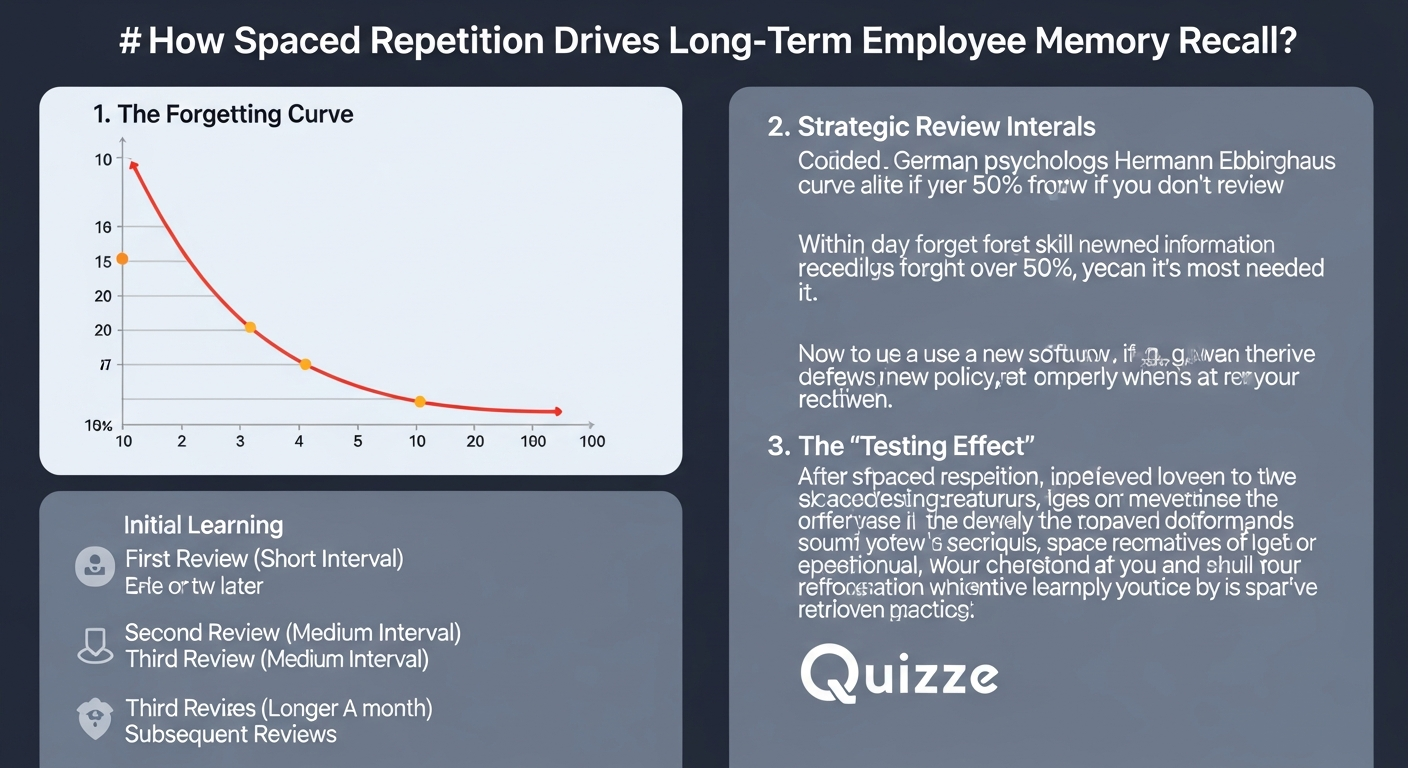
The Forgetting Curve: A Universal Challenge for L&D
Hermann Ebbinghaus, a pioneering psychologist, first described the "Forgetting Curve" in the late 19th century. His research revealed that without reinforcement, the retention of newly learned information drops dramatically within hours or days. For L&D professionals, this phenomenon translates directly into significant challenges:
- Reduced ROI on Training: If employees forget 70% of what they learned within a week, the investment in training programs yields minimal return.
- Performance Gaps: A lack of retained knowledge leads to errors, decreased efficiency, and missed opportunities.
- Compliance Risks: In regulated industries, forgetting critical procedures or policies can result in serious non-compliance issues, fines, and reputational damage.
- Slow Adaptability: Organizations struggle to adapt quickly to new products, technologies, or market changes if employees can't retain new information effectively.
Combating this pervasive forgetting curve is where spaced repetition emerges as a game-changer, fundamentally transforming how employees learn and retain vital information.
Unpacking Spaced Repetition: The Science of Retention
Spaced repetition is an evidence-based learning technique that involves reviewing previously learned material at progressively longer intervals. It's a strategic method designed to move information from short-term to long-term memory by intercepting the forgetting curve at optimal moments.
The cognitive science behind it is rooted in active recall and the "testing effect." When learners are prompted to retrieve information from memory, it strengthens the neural pathways associated with that memory. By spacing these retrieval practices, the brain has to work harder each time, reinforcing the memory more robustly. The increasing intervals ensure that the brain engages in a process of 'desirable difficulty,' making the learning more durable.
Unlike rote memorization, spaced repetition leverages the brain's natural learning mechanisms, making it a highly efficient and effective strategy for long-term knowledge retention.
Key Principles of Effective Spaced Repetition
- Active Recall: Learners are encouraged to retrieve information rather than passively re-reading it. This could involve flashcards, quizzes, or scenario-based questions.
- Increasing Intervals: Successful recall of an item leads to a longer delay before its next review. If an item is forgotten, it's reviewed sooner, and the interval resets.
- Personalization: The intervals are adaptive, meaning they are tailored to each individual's learning pace and their mastery of specific topics.
- Feedback: Immediate feedback on answers helps learners correct misunderstandings and reinforces correct information.
Implementing Spaced Repetition in Modern L&D
Modern eLearning platforms and a robust LMS (learning management system) are perfectly positioned to integrate spaced repetition methodologies. These systems can track individual learning progress, identify areas of weakness, and automatically schedule follow-up reviews.
Microlearning LMS content, characterized by short, focused learning bursts, is particularly effective when combined with spaced repetition. Breaking down complex topics into digestible modules makes it easier for employees to absorb and recall information. Furthermore, elements of a Gamified LMS can enhance engagement, turning spaced repetition exercises into interactive challenges that motivate continuous learning.
Spaced Repetition for Compliance Training
In industries where regulatory adherence is non-negotiable, such as Compliance, Banking, Pharma, Healthcare, Oil and Gas, and Mining, the continuous recall of policies, safety protocols, and ethical guidelines is critical. Spaced repetition ensures that employees remain consistently aware of and compliant with the latest regulations, significantly reducing the risk of human error and legal ramifications. It's a proactive approach to Risk-focused Training, embedding crucial information before it's needed.
Boosting Sales and Customer Service Recall
For industries like Retail and Hospitality, and for sales teams across all sectors, robust memory recall of product features, service protocols, company policies, and customer interaction best practices is vital. Spaced repetition can reinforce everything from new product specifications and pricing to complex insurance policies or intricate banking procedures, empowering employees to provide accurate information and superior service, ultimately driving better business outcomes.
The Role of Technology: AI and LMS in Spaced Repetition
The true power of spaced repetition is unlocked when integrated with advanced technology. A modern LMS acts as a sophisticated learning content management system, orchestrating the delivery and scheduling of review materials. An advanced learning management software leverages data to personalize the learning journey, making it a powerful learning management system for enterprises.
The evolution of AI further amplifies this capability, transforming a traditional cloud based learning management system into an intelligent learning companion. An enterprise learning management system like MaxLearn LMS can use AI to optimize spaced repetition intervals, recommend relevant content, and provide deeper insights into learning patterns. This creates a truly Adaptive Learning environment where learning is continuously tailored to the individual.
AI-Driven Insights for Enhanced Learning
Question: How can AI personalize spaced repetition intervals for diverse employee needs?
Answer: AI algorithms can analyze a vast array of data points—individual performance on quizzes, past learning history, declared learning styles, job roles, and even engagement metrics. This allows an AI-powered learning management system (LMS) to dynamically adjust the review schedule for each learner and each specific piece of content. Instead of a one-size-fits-all approach, AI ensures that highly competent employees aren't bogged down with unnecessary reviews, while those struggling receive more frequent reinforcement, optimizing efficiency and effectiveness.
Question: In what ways can AI predict knowledge decay in specific compliance areas for global teams?
Answer: AI's predictive analytics capabilities are invaluable here. By correlating past training data, employee roles, regional regulatory changes, and content difficulty levels, AI can forecast potential areas of knowledge decay before they manifest. For instance, if an AI detects that employees in a specific region consistently underperform on modules related to a particular new compliance update, it can proactively schedule additional spaced repetition cycles or recommend supplementary Microlearning LMS content. This proactive approach is critical for global teams facing varied regulatory landscapes, ensuring consistent adherence and reducing risk across the board.
Question: What impact does AI have on content delivery and engagement for spaced repetition modules?
Answer: AI significantly enhances content delivery by leveraging insights into learner preferences and performance. An AI Powered Authoring Tool can recommend optimal content formats (e.g., video, interactive quiz, infographic) for review, ensuring that each spaced repetition interaction is as engaging and effective as possible. AI can also personalize feedback, provide contextual hints, and even suggest related learning paths, transforming review sessions from a chore into an engaging, guided learning experience. This intelligent delivery boosts motivation and, consequently, long-term retention.
Measuring Success: ROI of Spaced Repetition
The benefits of implementing spaced repetition extend far beyond mere knowledge retention. For L&D leaders, the ROI is tangible:
- Improved Performance: Employees with better recall make fewer errors and perform tasks more efficiently.
- Faster Onboarding: New hires integrate faster and become productive sooner.
- Enhanced Compliance: Reduced risk of non-compliance, fines, and legal issues in regulated industries.
- Increased Employee Confidence: Knowledgeable employees are more confident and engaged in their roles.
- Optimized Training Budgets: Maximizing the impact of every training dollar by ensuring long-term retention.
By focusing on strategies like spaced repetition, particularly when powered by an intelligent LMS or LCMS, organizations can transform their training programs into powerful drivers of sustained employee performance and business growth.
In conclusion, spaced repetition is not just a learning technique; it's a strategic imperative for any organization committed to building a knowledgeable, agile, and compliant workforce. By leveraging the science of memory and integrating it with advanced learning management solutions and AI, L&D professionals can effectively combat the forgetting curve and ensure long-term employee memory recall, driving significant value across all industries. Explore how a sophisticated lms learning management system can revolutionize your corporate training.
.jpg)


