

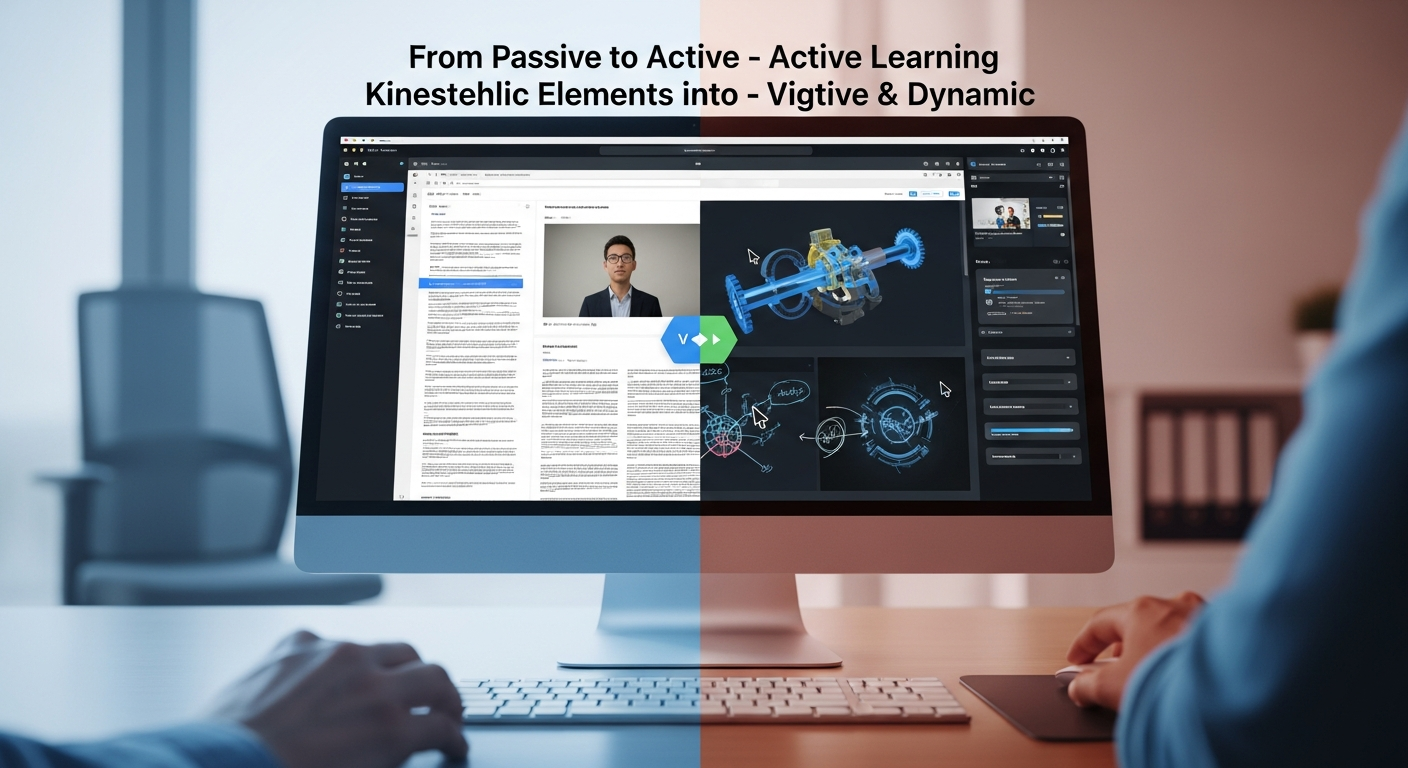
From Passive to Active Learning: Integrating Kinesthetic Elements into Digital LMS
In the dynamic landscape of corporate learning and development, the quest for highly engaged and effective training programs remains paramount. For Vice Presidents, Directors, and Managers of L&D, the challenge isn't just delivering content, but ensuring that knowledge translates into tangible skills and improved performance. Traditional eLearning, while efficient in content delivery, often falls short in fostering active engagement, leading to passive consumption rather than true mastery. The solution lies in a paradigm shift: integrating kinesthetic elements into digital Microlearning LMS.
Across diverse sectors such as Compliance, Sales, Banking, Finance, Insurance, Retail, Pharma, Health care, Hospitality, Oil and Gas, and Mining, the need for practical, hands-on learning is critical. This article explores how to transform digital learning experiences from mere information absorption to active, experiential journeys, leveraging the power of modern learning management software.
Understanding the Shift: Why Kinesthetic Learning Matters Digitally
Kinesthetic learning, often described as "learning by doing," involves physical activity and hands-on experience. Historically, this has been the domain of workshops, field training, and simulations. In a digital environment, recreating this tactile experience requires innovative design. However, the benefits are undeniable:
- Enhanced Retention: Engaging multiple senses, particularly touch and movement, cements information more effectively than passive listening or reading.
- Skill Development: Complex procedures, critical decision-making, and soft skills are best learned through practice, not just observation.
- Increased Engagement: Active participation combats learner fatigue and fosters a sense of ownership over the learning process.
- Immediate Feedback: Kinesthetic activities inherently offer opportunities for instant feedback, allowing learners to correct mistakes in real-time.
For L&D professionals grappling with low completion rates or a disconnect between theoretical knowledge and practical application, a robust MaxLearn LMS that supports kinesthetic integration offers a compelling answer. It's about moving beyond simply presenting information to actively involving the learner in its application.
Bridging the Gap: Strategies for Kinesthetic Integration
Integrating kinesthetic elements into a digital Learning content management system requires a creative approach to instructional design and the utilization of advanced LMS features. Here are key strategies:
Simulations and Virtual Reality (VR)
Immersive simulations, whether 2D scenarios or full VR experiences, allow learners to practice procedures in a safe, controlled digital environment. Imagine a healthcare professional practicing a surgical procedure, a banking employee navigating a complex customer service scenario, or an oil rig worker rehearsing emergency protocols. These digital sandboxes provide invaluable practical experience without real-world risks.
Interactive Scenarios and Role-Playing
Digital interactive scenarios can present learners with real-world dilemmas, prompting them to make decisions and observe the consequences. This is particularly effective for compliance training, where understanding the implications of actions is crucial. Role-playing, often facilitated through video submissions or interactive dialogue trees, allows sales teams to practice pitches or hospitality staff to refine service interactions.
Gamification and Interactive Quizzes
Elements of Gamified LMS design, such as points, badges, leaderboards, and progress bars, encourage active participation. Interactive quizzes that go beyond multiple-choice, incorporating drag-and-drop elements, hot spots, or matching exercises, provide a more engaging way to assess understanding and reinforce learning through action.
Drag-and-Drop Activities and Interactive Infographics
Simple yet effective, drag-and-drop activities require learners to physically manipulate digital objects to categorize information, assemble components, or sequence steps. Interactive infographics, where clicking on different sections reveals deeper content or triggers animations, allow learners to actively explore information at their own pace.
Collaborative Projects and Peer Learning
Digital platforms can facilitate collaborative projects where learners work together on case studies, problem-solving tasks, or create shared outputs. This active participation fosters teamwork, communication, and critical thinking. Peer review features allow learners to provide and receive constructive feedback, further enhancing the active learning cycle.
Microlearning Modules with Actionable Tasks
Breaking down complex topics into short, focused Microlearning LMS modules, each culminating in a specific actionable task, can significantly boost engagement. For instance, a finance professional might complete a module on a new regulation and immediately apply it to a mini-case study within the learning management system.
The Technological Backbone: Enabling Active Learning
The success of integrating kinesthetic elements hinges on the capabilities of your learning management software. A robust enterprise learning management solution will offer:
- Advanced Content Authoring: An AI Powered Authoring Tool can dramatically speed up the creation of interactive and simulation-based content, reducing the burden on L&D teams.
- Rich Media Support: The ability to seamlessly integrate videos, interactive graphics, 3D models, and VR content.
- Performance Tracking & Analytics: Beyond completion rates, the MaxLearn LMS should track engagement with interactive elements, decision-making accuracy, and time spent on active tasks.
- Mobile Accessibility: Ensuring kinesthetic activities are accessible across devices allows for flexible, on-the-go learning.
- Personalization and Adaptive Learning: Tailoring learning paths based on individual performance in active exercises ensures relevance and maximizes impact.
Benefits Across Industries
The application of kinesthetic digital learning resonates across our target industries:
- Compliance: Risk-focused Training through scenarios where incorrect actions lead to simulated penalties, deeply embedding policy adherence.
- Sales: Virtual product demonstrations, objection handling simulations, and pitch practice sessions, all tracked by the lms learning management system.
- Banking & Finance: Interactive modules on fraud detection, regulatory changes, or complex financial product explanations through decision-tree simulations.
- Healthcare: Procedural training, patient interaction simulations, and virtual anatomy labs.
- Manufacturing & Energy: Safety protocol drills, equipment operation simulations, and fault-finding exercises.
- Retail & Hospitality: Customer service role-playing, product placement simulations, and service recovery training.
An effective `cloud based learning management system` ensures these interactive experiences are scalable and accessible to all employees, regardless of their location.
Navigating the Future: AI, Personalization, and the Active Learner
The convergence of kinesthetic learning and AI-powered learning management solutions marks a new frontier for L&D leaders.
How can digital learning be made more personally relevant and impactful for individual employees?
An Adaptive Learning approach, guided by AI, is key. By analyzing a learner's interactions with kinesthetic elements—their decisions in simulations, their performance in gamified tasks—the LCMS can dynamically adjust content. If an employee struggles with a particular type of scenario, the system can automatically recommend additional practice, relevant Microlearning LMS modules, or even connect them with a mentor. This ensures that every learner receives a tailored, active learning journey focused on their specific development needs.
What are the most effective ways to ensure consistent, high-quality skill development across a globally dispersed workforce?
Digital kinesthetic elements provide an unparalleled solution for global consistency. Standardized simulations, interactive case studies, and virtual role-playing exercises can be deployed universally via a cloud based learning management system. AI-driven feedback mechanisms ensure that learners worldwide receive objective, immediate coaching, irrespective of geographical location or trainer availability. This harmonizes skill development and performance standards across all regions, a critical aspect for global enterprises.
Beyond traditional metrics, what advanced insights can `MaxLearn LMS` provide to measure the true impact of hands-on digital training?
Modern `learning management solutions` powered by AI go far beyond simple completion rates. An advanced MaxLearn LMS can track decision-making paths within simulations, identify common error patterns in interactive tasks, measure the speed of task execution, and correlate active learning engagement with subsequent job performance metrics. These deep insights allow L&D leaders to demonstrate the direct ROI of their training programs, proving that kinesthetic digital learning isn't just engaging, but genuinely impactful.
Conclusion
The future of corporate learning is active, immersive, and deeply integrated into the digital realm. For L&D leaders, embracing kinesthetic elements within a robust `learning management system` is no longer an option but a strategic imperative. By moving beyond passive information delivery to engaging learners through doing, organizations can unlock unprecedented levels of skill development, performance improvement, and employee engagement.
The journey from passive to active learning, powered by innovative digital tools and an intelligent enterprise learning management system, is set to redefine how professionals across all industries acquire and master critical skills, driving business success in an ever-evolving world.
.jpg)


