

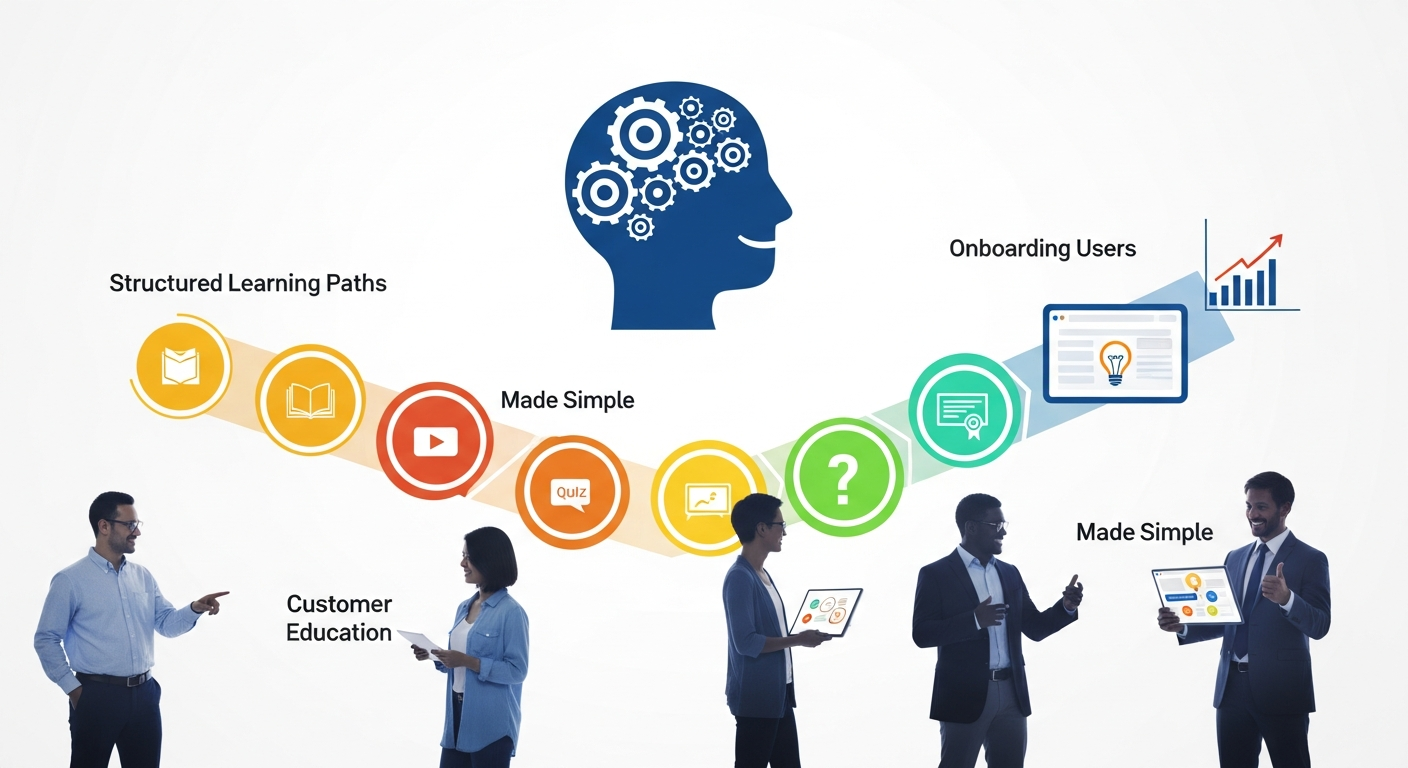
Customer Education Made Simple: Onboarding Users via Structured Learning Paths
For Vice Presidents, Directors, and Senior Managers in Learning & Development, the challenge of effectively onboarding new customers is a perennial concern. In today's competitive landscape, where user adoption and retention are paramount, haphazard approaches to customer education simply won't suffice. The solution lies not in more information, but in better structured information: specifically, through the implementation of structured learning paths designed to guide users seamlessly from novice to proficient.
Effective customer onboarding via strategic learning paths is no longer a 'nice-to-have' but a fundamental pillar of sustainable business growth. It's about empowering your users, reducing the burden on support teams, and ultimately, ensuring your product or service delivers maximum value from day one.
Why Customer Education is Critical for Business Growth
Poor onboarding is a silent killer of customer relationships. Studies consistently show that a significant percentage of users abandon a product or service within the first few weeks if they don't quickly grasp its value or functionality. This leads to wasted acquisition costs, negative word-of-mouth, and a direct impact on your company's bottom line.
Conversely, a robust customer education strategy yields substantial returns. It directly contributes to increased customer lifetime value (CLTV) by fostering deeper product engagement and satisfaction. When customers feel empowered and knowledgeable, they are more likely to utilize features fully, integrate the product into their workflows, and become loyal advocates. This proactive approach to learning reduces churn rates, transforms users into power users, and allows your sales and support teams to focus on higher-value activities.
The Pitfalls of Traditional Onboarding Approaches
Many organizations still rely on outdated or unstructured methods for customer onboarding, leading to several common pitfalls:
- Information Overload: Dumping all product features at once overwhelms users and leads to cognitive fatigue.
- Lack of Personalization: A one-size-fits-all approach fails to address the diverse needs and roles of different user segments.
- Inconsistent Messaging: Disjointed documentation, tutorials, and support articles create confusion and erode trust.
- Inefficient Resource Utilization: Support teams spend excessive time answering repetitive questions that could be resolved through self-service learning.
- Poor Engagement: Static manuals or lengthy video tutorials often fail to hold user attention and provide practical, hands-on experience.
Structured Learning Paths: The Modern Solution for Onboarding
Structured learning paths offer a comprehensive and user-centric approach to customer education. They define a clear, progressive journey for users, breaking down complex topics into digestible modules and guiding them through relevant content based on their specific needs and goals. This methodology is particularly effective for products in compliance, sales, banking, finance, insurance, retail, pharma, healthcare, hospitality, oil and gas, and mining, where intricate processes and regulatory requirements necessitate precise and easily consumable learning.
By implementing a structured path, you move beyond mere documentation to a guided educational experience. This approach addresses the shortcomings of traditional methods by providing clear milestones, relevant content, and opportunities for practical application.
Key Elements of an Effective Structured Learning Path
Designing impactful learning paths requires careful consideration of several core components:
- Modular Content Design: Break down product features, workflows, or concepts into small, focused, and easily consumable units. This Microlearning LMS approach prevents overwhelm and facilitates knowledge retention.
- Personalization & Adaptability: Leverage user data (roles, goals, prior experience) to tailor the learning journey. Adaptive Learning technologies can dynamically adjust content and progression, ensuring relevance for each individual.
- Engagement & Gamification: Incorporate interactive elements, quizzes, simulations, and progress tracking to maintain user interest. A Gamified LMS can motivate users through points, badges, and leaderboards, encouraging completion and deeper engagement.
- Assessment & Feedback Mechanisms: Integrate regular checks for understanding and provide immediate feedback. This ensures comprehension and allows users to self-correct before progressing.
- Accessibility & On-Demand Availability: Ensure learning content is accessible across multiple devices and available whenever users need it, fitting into their workflow rather than disrupting it.
How Learning Management Systems Facilitate Structured Onboarding
A robust LMS (Learning Management System) is the backbone of any successful structured customer education program. It provides the technological infrastructure to create, deliver, manage, and track learning paths effectively. Modern solutions like the MaxLearn LMS offer comprehensive features that simplify the entire process.
An advanced learning management software empowers L&D teams to streamline content creation and deployment. With features such as an AI Powered Authoring Tool, creating engaging and relevant courses becomes significantly faster and more efficient. These tools assist in generating content, quizzes, and even simulations, reducing the manual effort involved.
Furthermore, a modern learning management solutions provides centralized control over all learning assets, making it an excellent Learning content management system (LCMS). This ensures consistency in branding and messaging across all onboarding materials. The tracking and analytics capabilities of a powerful lms learning management system are invaluable. They offer insights into user progress, completion rates, and areas where users might be struggling, allowing for continuous optimization of the learning paths. For global organizations, a cloud based learning management system ensures scalability and accessibility regardless of geographical location, providing a consistent experience for all customers. For large enterprises, an enterprise learning management system provides the security, integration capabilities, and robust feature set required for complex onboarding scenarios.
AI's Role in Modern Customer Education
As L&D leaders look to the future, artificial intelligence is transforming how we approach customer education. Here are some common questions and answers regarding AI's impact:
How can artificial intelligence personalize customer learning experiences?
Artificial intelligence excels at analyzing vast amounts of user data, including their interactions with your product, learning history, role, and even their previous search queries. Based on this analysis, AI algorithms can dynamically recommend the most relevant learning modules, adjust the difficulty of content, or even suggest alternative learning paths that align with an individual user's demonstrated needs and learning style. This leads to truly adaptive and personalized experiences, ensuring each customer receives the specific education they need at the optimal time.
Can AI help ensure our training content is relevant for users across different regions?
Absolutely. For organizations with a global customer base, AI is a game-changer for content localization and relevance. AI-powered translation tools can quickly and accurately adapt learning materials into multiple languages. Beyond language, AI can also help identify cultural nuances and regional preferences, ensuring that examples, case studies, and even the tone of your content resonate appropriately with diverse audiences, making your onboarding truly global and locally relevant.
What are the practical applications of AI in understanding what our users truly need from their onboarding?
AI provides deep insights into user behavior within learning paths. It can predict potential drop-off points by identifying patterns in user engagement, or pinpoint specific topics where many users consistently struggle. By analyzing sentiment from user feedback (e.g., through chatbots or open-ended survey responses), AI can uncover underlying pain points or areas of confusion that might not be obvious. This predictive and analytical power allows L&D teams to proactively refine and improve learning content, ensuring it precisely addresses the most pressing needs of their customer base.
Benefits Across Industries
The strategic implementation of structured learning paths using an advanced LMS provides tangible benefits across diverse industries:
- Compliance: For banking, finance, healthcare, and pharma, structured paths ensure all users receive mandatory training on regulatory requirements and best practices, significantly reducing Risk-focused Training and legal exposure.
- Sales & Retail: Accelerates product knowledge adoption for sales teams and store associates, leading to better customer interactions and higher conversion rates.
- Healthcare & Hospitality: Ensures consistent service delivery and protocol adherence by rapidly educating staff and partners on new procedures or system updates.
- Oil and Gas & Mining: Delivers essential safety and operational training to a dispersed workforce, ensuring compliance and minimizing workplace incidents.
Conclusion
Customer education, when executed through structured learning paths and supported by a robust LMS, transforms the onboarding experience from a daunting task into an engaging and empowering journey. For L&D professionals, this means moving beyond simple tutorials to creating strategic educational ecosystems that drive user proficiency, satisfaction, and long-term loyalty. By embracing modular content, personalization, gamification, and the power of AI-driven insights, organizations can make customer education simple, effective, and a true competitive differentiator. Tools like the MaxLearn LMS are at the forefront of enabling this transformation, helping businesses build a knowledgeable and engaged customer base.
.jpg)


