

Reinforcement In Operant Conditioning: The Science of Driving L&D Outcomes
In the dynamic world of corporate learning and development, the goal remains constant: to cultivate desired behaviors, enhance skills, and ensure compliance across the workforce. For Vice Presidents, Directors, Senior Managers, and L&D Managers, understanding the underlying psychology of how people learn and adapt is paramount. This is where the principles of operant conditioning, particularly the strategic application of reinforcement, offer a powerful framework.
From ensuring adherence to critical safety protocols in Oil and Gas to refining sales techniques in Retail, managing complex financial regulations in Banking and Finance, or improving patient care in Healthcare, the systematic reinforcement of behaviors is not merely theoretical—it's a practical, results-driven approach. This article delves into the science of reinforcement and how modern L&D leaders can harness its power, augmented by cutting-edge technology, to achieve unparalleled learning outcomes across diverse industries.
The Core Principles: Shaping Behavior Through Consequences
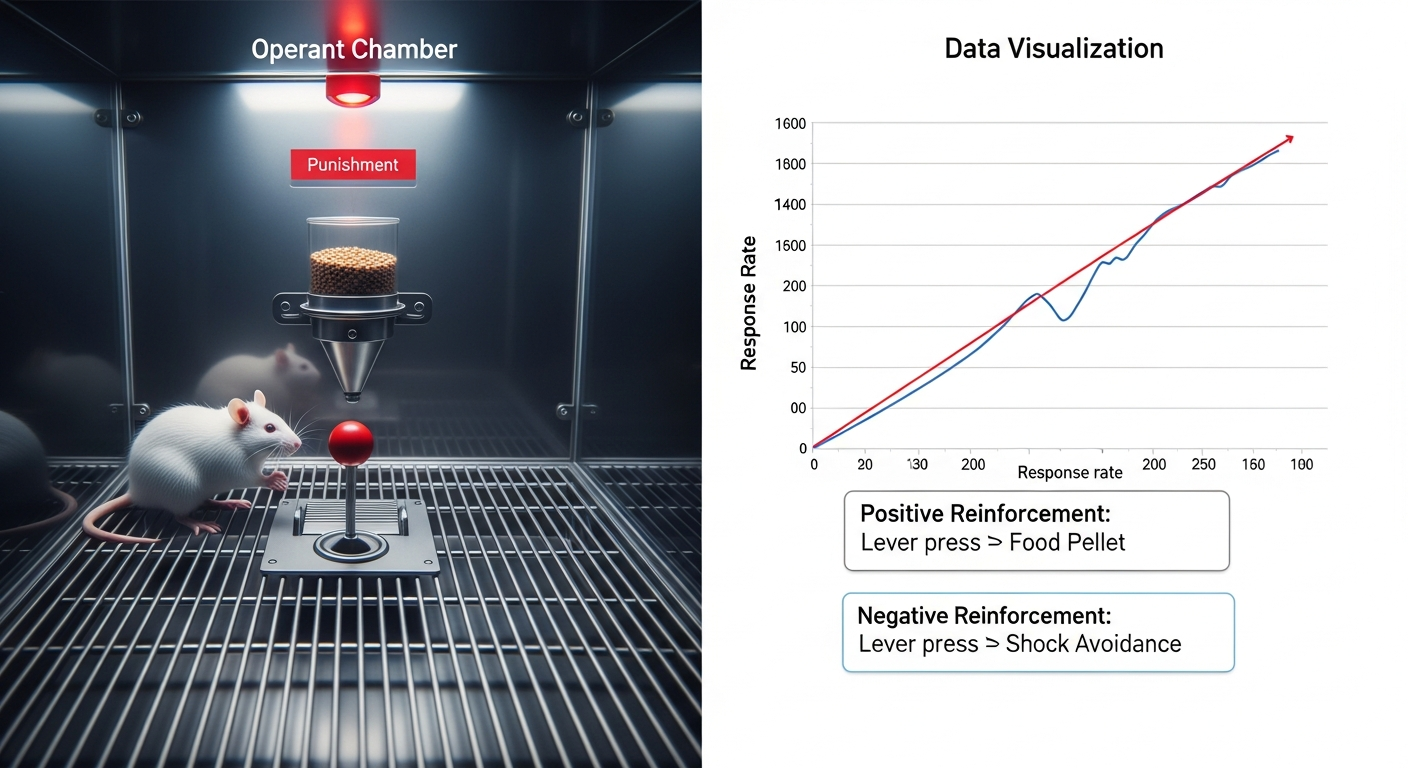
At its heart, operant conditioning, famously explored by B.F. Skinner, is about learning through consequences. It posits that behaviors followed by satisfying consequences are more likely to be repeated, while those followed by unpleasant consequences are less likely. The cornerstone of this framework for L&D is "reinforcement"—any consequence that strengthens or increases the likelihood of a behavior occurring again.
It's crucial to differentiate between two primary forms of reinforcement:
- Positive Reinforcement: Adding a desirable stimulus to increase a behavior. Think recognition, rewards, or successful completion feedback.
- Negative Reinforcement: Removing an aversive stimulus to increase a behavior. This is often misunderstood; it's about avoiding something unpleasant, not about punishment. For instance, completing mandatory compliance training to avoid penalties or fines.
While punishment aims to decrease a behavior, our focus for L&D lies firmly on reinforcement, which strategically builds and sustains desired actions and knowledge acquisition.
Positive Reinforcement: Building Desired Behaviors
Positive reinforcement is perhaps the most intuitive and widely applicable form of reinforcement in L&D. It involves providing a pleasant outcome when a learner exhibits a desired behavior, such as completing a module, mastering a skill, or applying new knowledge effectively.
In various industries, this can manifest as:
- Compliance: Acknowledging employees who consistently adhere to regulatory guidelines or successfully complete Microlearning LMS modules on data privacy (e.g., in Banking, Insurance, Healthcare).
- Sales: Rewarding sales teams for achieving targets, demonstrating new product knowledge, or effectively utilizing CRM tools.
- Pharma: Recognizing researchers for rigorous adherence to protocol or successful completion of clinical trial training.
- Retail & Hospitality: Praising staff for exceptional customer service or mastering new operational procedures.
Strategies for Effective Positive Reinforcement
- Immediacy: Reinforcement is most effective when delivered promptly after the desired behavior.
- Consistency: Regularly reinforce the target behavior, especially in the initial stages of learning.
- Relevance: The reinforcer should be meaningful and valuable to the individual.
- Variety: Use different types of reinforcers to prevent saturation and maintain engagement.
Modern learning management systems (LMS) excel at facilitating positive reinforcement. A Gamified LMS, for example, can automatically award points, badges, and unlock new content, leveraging intrinsic motivation and providing immediate feedback for successful task completion. An effective learning management software ensures that these mechanisms are integrated seamlessly into the learning journey.
Negative Reinforcement: Encouraging Avoidance of Undesirable Outcomes
Often confused with punishment, negative reinforcement is distinct and equally powerful. It involves the removal of an undesirable stimulus, which then increases the likelihood of a preceding behavior. The learner performs an action to escape or avoid an unpleasant situation.
Consider these L&D scenarios:
- Compliance: Employees complete mandatory Risk-focused Training on anti-money laundering (AML) to avoid the risk of non-compliance fines for the organization or disciplinary action for themselves (e.g., in Banking, Finance).
- Oil and Gas / Mining: Workers diligently complete safety training to avoid workplace accidents, equipment malfunction, or regulatory penalties.
- Healthcare: Medical staff complete training on new protocols to prevent medical errors or adverse patient outcomes.
In these cases, the "aversive stimulus" is the potential negative consequence (fines, accidents, errors), and the desired behavior (completing training) is reinforced because it removes or prevents that negative outcome.
Harnessing Negative Reinforcement Responsibly
For L&D, applying negative reinforcement requires careful consideration. The focus should always be on clearly defined risks and the proactive measures learners can take to mitigate them. It's about empowering employees to prevent adverse events, not inducing fear or anxiety. A robust learning content management system can clearly outline these consequences and provide clear pathways to avoid them through education.
Beyond the Basics: Timing Reinforcement for Maximum Impact
The timing and frequency of reinforcement—known as schedules of reinforcement—play a critical role in how quickly behaviors are learned and how resistant they are to extinction.
- Continuous Reinforcement: Every desired behavior is reinforced. Ideal for initial learning and skill acquisition, but behaviors can extinguish quickly once reinforcement stops.
- Partial Reinforcement: Behaviors are reinforced only some of the time. This leads to slower acquisition but much greater resistance to extinction, making it ideal for maintaining long-term engagement and behavior.
Within partial reinforcement, variable schedules (where the timing or number of responses between reinforcements changes unpredictably) are particularly effective for fostering consistent, persistent engagement, much like the unpredictable rewards of a slot machine keep players engaged.
In L&D, this translates to:
- Variable-Ratio: E.g., a sales manager praises a sales rep after an unpredictable number of successful calls.
- Variable-Interval: E.g., a leader provides positive feedback on a project at irregular intervals, keeping team members consistently motivated.
A cloud based learning management system can be configured to deliver reinforcement—such as prompts, feedback, or access to advanced content—on variable schedules, promoting sustained engagement with enterprise learning management initiatives.
AI-Driven Reinforcement: Personalizing the Learning Journey
The advent of artificial intelligence (AI) is revolutionizing how reinforcement principles can be applied in L&D, moving beyond static content to dynamic, personalized learning experiences. A sophisticated Adaptive Learning platform can significantly enhance the efficacy of reinforcement.
Dynamic Adaptation and Feedback
How can learning platforms automatically adjust content difficulty to keep learners engaged and motivated?
AI algorithms can analyze learner performance in real-time, providing immediate, personalized feedback and adjusting subsequent modules. This ensures the challenge is optimal, preventing disengagement from being too easy or frustration from being too hard. If a learner struggles with a concept, the system can offer supplementary resources or revisit foundational topics as positive reinforcement for perseverance, ensuring a truly personalized learning management system experience.
Contextual and Role-Specific Reinforcement
What are the most effective ways for digital learning environments to deliver relevant reinforcement based on an employee's specific role or operational environment?
Advanced learning management solutions leverage data analytics to understand a learner's job function, department, and even real-world performance metrics. This allows the system to recommend highly specific learning paths, provide scenario-based challenges directly applicable to their tasks, and offer reinforcement that is immediately valuable to their professional context, whether it's for a sales rep, a compliance officer, or a healthcare professional. For instance, a finance professional might receive positive reinforcement for correctly identifying a complex regulatory nuance specific to their region, supported by an LCMS.
Predicting Performance and Proactive Intervention
Can technology anticipate when a learner might struggle or disengage, and what automated interventions can it provide?
Predictive analytics within modern AI Powered Authoring Tool enhanced learning management software can identify patterns indicative of potential disengagement or skill gaps before they become critical. The system can then proactively trigger targeted nudges, supplementary micro-lessons, or direct a learner to an expert, ensuring continuous development and reinforcing positive learning habits. This kind of proactive support is a powerful form of negative reinforcement, removing the "aversive stimulus" of potential failure or knowledge gaps.
Practical Steps for L&D Leaders
For L&D professionals seeking to optimize learning outcomes, integrating reinforcement principles into your strategy is not just beneficial—it's essential. Here’s how:
- Define Desired Behaviors and Outcomes: Clearly articulate what behaviors you want to encourage. This could be consistent sales compliance, accurate data entry, or effective risk mitigation.
- Identify Effective Reinforcers: Understand what truly motivates your workforce. This could range from public recognition, career advancement opportunities, skill mastery, or simply positive feedback.
- Implement Diverse Reinforcement Schedules: Start with continuous reinforcement for new skills, then transition to variable partial schedules to ensure long-term retention and application.
- Leverage Technology: Utilize a robust LMS like MaxLearn LMS. An lms learning management system equipped with gamification, adaptive learning, and AI capabilities can automate and personalize reinforcement, scaling your efforts across the entire organization. This includes utilizing it as a learning content management system and for broader learning management solutions.
- Monitor, Evaluate, and Iterate: Continuously track the impact of your reinforcement strategies and adjust as needed. What works for a sales team might need adaptation for a pharma R&D group.
Conclusion
The principles of reinforcement in operant conditioning offer a scientifically validated pathway to driving superior L&D outcomes. By systematically applying positive and negative reinforcement through carefully designed learning experiences, L&D leaders can cultivate a workforce that not only acquires knowledge but consistently applies it to achieve strategic business objectives.
In today's complex corporate landscape, from Compliance to Healthcare, Sales to Oil and Gas, the ability to predictably shape behavior is a competitive advantage. Embracing modern learning management solutions, particularly those powered by AI, empowers L&D professionals to move beyond traditional training and build truly engaging, effective, and behavior-changing learning ecosystems.
.jpg)


