

```html
Single-Loop And Double-Loop Learning Examples: A Strategic Guide for L&D Leaders
In the dynamic landscape of modern business, continuous learning is not just a buzzword; it's a strategic imperative. For Vice Presidents, Directors, and Managers of Learning & Development across sectors like Compliance, Sales, Banking, Finance, Insurance, Retail, Pharma, Healthcare, Hospitality, Oil & Gas, and Mining, understanding the nuances of how organizations learn is paramount. At the heart of effective organizational development lies the distinction between single-loop and double-loop learning, concepts first introduced by Chris Argyris and Donald Schön. These frameworks offer a powerful lens through which to analyze and improve corporate training strategies, fostering environments that not only fix immediate problems but also question fundamental assumptions for sustained growth and innovation.
Understanding Single-Loop Learning
Single-loop learning is akin to a thermostat. When the room gets too cold, the thermostat turns on the heat. When it gets too hot, it turns on the AC. It takes a corrective action to maintain a desired state without questioning the thermostat's settings or the underlying HVAC system's design. In organizational terms, this involves detecting and correcting errors to maintain existing norms, policies, and objectives. It's about 'doing things right' within the established framework.
Single-Loop Learning in Action: Practical Examples
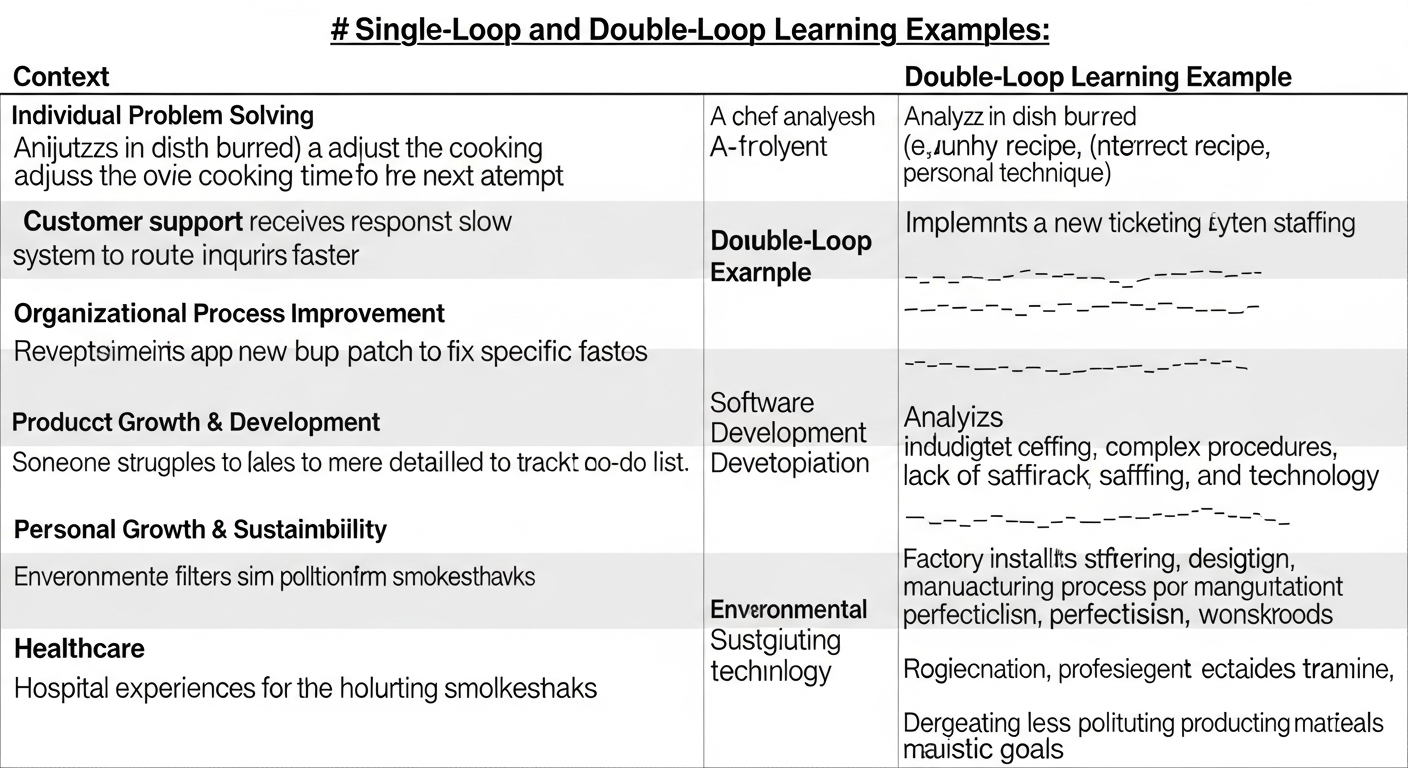
- Compliance Training: Imagine a financial institution where employees fail to adhere to a specific anti-money laundering (AML) protocol. Single-loop learning would involve identifying the employees who made the error, retraining them on the correct protocol, and perhaps implementing stricter checks to ensure future compliance. The goal is to fix the immediate lapse and ensure existing rules are followed. This type of Risk-focused Training is crucial for immediate remediation.
- Sales Performance: A sales team consistently misses its quarterly targets. Single-loop learning might focus on refining sales scripts, offering more competitive pricing, or providing additional training on product features. The team is looking for tactical adjustments to achieve the existing sales goal, without questioning the product's market fit, the sales strategy itself, or the broader market conditions. A Microlearning LMS can quickly deploy such tactical updates.
Single-loop learning is essential for operational efficiency, immediate problem-solving, and ensuring adherence to established procedures. It provides quick fixes and allows organizations to function effectively day-to-day. However, its limitation lies in its inability to question the underlying assumptions, values, and policies that might be contributing to the problems in the first place.
Delving into Double-Loop Learning
Double-loop learning, in contrast, involves a deeper level of inquiry. It's not just about correcting errors within the existing system but about questioning the system itself. This means examining the fundamental assumptions, values, and strategies that govern actions. It's about 'doing the right things' and re-evaluating 'what is right.' This transformative approach leads to shifts in mental models and organizational culture.
Double-Loop Learning in Action: Transformative Examples
- Banking and Financial Ethics: Following a major data breach or mis-selling scandal, a bank employing double-loop learning wouldn't just retrain employees on security protocols or sales ethics. Instead, it would delve into questions like: "Are our internal values truly aligned with customer trust and ethical behavior, or are they implicitly prioritizing short-term profits?" "Does our organizational structure inadvertently incentivize risky behavior?" "How do our leadership practices shape the ethical climate?" This questioning can lead to a complete overhaul of organizational values, incentive structures, and governance models.
- Healthcare Patient Safety: If a hospital experiences a recurring type of medical error, single-loop learning would involve retraining staff on specific procedures. Double-loop learning would prompt an investigation into why the error occurs repeatedly. Questions might include: "Are our patient care protocols inherently flawed or outdated?" "Does our staff scheduling lead to burnout and increased error rates?" "Is there a systemic communication breakdown between departments that contributes to these errors?" This can result in redesigning entire care pathways, revising institutional policies, or investing in new collaborative technologies to improve safety.
Double-loop learning fosters innovation, resilience, and adaptability. It allows organizations to anticipate future challenges and proactively reshape their identity. The challenge, however, is that it often requires confronting uncomfortable truths, challenging deeply held beliefs, and fostering psychological safety for open dialogue.
Integrating Learning Loops for Organizational Growth
For L&D leaders, the strategic value lies not in choosing one over the other, but in understanding when and how to deploy both. Single-loop learning maintains stability and efficiency, while double-loop learning drives evolution and competitive advantage. The interplay between them is crucial.
What is the primary difference between single-loop and double-loop learning in corporate training? The fundamental distinction lies in the level of inquiry. Single-loop learning focuses on correcting deviations from existing norms and achieving established goals without questioning those norms or goals. Double-loop learning, conversely, challenges the underlying assumptions, values, and frameworks that inform those norms and goals, leading to systemic change and redefinition of purpose.
How can organizations worldwide apply double-loop learning to enhance their risk management frameworks? Globally, organizations can enhance risk management by fostering a culture where every incident, near-miss, or audit finding isn't just a compliance item to be corrected (single-loop), but an opportunity to question the fundamental design of their risk appetite, control environment, and decision-making processes. This involves encouraging cross-functional dialogue, psychological safety for reporting systemic flaws, and leadership commitment to re-evaluating core strategies rather than just applying patches. For instance, after a major cybersecurity incident, an organization might not just update firewall rules but question its entire digital strategy, vendor selection process, and the risk assumptions embedded in its business model.
How can intelligent algorithms facilitate the shift from single-loop to double-loop thinking in employee development? Advanced analytical tools and machine learning can play a pivotal role. For single-loop tasks, AI can automate error detection and immediate feedback loops, for example, by identifying compliance breaches in real-time or pinpointing specific knowledge gaps in sales teams through performance data. This frees up human trainers to focus on deeper issues. For double-loop learning, intelligent algorithms can analyze vast datasets—from employee feedback and market trends to industry incidents and internal operational data—to identify patterns, correlations, and anomalies that human analysis might miss. This data-driven insight can then serve as a catalyst for questioning existing assumptions. An AI Powered Authoring Tool can then help L&D teams rapidly create and adapt content that addresses these deeper, systemic issues, fostering critical thinking and problem-solving skills necessary for double-loop engagement.
Leveraging Modern eLearning for Deeper Learning
Modern eLearning platforms offer powerful tools to facilitate both single-loop and double-loop learning. For single-loop efficiency, a Microlearning LMS can deliver targeted, bite-sized training modules that quickly correct knowledge gaps or update procedural understanding in specific areas like product knowledge or basic compliance. Such platforms ensure that employees are always 'doing things right' according to current standards.
To engage learners in deeper, double-loop thinking, Gamified LMS features can simulate complex scenarios, decision-making challenges, and ethical dilemmas, prompting learners to question their assumptions and explore consequences of different approaches in a safe environment. This experiential learning fosters critical thinking beyond mere adherence to rules.
Adaptive Learning technologies are also crucial, tailoring learning paths not just to address individual skill gaps (single-loop) but also to guide learners through more complex conceptual frameworks when systemic issues are identified (double-loop). For instance, if an employee consistently struggles with ethical decision-making, adaptive learning can present advanced modules that challenge their underlying moral reasoning, not just the procedural steps.
Furthermore, the integration of an AI Powered Authoring Tool empowers L&D teams to rapidly develop and iterate content that supports both learning loops. It can help analyze existing content for single-loop effectiveness and suggest modifications or new modules to encourage double-loop reflection. For industries with high stakes, like Banking, Pharma, or Healthcare, this capability is invaluable for creating Risk-focused Training that addresses both immediate compliance needs and systemic risk mitigation strategies.
Conclusion
The distinction between single-loop and double-loop learning provides L&D leaders with a robust framework for designing impactful training programs. While single-loop learning ensures operational excellence and adherence to existing standards, double-loop learning cultivates an environment of continuous improvement, strategic innovation, and deep organizational resilience. By strategically integrating both approaches, and leveraging the capabilities of modern eLearning technologies—from Microlearning and Gamified LMS to Adaptive Learning and AI-powered authoring—organizations can empower their workforce to not only react to challenges but also to fundamentally reshape their future. Embracing this dual perspective is key to transforming learning from a cost center into a powerful driver of sustainable business success across all industries.
```.jpg)


