

Mastering Organizational Agility: Unleashing Double-Loop Learning with Argyris and Schön
In today's relentlessly evolving business landscape, the ability to adapt, innovate, and thrive isn't just an advantage—it's a fundamental requirement for survival. For Vice Presidents, Directors, and Managers of Learning and Development (L&D), understanding and implementing advanced learning methodologies is paramount. Among these, the concept of Double-Loop Learning, pioneered by Chris Argyris and Donald Schön, stands out as a powerful framework for fostering true organizational agility and resilience. It's not merely about fixing problems; it's about fundamentally rethinking how we perceive and solve them.
Across diverse sectors like Compliance, Sales, Banking, Finance, Insurance, Retail, Pharma, Health Care, Hospitality, Oil and Gas, and Mining, the challenges are complex. From navigating stringent regulatory changes to optimizing customer experiences and ensuring workforce safety, organizations constantly face dilemmas that require more than surface-level fixes. This is where Double-Loop Learning transcends conventional training, driving profound shifts in understanding and action.
What is Double-Loop Learning? The Core Distinction
To grasp Double-Loop Learning, it's essential to first understand its counterpart: Single-Loop Learning.
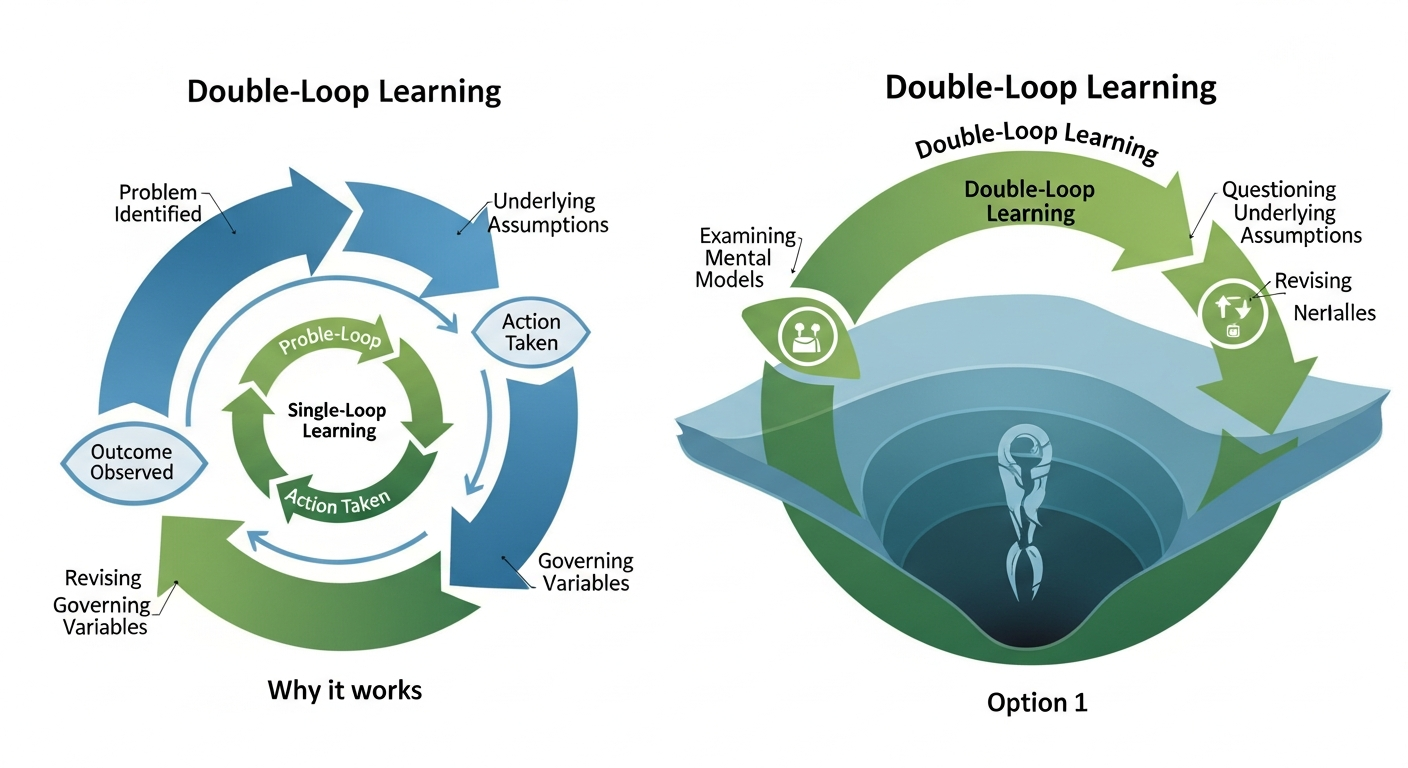
Single-Loop Learning: The "Error Correction" Mode
- This is the most common form of learning, akin to a thermostat. When the room gets too cold, the thermostat turns on the heater to reach the desired temperature. It fixes the immediate problem without questioning the desired temperature setting itself or the system that controls it.
- In an organizational context, Single-Loop Learning involves detecting and correcting errors or deviations from existing norms, policies, and goals. For example, if sales targets aren't met, Single-Loop Learning might involve retraining sales teams on existing techniques, or refining marketing collateral. The underlying assumptions about the sales process, product value, or market strategy remain unchallenged.
- It's essential for operational efficiency and maintaining current performance, but it doesn't lead to fundamental change or innovation.
Double-Loop Learning: The "Assumption Challenging" Mode
- Building on the thermostat analogy, Double-Loop Learning would ask: "Why is the desired temperature set at 72 degrees? Is this still optimal? What if we reconsider the entire heating/cooling system or even the building's insulation?"
- In an organization, Double-Loop Learning involves questioning the underlying assumptions, values, policies, and goals that guide actions. It’s about reflecting on the frameworks we use to make decisions and solve problems. If sales targets aren't met, Double-Loop Learning might prompt questions like: "Are our sales targets realistic in the current market? Is our core product strategy still relevant? Are our compensation models inadvertently discouraging certain behaviors? What cultural beliefs are hindering our sales effectiveness?"
- This form of learning leads to transformative change, innovation, and a deeper understanding of complex issues. It requires critical self-reflection, open dialogue, and a willingness to challenge deeply held beliefs.
Why Double-Loop Learning is Crucial for L&D Leaders Today
For L&D leaders, championing Double-Loop Learning is no longer optional; it's a strategic imperative. Here’s why:
- Navigating Unprecedented Change: Industries are being reshaped by technology (AI, automation), global events, and shifting market demands. Single-Loop fixes are temporary bandages. Double-Loop Learning equips organizations to fundamentally rethink strategies and adapt proactively.
- Fostering True Innovation: Innovation doesn't arise from repeating old patterns. It comes from questioning existing paradigms. L&D can cultivate environments where employees feel safe to challenge the status quo and propose new approaches.
- Enhancing Compliance and Risk Management: In sectors like Banking, Pharma, and Oil and Gas, compliance failures can have catastrophic consequences. Risk-focused Training that incorporates Double-Loop principles can move beyond simply adhering to rules. It can help teams understand why regulations exist, question if current practices truly mitigate risk, and identify systemic vulnerabilities before they become critical.
- Developing Adaptive Leadership: Senior managers and directors need to lead not just through directives but through inquiry. Double-Loop Learning develops leaders who can facilitate critical conversations, embrace uncertainty, and guide their teams through complex problem-solving.
- Driving Employee Engagement and Ownership: When employees are empowered to question and contribute to fundamental strategic shifts, their engagement and sense of ownership dramatically increase.
Implementing Double-Loop Learning in Your Organization
Transitioning to a Double-Loop Learning culture requires deliberate effort and a supportive environment:
- Cultivate Psychological Safety: People must feel safe to express dissenting opinions, admit mistakes, and challenge authority without fear of retribution. This is the bedrock upon which Double-Loop Learning is built. Leaders must model vulnerability and curiosity.
- Encourage Critical Reflection and Inquiry: Design training and development programs that move beyond rote memorization. Incorporate case studies, simulations, and facilitated discussions that ask "why?" and "what if?" instead of just "how?" Teach individuals and teams to look for underlying assumptions in their decisions.
- Promote Experimentation and Feedback Loops: Create opportunities for pilot projects, A/B testing, and iterative development. Establish clear, candid feedback mechanisms that encourage both constructive criticism and praise for challenging thinking.
- Integrate into Performance Management: Shift performance reviews to include not just outcomes, but also the learning process—how individuals and teams reflected on their actions, challenged assumptions, and adapted their strategies.
- Leverage Modern eLearning Tools: Technology can be a powerful accelerator for Double-Loop Learning.
The Role of Modern eLearning Tools in Fostering Double-Loop Learning
The right eLearning ecosystem can significantly enhance an organization's capacity for Double-Loop Learning:
- Microlearning LMS for Continuous Reflection: Deliver bite-sized content that prompts reflection and critical thinking. Microlearning LMS platforms can provide short scenarios or questions that challenge learners' assumptions about processes, customer interactions, or ethical dilemmas, encouraging them to pause and rethink.
- Gamified LMS for Experimental Learning: Gamification can create safe "playgrounds" for experimentation. Simulations, branching scenarios, and role-playing games within a Gamified LMS allow learners to make decisions, experience consequences, and reflect on the effectiveness of different approaches without real-world risks. These experiences are ideal for challenging underlying mental models.
- Adaptive Learning Paths for Personalized Insight: Adaptive Learning systems can tailor content based on a learner's responses, guiding them through a series of increasingly complex questions designed to uncover and challenge their implicit assumptions. This personalized journey fosters deeper self-awareness and critical thinking.
- AI Powered Authoring Tool for Rich, Reflective Content: An AI Powered Authoring Tool can rapidly generate diverse scenarios, ethical dilemmas, and complex problem-solving exercises across various industries. This allows L&D teams to quickly create dynamic content that pushes learners beyond simple compliance, into areas requiring profound judgment and assumption-challenging.
AI-Driven Questions for Deeper Organizational Insight
In the digital age, advanced analytics and intelligent systems can significantly bolster an organization's capacity for Double-Loop Learning. Here are common queries L&D leaders often pose:
-
Question: How can artificial intelligence aid in identifying systemic issues that hinder organizational learning, especially across varied business units?
Answer: AI-powered analytics can sift through vast amounts of performance data, training outcomes, employee feedback, and operational reports to uncover subtle patterns and root causes of recurring problems. By correlating seemingly disparate data points—from customer complaints to safety incidents or sales conversion rates—AI can pinpoint underlying assumptions, outdated policies, or cultural norms that might be inadvertently constraining progress or creating risk. This data-driven insight helps target areas where Double-Loop Learning is most needed.
-
Question: What digital tools are most effective for fostering a culture of critical reflection and collaborative inquiry across diverse teams operating in different regions?
Answer: Collaborative Microlearning LMS platforms equipped with robust discussion forums, virtual whiteboards, and interactive scenario simulations are highly effective. These features enable geographically dispersed teams to engage in deep, asynchronous discussions about challenging dilemmas, share diverse perspectives, and collectively scrutinize underlying assumptions, transcending geographical boundaries. The integration of Gamified LMS elements, such as peer challenges or collaborative problem-solving quests, can also significantly incentivize participation and elevate the quality of critical dialogue, encouraging a culture of shared learning and reflection.
-
Question: Can intelligent learning platforms truly accelerate the shift from reactive problem-solving (single-loop) to proactive, assumption-challenging behaviors (double-loop) in individuals and teams?
Answer: Absolutely. By leveraging Adaptive Learning paths, intelligent platforms can present learners with increasingly complex and ambiguous dilemmas, moving beyond simple 'right or wrong' answers. These systems can provide immediate, personalized feedback that doesn't just correct an error but prompts deeper reflection on the mental models or assumptions that led to the initial decision. An AI Powered Authoring Tool further enhances this by enabling L&D professionals to rapidly design and deploy rich, interactive content specifically crafted to challenge ingrained thinking and accelerate the development of critical inquiry necessary for Double-Loop Learning. This targeted approach significantly accelerates an individual's journey towards more proactive and reflective problem-solving.
Conclusion: The L&D Leader's Imperative
Double-Loop Learning is more than an academic concept; it's a strategic framework for future-proofing your organization. For L&D leaders in Compliance, Sales, Banking, Finance, Insurance, Retail, Pharma, Health Care, Hospitality, Oil and Gas, and Mining, embracing Argyris and Schön's insights means moving beyond traditional training. It means cultivating a learning culture where questioning is encouraged, assumptions are explored, and fundamental shifts are embraced.
By integrating Double-Loop principles with modern eLearning tools, L&D departments can become true architects of organizational transformation, equipping their workforce to not just react to change, but to proactively shape the future. It's about empowering your people to learn, unlearn, and relearn at the deepest possible level, ensuring enduring agility and competitive advantage.
.jpg)


