

Mastering Organizational Agility: An Example Of Double Loop Learning in L&D
In today's rapidly evolving business landscape, the traditional approach to problem-solving often falls short. For Vice Presidents, Directors, and Senior Managers in Learning & Development, fostering genuine organizational change requires more than just fixing symptoms; it demands a deeper dive into underlying assumptions and systemic issues. This is where the concept of Double Loop Learning, championed by Chris Argyris and Donald Schön, becomes indispensable. It’s a powerful framework that moves beyond simply correcting errors to transforming the very way an organization thinks and operates.
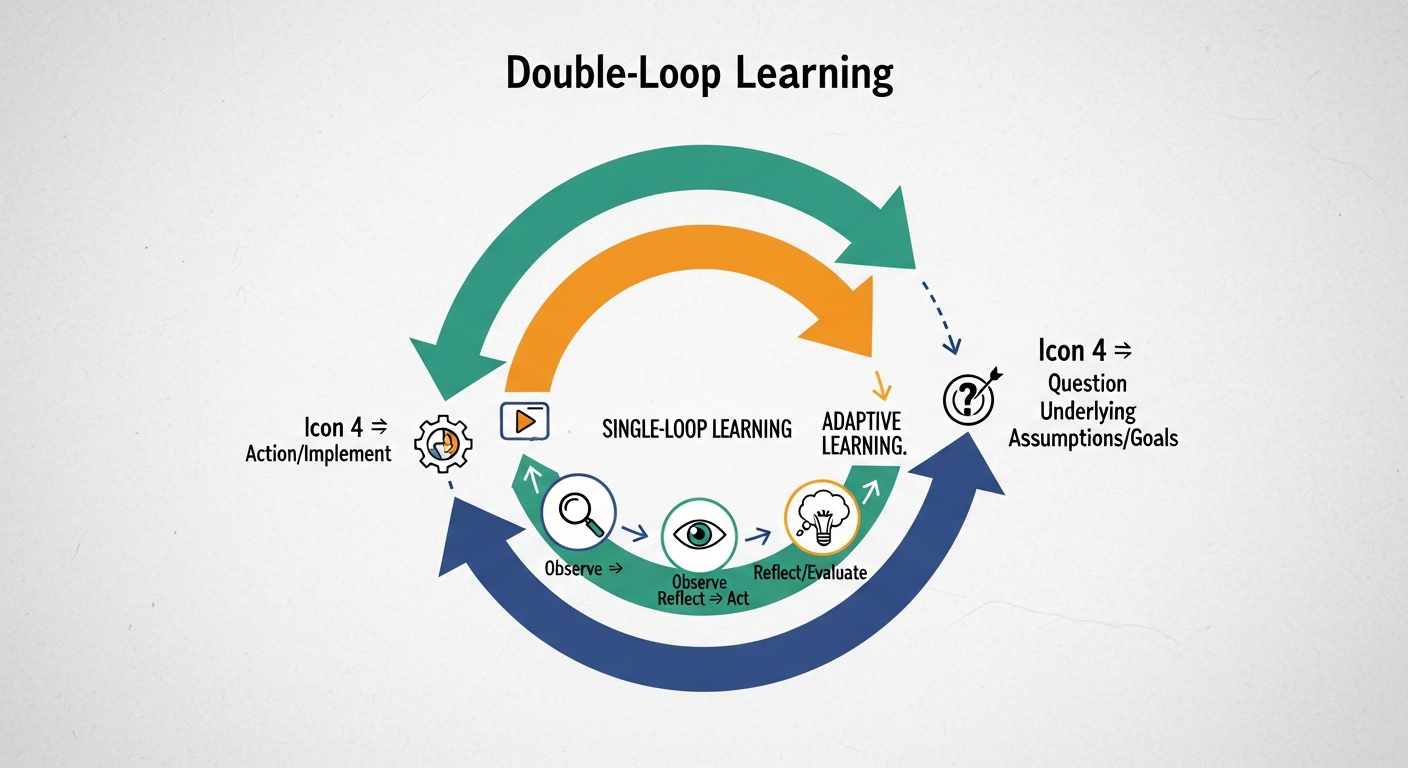
Imagine your organization as a thermostat. Single Loop Learning is when the thermostat detects the room is too cold and turns on the heater – a direct response to a detected error, within existing parameters. Double Loop Learning, however, is asking, "Why is the room getting cold in the first place? Is the insulation faulty? Is the thermostat itself calibrated correctly? Should we be optimizing for energy efficiency rather than just temperature?" It’s about questioning the governing variables and strategies themselves, leading to a profound shift in understanding and action.
Understanding the Essence of Double Loop Learning
To truly grasp Double Loop Learning, it's crucial to differentiate it from its more common counterpart:
Single Loop Learning: The Corrective Action
- Focuses on detecting and correcting errors within a given set of rules or parameters.
- Asks: "Are we doing things right?"
- Examples: Rerunning a compliance module after an employee fails a test, refining a sales script that isn't converting well, or updating a product feature based on user complaints.
- While necessary for operational efficiency, it doesn't challenge the fundamental assumptions guiding behavior.
Double Loop Learning: The Transformative Insight
- Challenges the underlying values, assumptions, and strategies that led to the error in the first place.
- Asks: "Are we doing the right things?" and "Why are we doing them this way?"
- Involves critical reflection, open dialogue, and a willingness to question deeply held beliefs.
- Leads to changes in organizational policies, culture, and learning methodologies.
- Crucial for long-term adaptability, innovation, and strategic advantage.
A Practical Example: Elevating Compliance Training in Banking
Consider a large multinational bank that consistently faces challenges with compliance adherence, leading to significant fines and reputational damage. The L&D department, tasked with improving this, traditionally employs Single Loop Learning:
The Single Loop Approach:
- Employees fail an annual anti-money laundering (AML) or data privacy assessment.
- L&D mandates a refresher course, perhaps with updated content or a more stringent test.
- New regulations emerge, and L&D quickly develops new modules to cover them.
While these actions are necessary, they treat the symptoms. If the same issues resurface year after year, it's a clear signal that a deeper intervention is needed.
The Double Loop Approach:
An L&D leader, adopting a Double Loop perspective, wouldn't just update the training. They would ask:
- Why are employees failing these assessments despite repeated training? Is the training content too dense, irrelevant to their daily roles, or delivered in an unengaging format?
- Are our internal policies and procedures clear and actionable? Or are they so complex that employees struggle to translate them into practice?
- Is there a cultural issue? Do employees perceive compliance as a bureaucratic burden rather than a critical element of responsible banking? Is leadership modeling compliant behavior effectively?
- What feedback mechanisms exist beyond just assessment scores? Are we soliciting qualitative feedback from front-line staff on the real-world challenges of compliance?
Through this deeper inquiry, the L&D team might uncover:
- The existing training, while comprehensive, is delivered annually in a lengthy, text-heavy format that lacks retention.
- Front-line staff struggle with highly specific, real-time compliance decisions that current training doesn't adequately address.
- There's a disconnect between policy and practice, with managers sometimes implicitly encouraging shortcuts.
The Double Loop solution would then involve a systemic overhaul:
- Implementing a Microlearning LMS that delivers bite-sized, context-specific compliance training modules just-in-time, linked directly to workflows.
- Introducing a Gamified LMS to increase engagement and provide immediate, low-stakes practice environments for complex compliance scenarios.
- Developing Adaptive Learning paths that personalize compliance training based on an individual's role, previous performance data, and identified knowledge gaps, ensuring relevance and efficiency.
- Utilizing an AI Powered Authoring Tool to rapidly create and iterate scenario-based content that addresses real-world challenges identified from feedback.
- Working with leadership to foster a culture of transparent reporting and proactive Risk-focused Training, demonstrating the "why" behind compliance beyond mere regulation.
- Revising policies to be clearer, more accessible, and integrated into daily operations, rather than standalone documents.
This approach isn't just about better training; it's about fundamentally changing how the organization perceives, manages, and learns about compliance, leading to sustainable improvements and a more resilient operational framework.
Addressing Key Inquiries for L&D Leaders
Optimizing for Strategic Foresight:
Q: How can advanced analytics help us preempt skill gaps before they become critical and impact our strategic goals?
A: By leveraging data from performance reviews, project outcomes, and learning platform engagement, L&D leaders can utilize predictive analytics to identify emerging skill requirements and potential deficits. This allows for proactive curriculum development and talent pipeline management, ensuring the workforce is prepared for future challenges, rather than reactively training after issues arise. Such insights are crucial for industries like finance, pharma, and oil & gas where future competencies directly impact market position and safety.
Adapting to Diverse Contexts:
Q: What learning strategies are most effective for geographically dispersed teams in highly regulated industries like healthcare or mining?
A: For global teams, the most effective strategies combine technology with localized content. This involves deploying a versatile Microlearning LMS that can deliver culturally relevant and language-specific content. Additionally, incorporating virtual reality for simulated environments, especially for high-risk operations, and facilitating peer-to-peer learning networks helps bridge geographical divides. The key is ensuring that core compliance and safety training is consistent while allowing for regional nuance and delivery preferences, critical in sectors like mining or healthcare with unique local regulations.
Cultivating Proactive Problem-Solving:
Q: What are the most effective strategies to shift our organizational learning culture from reactive problem-solving to proactive innovation and continuous improvement?
A: Shifting culture requires leadership commitment and systemic changes. Start by establishing clear channels for feedback and reflection at all levels. Encourage psychological safety so employees feel empowered to question existing processes without fear of reprisal. Implement project-based learning and cross-functional teams to tackle complex challenges, fostering an environment where assumptions are regularly challenged and new approaches are tested. Gamified LMS platforms can also incentivize experimentation and knowledge sharing, making proactive learning an engaging part of daily work.
Implementing Double Loop Learning: A Strategic Roadmap
For L&D leaders looking to integrate Double Loop Learning into their organizations, consider these steps:
- Cultivate a Culture of Inquiry: Encourage "why" questions. Promote psychological safety where challenging norms is seen as valuable, not insubordinate.
- Gather Diverse Data: Look beyond standard KPIs. Collect qualitative feedback, conduct root cause analyses, and observe actual behaviors, not just reported ones.
- Facilitate Reflective Dialogue: Create forums (workshops, team meetings, peer coaching) where teams can openly discuss assumptions, mental models, and their impact on outcomes.
- Pilot & Iterate Systemic Changes: Based on insights, design pilot programs that challenge existing training methodologies or operational policies. Measure impact and be prepared to iterate.
- Champion Technology: Leverage modern learning platforms. An Microlearning LMS can offer the agility to rapidly deploy and test new approaches, while Adaptive Learning can personalize experiences to directly address identified systemic issues. An AI Powered Authoring Tool can dramatically speed up the creation of iterative, responsive content.
- Lead by Example: L&D leaders themselves must demonstrate a willingness to question their own assumptions and learning strategies, showcasing the power of Double Loop Learning in action.
Conclusion
Double Loop Learning isn't merely a theoretical concept; it's a strategic imperative for L&D leaders aiming to build resilient, innovative, and adaptable organizations. By moving beyond superficial fixes and engaging in deep reflection, organizations can transform their core assumptions, policies, and ultimately, their performance. In industries from retail to healthcare, adopting this powerful framework means not just training employees to do things right, but empowering them to question whether they are doing the right things, thereby securing sustainable growth and competitive advantage. The journey requires courage, curiosity, and a commitment to continuous, profound learning, positioning L&D as a true driver of strategic organizational transformation.
.jpg)


