

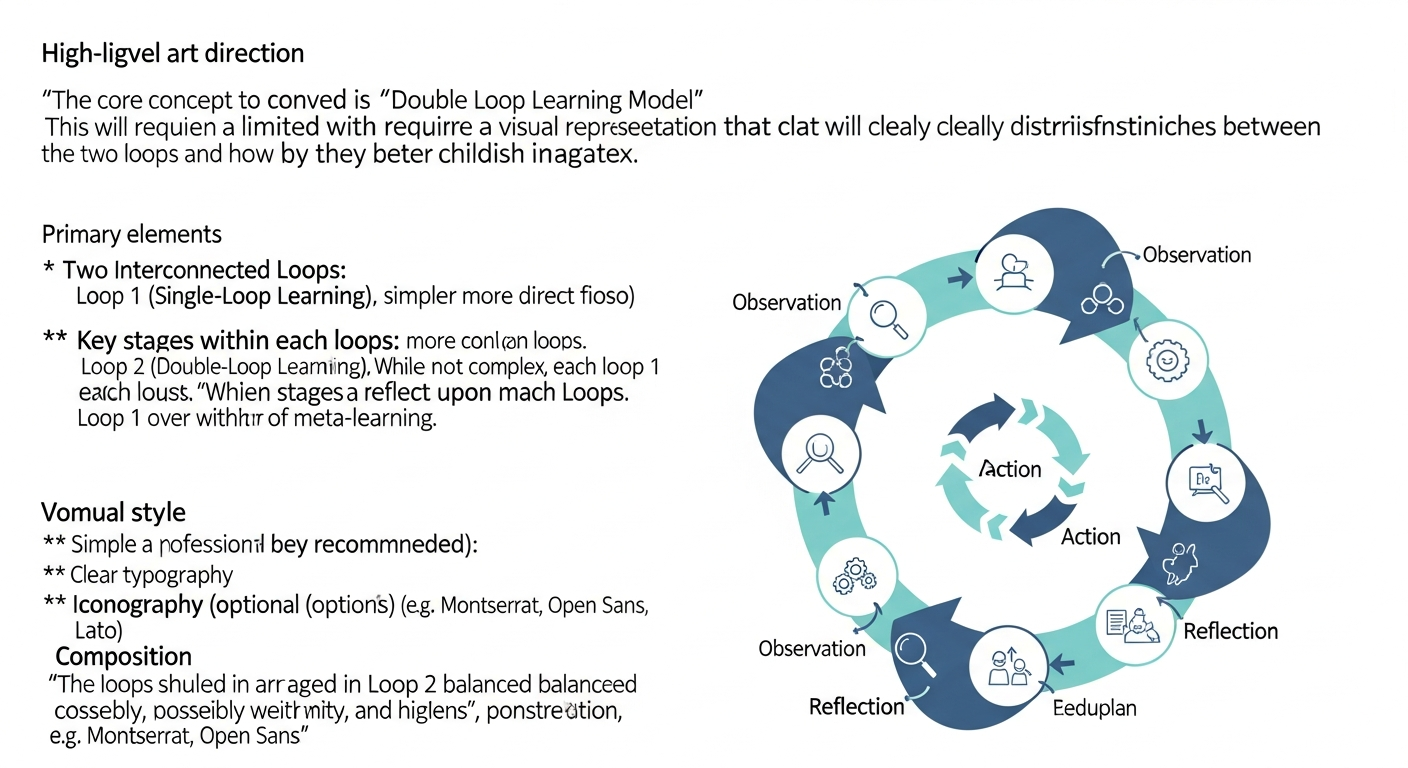
Beyond the Surface: Driving Transformative Growth with the Double Loop Learning Model
In today’s rapidly evolving business landscape, organizations face unprecedented challenges and opportunities. For Learning & Development (L&D) leaders – Vice Presidents, Directors, and Senior Managers across sectors like Compliance, Sales, Banking, Finance, Insurance, Retail, Pharma, Healthcare, Hospitality, Oil and Gas, and Mining – the goal isn’t just to train, but to transform. While traditional training often focuses on improving existing processes, true innovation and sustainable growth demand a deeper approach: the Double Loop Learning Model.
This powerful framework, developed by Chris Argyris and Donald Schön, moves beyond merely correcting errors to questioning the very assumptions that underpin our actions. It's the difference between merely fixing a leaky faucet and asking why the plumbing system was designed to leak in the first place.
Understanding Single-Loop Learning
Most organizational learning operates in a single-loop fashion. This is where individuals or teams identify a problem, seek a solution within the existing framework, and implement it. Think of it as a thermostat: when the temperature deviates from the set point, the thermostat activates the heating or cooling to bring it back in line. The underlying rule (the desired temperature) is not questioned.
- Problem Identification: An issue arises (e.g., sales targets not met, compliance error rates are high).
- Solution Development: Training is provided on new sales techniques, or a refresher on existing compliance protocols.
- Implementation & Adjustment: Learners apply new skills, and performance improves.
Single-loop learning is efficient for routine problem-solving and ensuring operational effectiveness. It's crucial for maintaining standards and continuous improvement. However, its limitation lies in its inability to challenge the fundamental assumptions, strategies, and values that might be contributing to the problems in the first place. For L&D, it means delivering training that helps people do things better, but not necessarily do better things.
Unpacking Double-Loop Learning
Double-loop learning, in contrast, involves a profound level of reflection. It's not just about correcting errors; it's about questioning the governing variables – the underlying beliefs, norms, policies, and goals – that led to those errors. If single-loop learning asks, "Are we doing things right?", double-loop learning asks, "Are we doing the right things?" and "Why do we believe these are the right things to do?"
Consider the thermostat example again: double-loop learning would involve questioning the desirability of the set temperature itself, or even the fundamental need for a heating/cooling system in its current form. In an organizational context:
- Reflection on Outcomes: An existing solution or strategy isn't yielding desired long-term results.
- Challenging Governing Variables: Instead of just tweaking the process, individuals or teams critically examine the foundational assumptions, mental models, and organizational culture that influenced the initial strategy.
- Re-framing the Problem: The problem is redefined based on new insights into underlying causes.
- Transformative Action: New strategies, policies, and behaviors are developed that fundamentally alter the way the organization operates.
This form of learning is transformative. It moves organizations from adaptation to innovation, fostering a culture of genuine inquiry and systemic change. For L&D leaders, this means designing learning experiences that cultivate critical thinking, reflection, and the courage to challenge the status quo.
Why Double-Loop Learning Matters for L&D
For L&D professionals tasked with driving organizational performance and future-proofing their workforce, embracing double-loop learning is not optional; it’s imperative. Here’s why:
- Cultivates Innovation: By questioning deeply held beliefs, teams can uncover novel solutions and pioneer new approaches to old problems. This is critical for industries facing rapid technological shifts or evolving market demands.
- Enhances Adaptability: In volatile environments, the ability to fundamentally rethink strategies is a core competitive advantage. L&D can equip employees to navigate uncertainty with agility.
- Improves Decision-Making: Decision-makers are better equipped to understand the systemic implications of their choices, leading to more robust and sustainable outcomes.
- Fosters a Culture of Continuous Improvement: It moves beyond superficial fixes to embed a mindset of deep, ongoing reflection and learning at every level of the organization.
- Addresses Complex Challenges: Industries dealing with intricate regulatory environments (Compliance, Banking, Pharma), high-stakes operations (Oil & Gas, Healthcare), or dynamic customer behavior (Retail, Sales) benefit immensely from a framework that allows for profound systemic analysis.
Implementing Double-Loop Learning in eLearning
Integrating double-loop learning into eLearning programs requires a deliberate shift from content delivery to experience design that promotes critical inquiry. Modern Microlearning LMS and advanced learning technologies are key enablers.
Leveraging Technology for Deeper Insights
- Simulations and Scenario-Based Learning: Create realistic environments where learners experience the consequences of their actions and, more importantly, are prompted to reflect on why those consequences occurred. A Gamified LMS can provide immersive scenarios that allow for safe experimentation and critical debriefing.
- Interactive Case Studies: Go beyond merely presenting solutions. Design case studies that force learners to dissect the underlying assumptions and decision-making processes that led to historical outcomes, good or bad.
- Peer Feedback and Discussion Forums: Encourage open dialogue and constructive challenge among learners. Moderated forums can guide discussions towards questioning established norms and sharing diverse perspectives.
- Personalized Reflection Pathways: Implement Adaptive Learning paths that offer reflective prompts based on learner responses, pushing them to think beyond initial answers and explore root causes.
Designing for Critical Reflection
L&D content development itself needs to support this. An AI Powered Authoring Tool can help in structuring content that facilitates this process, perhaps by suggesting reflective questions or alternative perspectives based on the topic.
- "Why" Questions: Throughout modules, embed questions that repeatedly ask "Why?" This encourages learners to dig deeper into motivations, consequences, and underlying principles.
- Assumption Challenge Exercises: Design specific activities where learners identify and then challenge common assumptions within their role or industry.
- Mental Model Exploration: Help learners articulate their own mental models related to specific tasks or problems, then provide counter-examples or alternative frameworks for comparison.
- Ethical Dilemmas and Risk-focused Training: Present complex scenarios that don't have clear-cut answers, forcing a re-evaluation of values and priorities. This is especially potent in compliance, finance, and healthcare.
AI & The Future of Organizational Learning
Artificial intelligence is rapidly transforming how we approach learning, offering unprecedented tools to facilitate even deeper learning experiences.
How can artificial intelligence support critical reflection in learning programs?
AI can analyze learner interactions, responses, and even sentiment to identify areas where assumptions might be going unchallenged. Intelligent systems can then dynamically introduce content, questions, or counter-arguments designed to prompt deeper reflection. For instance, an AI could detect a learner consistently choosing a particular approach in a simulation and then present a scenario where that approach fails, forcing the learner to reconsider their strategy and the underlying reasons for its ineffectiveness.
What role do advanced learning platforms play in fostering systemic change?
Modern learning platforms, particularly those incorporating advanced analytics and machine learning, can map learning pathways not just for skill acquisition but for mindset shifts. They can track how learners engage with reflective content, identify patterns in how teams challenge existing norms, and provide data-driven insights to L&D leaders on areas requiring systemic intervention. By connecting individual learning outcomes to broader organizational performance metrics, these platforms reveal where deeper conceptual changes are occurring and where they are still needed.
Can intelligent systems help identify and challenge deeply held organizational beliefs?
Absolutely. By analyzing large datasets from internal communications, performance reviews, project post-mortems, and even informal feedback channels, advanced intelligent systems can identify recurring themes, ingrained biases, or unchallenged assumptions that permeate an organization's culture. While human insight is always crucial for interpretation and action, AI can act as a powerful diagnostic tool, highlighting "blind spots" and providing L&D with actionable data to design interventions that specifically target these deeply held, often unconscious, beliefs.
Industry-Specific Impact
The application of Double-Loop Learning resonates across diverse industries:
- Banking & Finance: Moving beyond adherence to regulations to questioning the ethical frameworks and incentive structures that might inadvertently encourage risky behavior.
- Healthcare: Beyond following clinical protocols to critically examining the efficacy of established treatment paradigms and patient care models.
- Sales & Retail: Shifting from improving closing techniques to fundamentally rethinking customer engagement strategies and market positioning based on evolving consumer psychology.
- Compliance & Pharma: From mere policy updates to questioning the organizational culture around risk tolerance and proactive ethical decision-making.
- Oil & Gas / Mining: Evolving from safety procedure adherence to critically evaluating the underlying engineering assumptions and operational philosophies that contribute to systemic risks.
Conclusion
For L&D leaders, the journey towards double-loop learning is an investment in your organization's future resilience and innovative capacity. It’s about empowering employees to not just adapt to change, but to initiate it; not just to solve problems, but to prevent them by questioning the very foundations upon which they arise. By intentionally designing eLearning experiences that foster deep reflection, critical inquiry, and a willingness to challenge assumptions, you can lead your organization through transformative growth, ensuring it's not just doing things right, but truly doing the right things.
.jpg)


