

Unlocking Organizational Agility: A Deep Dive into Double Loop Learning for L&D Leaders
In an era defined by relentless change, disruption, and an ever-shifting competitive landscape, organizations across industries—from Compliance and Sales to Banking, Finance, Insurance, Retail, Pharma, Healthcare, Hospitality, Oil and Gas, and Mining—face an existential challenge: how to not just adapt, but truly thrive. For Vice Presidents, Directors, and Senior Managers of Learning & Development, the mandate is clear: cultivate a workforce capable of continuous evolution. This is where the profound power of Double Loop Learning emerges as a critical strategic imperative.
More than just problem-solving, Double Loop Learning offers a pathway to fundamentally re-evaluate and transform an organization's core assumptions, policies, and goals. It's about questioning the 'why' behind the 'what,' moving beyond superficial fixes to engineer deep, sustainable change. For L&D professionals, understanding and implementing this advanced learning model isn't just beneficial; it's essential for building resilient, innovative, and future-ready enterprises.
Understanding Double Loop Learning: Beyond Surface-Level Solutions
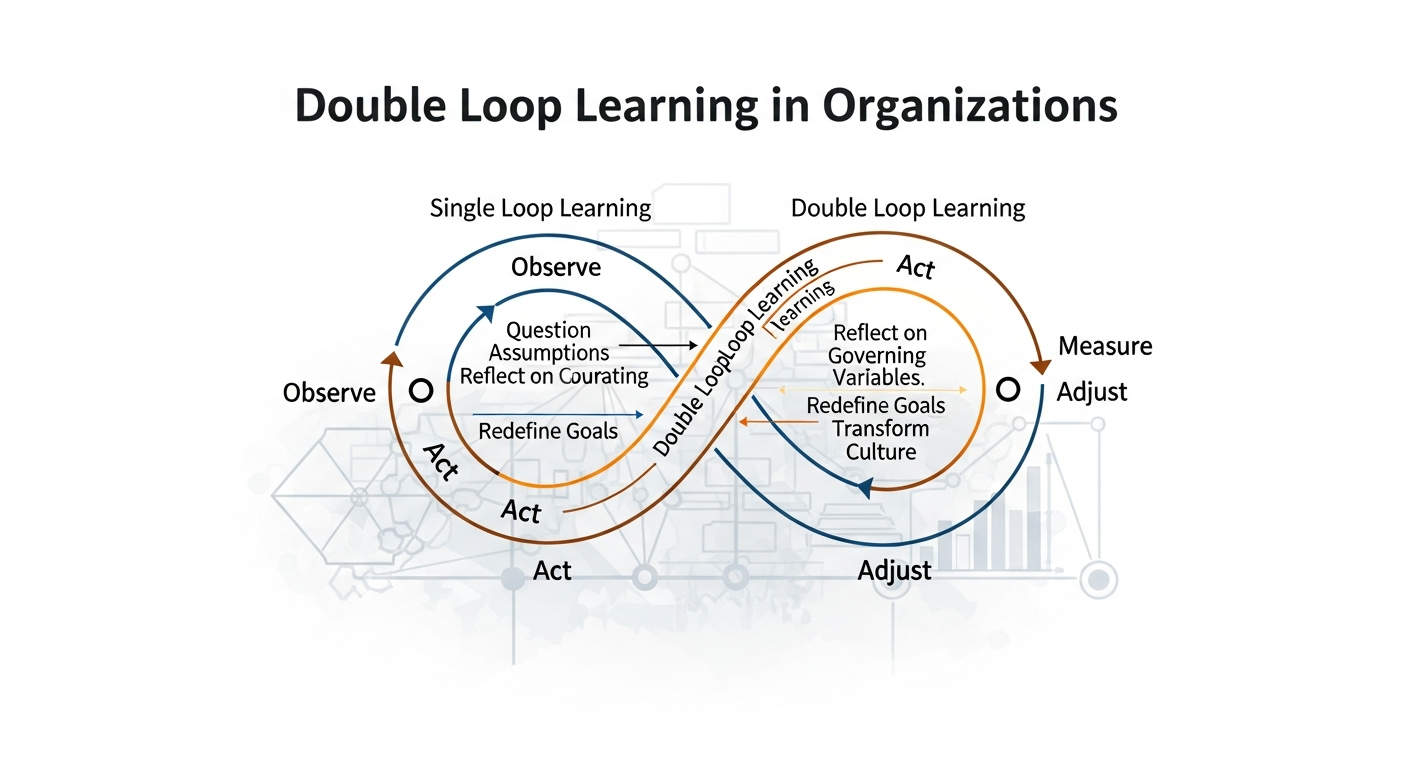
To grasp Double Loop Learning, it's helpful to first understand its counterpart: Single Loop Learning. Imagine a thermostat. When the room gets too cold, it turns on the heater. When it's too hot, it turns on the AC. This is Single Loop Learning—adjusting actions to correct deviations from a set norm, without questioning the norm itself. In an organizational context, this looks like:
- Identifying a problem (e.g., sales targets not met).
- Implementing a solution within existing frameworks (e.g., more sales calls, new script).
- Measuring the outcome and making further adjustments, still within the original strategy.
Single Loop Learning is valuable for routine problem-solving and efficiency, but it fails when the underlying assumptions or strategies are flawed. It won't help if your sales targets are unrealistic or if your product is fundamentally misaligned with market needs.
Double Loop Learning, by contrast, challenges the entire framework. It asks:
- Why are we doing things this way?
- Are our fundamental assumptions about our customers, market, or internal processes still valid?
- Should we change our goals, strategies, or even our organizational values?
Instead of just turning up the heat, the "thermostat" engaging in Double Loop Learning would ask: "Is this temperature setting still appropriate for our needs? Should we be in a different climate altogether?" For L&D, this means designing learning experiences that not only teach new skills but also foster critical reflection on existing mental models and organizational paradigms.
The Imperative for Double Loop Learning in Today's Dynamic Industries
The urgency for Double Loop Learning resonates deeply across diverse sectors. In Compliance, regulatory frameworks are constantly evolving, demanding a re-evaluation of not just adherence tactics but the very culture of integrity. In Banking, Finance, and Insurance, digital disruption and new risk profiles necessitate a fundamental rethink of customer engagement, security, and product development. Retail grapples with changing consumer behaviors and e-commerce dominance, requiring a paradigm shift in strategy, not just operational tweaks.
Pharma and Healthcare face rapid scientific advancements and ethical dilemmas that challenge established practices. Hospitality must reinvent experiences in response to global events and evolving guest expectations. Even in stable sectors like Oil and Gas and Mining, technological innovation, sustainability pressures, and market volatility demand organizations to question their long-held operational tenets and strategic directions. Double Loop Learning empowers these industries to not just survive but lead through profound transformation.
Implementing Double Loop Learning: Practical Strategies for L&D Leaders
Driving Double Loop Learning requires a deliberate, strategic approach from L&D leaders. It's about creating an environment where inquiry, dissent, and fundamental questioning are not just tolerated but encouraged.
1. Foster Psychological Safety and Open Dialogue
People will only challenge the status quo if they feel safe to do so. L&D can champion initiatives that build trust, encourage vulnerability, and create platforms for candid discussion without fear of retribution. This includes training leaders in facilitative communication and active listening.
2. Design Learning for Critical Reflection and Inquiry
Move beyond purely instructional content. Integrate case studies that highlight organizational failures resulting from unchallenged assumptions. Use Socratic questioning, simulations, and group exercises that force learners to explore underlying beliefs and decision-making processes. Modern learning platforms, such as a Microlearning LMS, can deliver bite-sized content that primes learners for reflection rather than just rote memorization.
3. Leverage Technology for Insight and Engagement
- Data Analytics: Utilize data from learning platforms and business operations to highlight discrepancies between espoused theories (what we say we believe) and theories-in-use (what we actually do).
- Interactive Platforms: A Gamified LMS can create low-stakes environments for experimentation and challenging assumptions, rewarding critical thinking and innovative solutions.
- Personalized Journeys: Implement Adaptive Learning paths that guide individuals through content designed to challenge their specific cognitive biases or departmental assumptions, rather than a one-size-fits-all approach.
- Content Creation: An AI Powered Authoring Tool can rapidly generate and refine learning scenarios that are highly contextual, helping teams explore "what-if" situations and question deeply held beliefs more effectively.
4. Embrace Risk-focused Training
In many industries, especially highly regulated ones, an inherent bias towards avoiding immediate risks can stifle innovation and prevent deeper learning. L&D must champion Risk-focused Training that teaches employees not just to mitigate existing risks, but to identify and critically evaluate the assumptions that generate new ones, promoting a culture of thoughtful experimentation rather than paralysis.
AI and the Future of Organizational Learning: Addressing Key Inquiries
The integration of advanced technologies, particularly artificial intelligence, is revolutionizing how organizations approach deep learning and strategic adaptation. L&D leaders frequently ponder how these innovations can accelerate their journey toward Double Loop Learning.
How can advanced digital intelligence aid in identifying deeply ingrained organizational assumptions?
Modern AI tools are adept at pattern recognition and anomaly detection within vast datasets. By analyzing communication patterns, project outcomes, customer feedback, and even employee sentiment, AI can highlight inconsistencies between stated goals and actual behaviors. For instance, an AI might flag that while a company espouses "customer-centricity," internal metrics heavily reward short-term sales over long-term customer satisfaction. This objective, data-driven insight can serve as a powerful catalyst for L&D to initiate Double Loop Learning discussions, prompting teams to question their operational models and underlying belief systems.
Are there specific industries or regions where embracing transformative learning cycles is particularly crucial?
While fundamental re-evaluation is universally beneficial, its criticality is amplified in industries characterized by high velocity, high risk, or intense global competition. Financial services, pharmaceutical research, cybersecurity, and advanced manufacturing are prime examples where a failure to question foundational assumptions can lead to catastrophic consequences or rapid obsolescence. Geographically, markets experiencing rapid technological adoption or significant political and economic shifts—like emerging economies or highly interconnected global hubs—also necessitate organizations to engage in deep learning to remain relevant and competitive. The ability to quickly pivot based on a re-evaluation of the market's fundamental structure becomes a key differentiator.
What advanced techniques can organizations leverage to optimize the shift from reactive adjustments to proactive, foundational re-evaluation?
Beyond traditional methods, organizations can employ AI-driven simulations and predictive analytics to create "what-if" scenarios that challenge existing assumptions without real-world risk. AI can model the long-term impact of current strategies, revealing potential future failures if underlying paradigms remain unchallenged. Furthermore, AI-powered conversational agents can facilitate reflective practices, prompting learners with critical questions and guiding them through a process of self-assessment regarding their mental models. This intelligent scaffolding helps individuals and teams move beyond superficial problem-solving to genuinely question their core beliefs and design more robust, future-proof strategies.
The Benefits: Why L&D Leaders Should Prioritize Double Loop Learning
Embracing Double Loop Learning is not merely an academic exercise; it yields tangible, transformative benefits for organizations:
- Enhanced Problem-Solving: Organizations move from addressing symptoms to resolving root causes, leading to more sustainable solutions.
- Increased Innovation and Adaptability: By constantly questioning and reinventing, organizations become inherently more agile and capable of generating breakthrough ideas.
- Stronger Organizational Culture: Fosters a culture of critical thinking, continuous improvement, and psychological safety, where learning is valued at all levels.
- Better Decision-Making: Decisions are based on current realities and validated assumptions, leading to more strategic and effective outcomes.
- Sustainable Competitive Advantage: Organizations that learn how to learn—at a fundamental level—are better equipped to outmaneuver competitors and secure long-term success.
Conclusion
For L&D leaders operating in today's complex business environment, fostering Double Loop Learning is no longer a luxury but a necessity. It is the engine that drives true organizational agility, resilience, and innovation. By strategically designing learning experiences that encourage deep reflection, leverage advanced technologies, and cultivate a culture of courageous inquiry, L&D can empower their organizations to not just navigate change, but to proactively shape their future. The journey from single-loop adjustments to double-loop transformation is challenging, but the rewards—a truly learning-agile and future-ready organization—are immeasurable.
.jpg)


