

Mastering Organizational Agility: The Power of the Double Loop Learning Diagram for L&D Leaders
In today's hyper-competitive and rapidly evolving business landscape, the ability to adapt, innovate, and continuously improve is paramount. For Vice Presidents, Directors, and Senior Managers in Learning & Development across sectors like Compliance, Sales, Banking, Finance, Insurance, Retail, Pharma, Healthcare, Hospitality, Oil & Gas, and Mining, the challenge isn't just delivering training; it's about fostering profound, sustainable organizational change. This is where the Adaptive Learning framework of the Double Loop Learning Diagram becomes an indispensable tool.
As L&D leaders, you're tasked with equipping your workforce not just with new skills, but with the mindset to question, challenge, and fundamentally rethink existing approaches. Single loop learning, while useful for incremental adjustments, often falls short in driving the transformative shifts necessary for long-term success. Double loop learning, however, offers a robust framework for examining the underlying assumptions that shape our actions, paving the way for true innovation and resilience.
Understanding the Fundamentals: Beyond Surface-Level Adjustments
To appreciate the power of double loop learning, it's essential to first differentiate it from its simpler counterpart.
Single Loop vs. Double Loop Learning: A Critical Distinction
- Single Loop Learning: This type of learning focuses on identifying and correcting errors within existing frameworks, rules, and procedures. Think of a thermostat. When the room gets too cold, it turns on the heater. The thermostat doesn't question *why* the room got cold, or if turning on the heater is the most efficient long-term solution. It simply acts to bring the system back to its desired state by adjusting its actions within its predefined operating parameters. In L&D, this might look like refining a sales training module because sales numbers dipped, without questioning the entire sales strategy or the market assumptions.
- Double Loop Learning: This goes a step further. It involves questioning the fundamental assumptions, values, and policies that guide actions. It's about asking "why did we make this error in the first place?" and "are our underlying beliefs still valid?" In the thermostat analogy, double loop learning would be asking if the desired temperature setting is appropriate for the current season, if the insulation is adequate, or if the energy source is sustainable. For L&D, this means examining whether the entire sales methodology is outdated, if the product positioning is still relevant, or if the market has shifted dramatically, necessitating a complete overhaul of the training philosophy and content.
The Double Loop Learning Diagram Explained
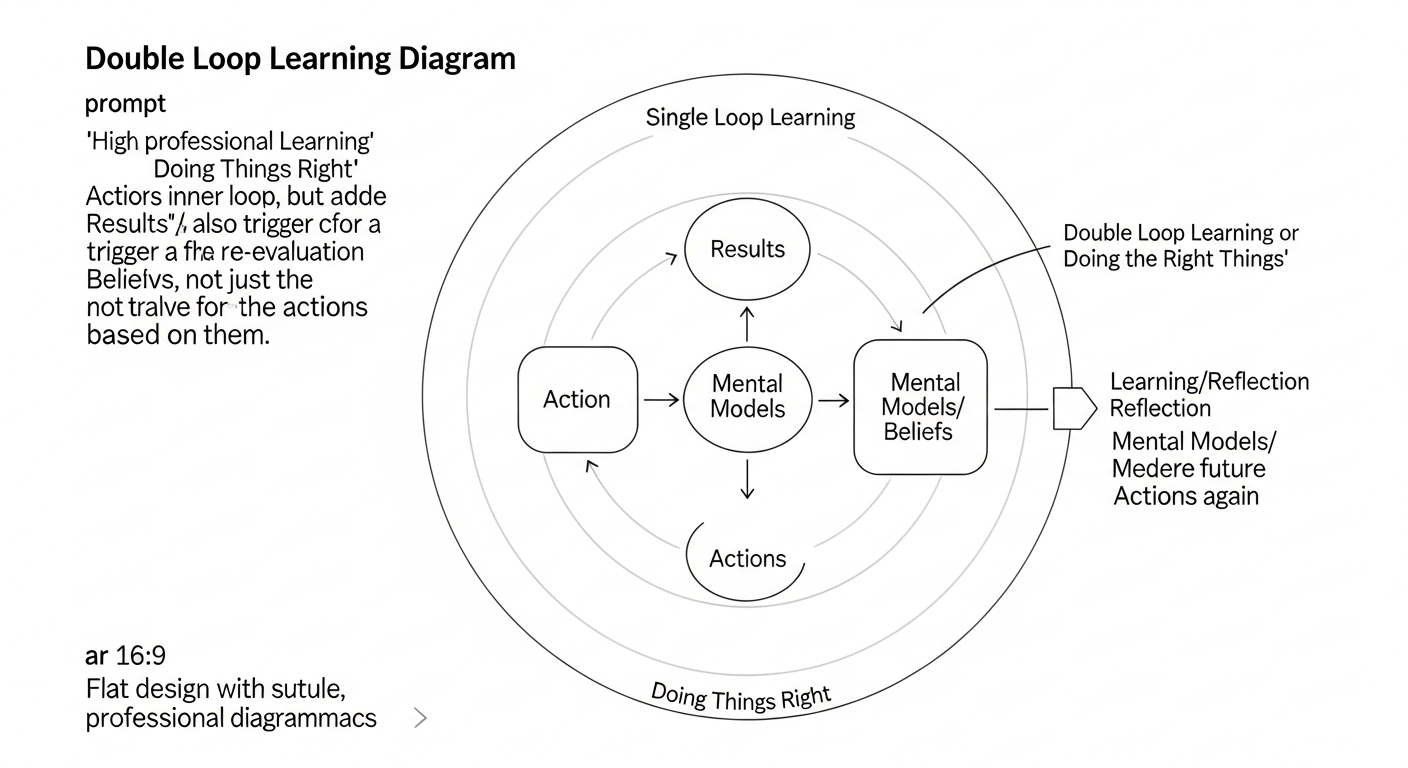
The diagram illustrates a continuous cycle:
- Actions/Outcomes: This is the observable behavior and its immediate results.
- Governing Variables/Mental Models: These are the rules, policies, and strategies that dictate actions. Single loop learning operates by adjusting actions to align with these variables.
- Values/Assumptions/Beliefs: These are the deeper, often unspoken, principles and theories that underpin the governing variables. Double loop learning challenges these foundational elements.
The process involves identifying a problem (an outcome), examining the actions that led to it, then scrutinizing the governing variables that prompted those actions. Crucially, double loop learning pushes us to question the underlying values and assumptions from which those governing variables arose. By critically assessing these foundational beliefs, L&D leaders can facilitate profound shifts in strategy and behavior, leading to more effective and sustainable solutions.
Why Double Loop Learning is Crucial for L&D Leaders
For L&D professionals in demanding industries, embracing this deeper level of learning offers significant advantages:
- Enhanced Adaptability: In sectors like Banking and Finance, where regulations and market dynamics change constantly, the ability to question and adapt core strategies is critical. Double loop learning fosters organizational agility.
- Fostering Innovation: By challenging assumptions, teams are encouraged to think creatively and develop novel solutions, essential in Pharma and Healthcare for drug discovery or patient care models.
- Strategic Impact: L&D moves beyond being a cost center to a strategic partner, driving profound organizational transformation rather than just skill transfer.
- Root Cause Resolution: Instead of merely patching symptoms, L&D can help identify and address the fundamental issues causing performance gaps or compliance breaches, vital in Compliance and Oil & Gas.
Implementing Double Loop Learning in Your Organization
Translating this theoretical framework into practical application requires deliberate effort and the right tools.
Practical Steps for L&D Teams
- Cultivate a Culture of Inquiry: Encourage critical questioning and create safe spaces for challenging established norms without fear of retribution.
- Facilitate Reflective Dialogue: Design training and development programs that include exercises for introspection, group discussions, and peer coaching focused on examining underlying assumptions.
- Embrace Experimentation: Support pilot programs and initiatives where new approaches can be tested and evaluated, providing data for reflection.
- Leader as Facilitator: Train managers and leaders to guide their teams through double loop learning processes, helping them surface and question their mental models.
Leveraging Modern Learning Technology
Advanced learning platforms are no longer just content delivery systems; they are powerful enablers of double loop learning:
- A robust Microlearning LMS can deliver iterative content and quick feedback loops, allowing organizations to test new ideas and gather data on their effectiveness rapidly. This agility supports constant reassessment of training strategies and underlying assumptions.
- Gamified LMS features can encourage experimentation and risk-taking in a safe environment, where learners can try out new behaviors and challenge old ways of thinking without real-world consequences, fostering a mindset of continuous improvement.
- An AI Powered Authoring Tool can analyze learning data to identify patterns, highlight areas where assumptions might be hindering performance, and suggest content revisions that address deeper issues rather than just surface-level skills gaps. This analytical power is crucial for identifying when a 'single loop' fix isn't enough.
- Implementing Risk-focused Training through these platforms can compel employees in high-stakes industries like Compliance, Insurance, or Mining to critically examine their protocols, not just follow them. This leads to a deeper understanding of 'why' certain risks exist and 'how' underlying assumptions contribute to them.
Unlocking Deeper Insights with Intelligent Systems: AI-Related Questions
As L&D professionals navigate complex organizational challenges, leveraging advanced analytical capabilities becomes critical for double loop learning. Consider how intelligent systems can support your strategic initiatives:
Question: How can intelligent systems help my team uncover deeper learning insights and question existing training paradigms?
Answer: Intelligent analytics can sift through vast datasets of learner performance, engagement, and business outcomes. By identifying subtle correlations and anomalies that human analysis might miss, these systems can highlight not just *what* isn't working, but potentially *why*—pointing towards underlying assumptions in content design, delivery methods, or even strategic learning objectives. This data-driven perspective empowers L&D leaders to move beyond incremental adjustments and challenge foundational beliefs about learning effectiveness and organizational capabilities.
Question: What are the best approaches for fostering a learning culture across diverse international teams, promoting a consistent questioning of norms?
Answer: For globally distributed teams, intelligent platforms facilitate consistent learning experiences while adapting to regional nuances. Best practices include employing adaptive content delivery that respects cultural contexts, providing collaborative spaces for cross-geographical knowledge sharing, and leveraging analytics to identify common conceptual roadblocks or ingrained behaviors across different regions. This helps pinpoint universal assumptions that might need re-evaluation, fostering a cohesive yet critically thinking global workforce.
Question: How can advanced analytics pinpoint the fundamental causes of performance gaps in our training programs, rather than just identifying symptoms?
Answer: Advanced analytics moves beyond simple pass/fail rates. It correlates learning outcomes with real-world business performance, identifying where specific training modules or methodologies fail to translate into desired behavioral changes or business results. By dissecting complex learner journeys and post-training impact, these systems can reveal if the performance gap stems from inadequate skill transfer (single loop) or from a deeper misalignment between training objectives and organizational values/strategic goals (double loop). This allows L&D to address the root systemic issues that hinder true performance improvement.
Conclusion: The Path to True Organizational Transformation
The Double Loop Learning Diagram is more than just a theoretical model; it's a strategic imperative for L&D leaders committed to driving profound organizational change. By moving beyond surface-level fixes and delving into the fundamental assumptions that shape your organization's actions, you empower your teams to not just react to change, but to proactively shape their future.
In industries grappling with rapid disruption – from the regulatory complexities of Finance and Insurance to the operational efficiencies demanded in Retail and Hospitality – the ability to continually question and reinvent is the ultimate competitive advantage. Embrace double loop learning, equip your L&D teams with the right mindset and technological tools, and lead your organization towards a future of continuous innovation and sustained success.
.jpg)


