

Win-Win Gamification: Designing Non-Toxic Leaderboards That Build Team Spirit
In today's fast-paced corporate environment, particularly across industries like Sales, Banking, Finance, Insurance, Retail, Pharma, and Healthcare, the drive for continuous employee development is paramount. Learning and Development (L&D) leaders – from VPs to senior managers – are constantly seeking innovative strategies to engage teams, boost performance, and cultivate a positive organizational culture. Gamification has emerged as a powerful tool in this endeavor, promising increased motivation and engagement. However, its implementation, especially concerning leaderboards, often walks a fine line between healthy competition and detrimental toxicity.
The goal of true gamification in an eLearning context isn't merely to rank individuals but to foster a thriving learning ecosystem. This article explores how L&D professionals can design "win-win" gamified experiences and non-toxic leaderboards that genuinely build team spirit, enhance skill acquisition, and drive collective success, supported by robust platforms like a modern Microlearning LMS.
The Promise and Peril of Gamification in L&D
Gamification, when applied thoughtfully, can transform mundane training into an exciting journey. It taps into innate human desires for achievement, recognition, and mastery. A well-designed gamified learning management system can significantly improve learner engagement, knowledge retention, and skill application. Imagine a sales team leveraging a Gamified LMS for product knowledge training, or a compliance department using it to make critical regulatory updates more engaging. The potential for positive impact is enormous.
The Toxic Trap: When Leaderboards Go Wrong
Unfortunately, many leaderboards fall into common traps, inadvertently sowing seeds of negativity:
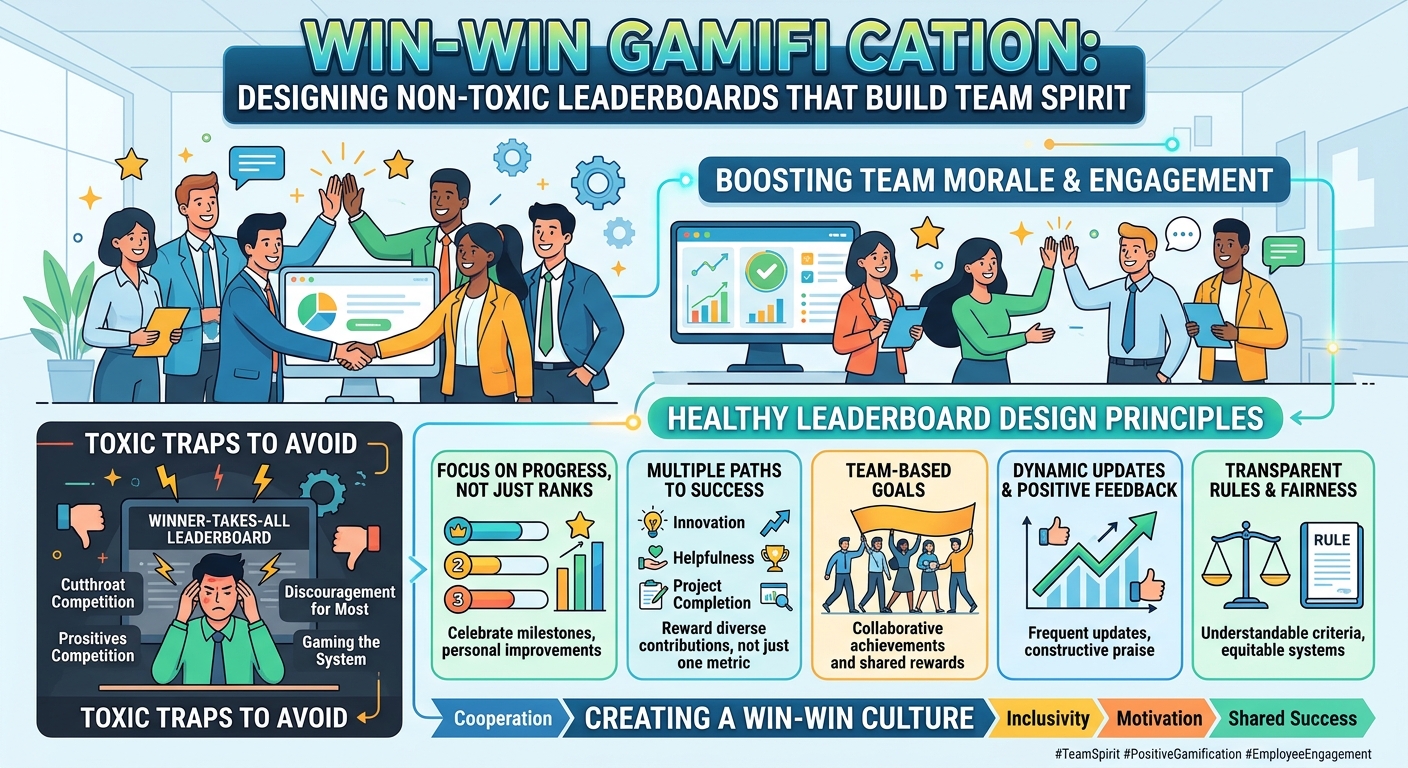
- Exclusivity: Only the top few are recognized, demotivating the majority.
- Unfair Metrics: Ranking based on easily manipulated or irrelevant criteria.
- Solo Focus: Encouraging individualistic behavior at the expense of collaboration.
- Performance Anxiety: Creating undue pressure and stress, leading to burnout or disengagement.
- Stagnation: Once someone falls behind, they give up, seeing no path to improvement.
For organizations in sectors like Oil and Gas, Mining, or Hospitality, where teamwork and safety are critical, a poorly designed leaderboard can undermine foundational values. The key is to shift from a zero-sum game where only one can win, to an environment where everyone can achieve, contribute, and feel valued.
Pillars of Win-Win Gamification: Crafting Non-Toxic Leaderboards
Designing a leaderboard that promotes team spirit requires a strategic approach. Here are key pillars for L&D leaders:
1. Clear Goals and Purpose
Every gamified element, especially leaderboards, must align with clear learning objectives and business outcomes. What skills are we trying to build? What behaviors are we encouraging? In Compliance training, for instance, the goal might be 100% understanding of new regulations, not just who finishes fastest. This focus ensures that competition serves a greater purpose.
2. Focus on Progress, Not Just Position
Instead of merely displaying top performers, highlight individual and team progress.
- Personal Milestones: Reward learners for completing modules, achieving specific scores, or mastering new concepts.
- Growth Metrics: Show how much a learner has improved over time or compared to their own past performance. This is particularly effective with Adaptive Learning paths that cater to individual needs.
- Tiered Recognition: Create multiple "tiers" or "leagues" that learners can advance through, ensuring more individuals experience the thrill of leveling up.
3. Collaborative Challenges
Shift the competitive focus from individuals against individuals to teams against challenges, or even teams against other teams.
- Team Quests: Assign group projects or challenges where collective effort contributes to a shared score or unlocks team rewards.
- Shared Goals: Set a departmental or organizational goal (e.g., "Achieve 90% completion rate for mandatory training by month-end") and use the leaderboard to track collective progress.
- Peer Support: Integrate features where learners can earn points by helping others, answering questions, or sharing insights.
4. Multi-Dimensional Recognition
Recognize more than just speed or accuracy. A holistic learning content management system should allow for varied recognition:
- Effort & Engagement: Acknowledge active participation, discussion contributions, and consistent login.
- Quality Contributions: Reward learners who provide valuable feedback, create useful resources, or mentor peers.
- Skill Diversity: Celebrate mastery in different skill sets, not just the "most learned."
- Non-Monetary Rewards: Badges, virtual trophies, shout-outs, and opportunities for professional development can be highly motivating.
5. Timely and Actionable Feedback
Leaderboards should be feedback mechanisms, not just scoreboards. When a learner sees their position, they should also understand *why* they are there and *how* they can improve. This can be facilitated by an AI Powered Authoring Tool that helps create dynamic feedback loops.
AI's Role in Crafting Empathetic Leaderboards
Artificial intelligence offers groundbreaking possibilities for making gamification more personal, effective, and less toxic. L&D leaders should consider how intelligent systems can enhance their strategies.
Q: How can artificial intelligence help in designing more inclusive learning experiences that cater to diverse learner needs and preferences?
A: AI can analyze individual learning styles, prior knowledge, and performance patterns to tailor content and challenges. For leaderboards, this means AI can dynamically adjust difficulty, suggest personalized improvement paths, and highlight different forms of achievement relevant to each learner. This moves beyond a one-size-fits-all ranking, ensuring that all participants feel seen and supported, regardless of their starting point or specific strengths.
Q: Can intelligent systems personalize gamified learning for a globally dispersed workforce, considering cultural nuances and varied access to resources?
A: Absolutely. AI can adapt gamification mechanics to different cultural contexts, recommend content in native languages, and even adjust challenge timings to accommodate various time zones. For leaderboards, AI can segment teams by region, project, or department, enabling healthy competition within relevant groups, rather than an overwhelming global comparison. This ensures that a cloud based learning management system serves all employees effectively, from those in bustling financial centers to remote mining sites.
Q: What role does AI play in optimizing individual learning paths within a competitive framework, ensuring personal growth alongside team success?
A: AI is crucial for individual optimization. It can identify skill gaps, recommend specific microlearning modules, and even predict potential areas of struggle. Within a gamified context, AI can provide individual coaching, nudges, and personalized challenges that contribute to both personal mastery and team objectives. This means the system continuously works to elevate everyone's capability, turning competition into a catalyst for collective improvement.
Implementing Win-Win Leaderboards with a Modern Learning Platform
To successfully implement these strategies, L&D departments require a robust enterprise learning management solution. A modern LMS (Learning content management system) like MaxLearn LMS offers the features necessary to build engaging, non-toxic gamified experiences. Look for a learning management software that supports:
- Configurable leaderboard metrics (e.g., completion rates, participation, quality scores, collaborative points).
- Team-based challenges and tracking.
- Rich recognition systems (badges, points, levels, virtual rewards).
- Integration with an LMS learning management system for seamless tracking of learning progress.
- Analytics that provide insights into engagement, progress, and areas for improvement, helping L&D teams refine their gamification strategies.
- Specialized features for sectors requiring Risk-focused Training, ensuring compliance and safety remain top priorities.
Whether you're in Banking, Pharma, or Retail, a comprehensive learning management solutions platform equipped with powerful gamification tools can be a game-changer for fostering skill development and team cohesion. An LCMS with these capabilities ensures that content creation, delivery, and tracking are all aligned with your win-win gamification goals.
Conclusion: Elevate Performance, Foster Connection
The transition from traditional, often demoralizing, leaderboards to dynamic, non-toxic versions is a strategic imperative for L&D leaders. By focusing on progress, collaboration, multi-dimensional recognition, and leveraging the power of AI, organizations can create gamified learning experiences that truly build team spirit, enhance skills, and drive business success across all industries. A forward-thinking learning management system, especially one designed for microlearning and intelligent adaptability, empowers L&D professionals to design a future where competition elevates everyone, fostering a culture of continuous learning and collective achievement.


