

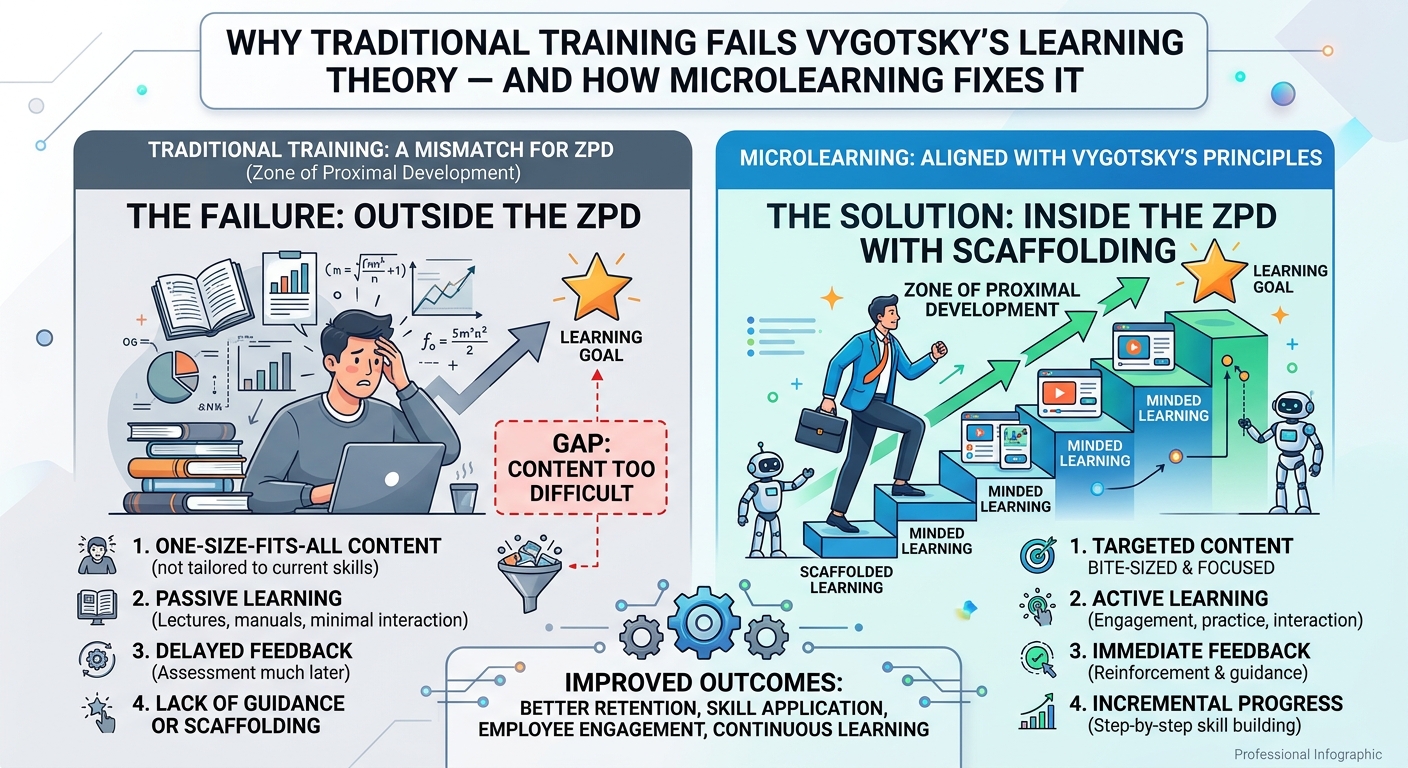
Bridging the Learning Gap: Why Traditional Training Fails Vygotsky—and How Microlearning Delivers
In the dynamic landscape of corporate learning and development, the quest for effective training solutions is perpetual. L&D leaders strive to cultivate skilled, knowledgeable, and adaptable workforces. Yet, many traditional training methodologies fall short, leaving employees disengaged and knowledge retention low. To understand why, we can turn to the foundational insights of a pioneering psychologist: Lev Vygotsky. His sociocultural theory of learning offers a profound lens through which to examine these shortcomings and, crucially, illuminates a path forward through modern solutions like a Microlearning LMS.
Understanding Vygotsky's Sociocultural Theory of Learning
Lev Vygotsky, a Soviet psychologist, proposed that learning is not a solitary endeavor but a deeply social and cultural process. His theory centers on several key concepts:
- Zone of Proximal Development (ZPD): The sweet spot where a learner can't quite perform a task independently but can with guidance from a more knowledgeable individual.
- More Knowledgeable Other (MKO): Anyone, typically an expert or a peer, who has a better understanding or higher ability level than the learner regarding a particular task or concept.
- Social Interaction: The bedrock of learning, where knowledge is co-constructed through dialogue and collaboration.
- Cultural Tools: Language, symbols, and technologies that mediate thinking and learning.
For Vygotsky, effective learning occurs when individuals are actively engaged in social interactions, guided by MKOs within their ZPD, and utilizing cultural tools to internalize new concepts. This framework highlights the critical role of context, collaboration, and tailored support in truly transformative learning experiences.
The Inherent Flaws of Traditional Training
Given Vygotsky’s insights, it becomes clear why conventional training often falters. Traditional methods, characterized by lengthy classroom sessions, generic content, and infrequent assessments, struggle to meet these core principles:
- Ignoring the ZPD: One-size-fits-all training bombards learners with information they may already know or, more commonly, material that is far beyond their current capabilities, leading to disengagement or overwhelm.
- Lack of Meaningful Social Interaction: While traditional settings might have group activities, they often lack sustained, structured peer-to-peer or mentor-mentee interaction critical for co-constructing knowledge.
- Absence of MKOs in Real-Time: Expertise is often delivered in a lecture format, without the opportunity for immediate, tailored guidance when a learner is struggling within their ZPD.
- Decontextualized Learning: Generic scenarios fail to replicate the complex, real-world challenges faced by employees in their daily roles.
- Passive Reception Over Active Construction: Learners are often passive recipients of information, rather than active participants in the learning process, stifling deeper understanding and retention.
The result? A significant gap between training delivery and actual application, leading to wasted resources and unfulfilled potential. This is where a modern learning management system comes into play.
Microlearning: The Vygotskian Answer for Modern Enterprises
Enter microlearning—a pedagogical approach delivering content in small, digestible chunks, typically 3-7 minutes in duration, focused on a single learning objective. This isn't just a trend; it's a strategically aligned solution to Vygotsky's theory.
How Microlearning Aligns with Vygotsky’s Principles:
- Pinpointing the ZPD with Precision: Microlearning allows for highly targeted content. An Adaptive Learning approach, often integrated into a sophisticated LMS, can identify specific skill gaps and deliver only the relevant micro-content, effectively operating within each learner's ZPD. This ensures a professional learns about a new product feature just before a client meeting, or a healthcare worker refreshes a specific procedure.
- Leveraging the MKO Through Expert Content and Curation: Each micro-lesson can be crafted by an MKO (subject matter expert) and delivered with clarity. Furthermore, peer-to-peer learning and discussion forums within a learning content management system or enterprise learning management platform facilitate direct interaction with MKOs, whether they are instructors, senior colleagues, or even AI-driven intelligent tutors.
- Fostering Social Interaction and Collaboration: Modern lms learning management system solutions, especially those featuring Gamified LMS elements, encourage social learning through leaderboards, challenges, and collaborative projects. Microlearning modules can be followed by quick discussion prompts, peer review tasks, or scenario-based simulations, stimulating dialogue and knowledge sharing.
- Integrating Cultural Tools and Context: Microlearning excels at providing contextually relevant information. A short video demonstrating a specific compliance procedure, an interactive module on a new financial regulation, or a checklist for hotel check-ins serves as a "cultural tool" that is immediately applicable and integrated into the learner's workflow. This makes the learning highly practical and impactful, especially for Risk-focused Training.
The Power of a Modern Microlearning Ecosystem
Implementing microlearning effectively requires a robust technological backbone. A sophisticated MaxLearn LMS provides the infrastructure to deliver, manage, and track these bite-sized learning experiences. This type of cloud based learning management system goes beyond simple content delivery:
- It facilitates the creation of engaging content through an AI Powered Authoring Tool, enabling L&D teams to rapidly develop relevant and interactive modules.
- It offers powerful analytics to identify learning gaps and personalize pathways, embodying the spirit of the ZPD on a grand scale.
- It supports social features, leaderboards, and certifications, fostering a vibrant learning community that enhances social interaction.
- It ensures content is easily accessible anytime, anywhere, transforming learning into an ongoing, integrated part of work rather than a separate event.
Intelligent Learning for Global Workforces: Addressing Key Questions
How does smart technology elevate learning experiences for a diverse, globally distributed workforce?
Intelligent automation, often embedded within a learning management software, plays a pivotal role. It dynamically tailors learning paths based on individual performance, role, and even cultural context. For instance, a system might recommend specific micro-modules on regional compliance variations for an employee in a particular country, or offer advanced training to those who master basic concepts quickly. This personalization ensures each learner operates within their optimal growth zone, regardless of location or prior knowledge.
In what ways does an advanced learning system ensure content is relevant to employees across different geographic locations?
Modern learning management solutions leverage sophisticated content tagging and delivery. This allows L&D teams to create foundational micro-content and then adapt or localize it with region-specific examples, language variations, or legal frameworks. An insurance company, for example, can deliver core product training globally, but supplement it with country-specific regulatory updates as micro-lessons, ensuring complete relevance for every learner. This capability is crucial for multinational organizations.
How does automated intelligence improve the overall efficiency and impact of corporate education initiatives?
Automated intelligence significantly streamlines the entire learning lifecycle. From identifying training needs through skill gap analysis to recommending relevant content, automating assessment grading, and providing real-time feedback, it enhances efficiency. For L&D professionals, this means less time on administrative tasks and more time on strategic planning, content refinement, and fostering a culture of continuous learning. It transforms the LCMS into a proactive partner in talent development, ensuring a higher return on investment for training efforts.
Conclusion
Vygotsky's learning theory, with its emphasis on social interaction, individualized support within the ZPD, and the role of cultural tools, provides a timeless blueprint for effective education. Traditional corporate training models frequently contravene these fundamental principles, leading to suboptimal outcomes. Microlearning, powered by a sophisticated MaxLearn LMS, offers a compelling solution. By delivering targeted, contextualized, and interactive content in bite-sized formats, it naturally aligns with Vygotsky's vision, creating a more engaging, efficient, and ultimately, more impactful learning experience for today's dynamic workforce across all industries. Embrace microlearning to unlock your team's full potential and build a truly knowledgeable enterprise.


