

```html
Why Is Bite-Sized Learning More Effective Than Traditional Seminars for Sales Teams?
In the dynamic world of sales, continuous learning is not just an advantage; it's a necessity. Sales professionals must constantly adapt to new products, market trends, evolving customer needs, and sophisticated sales methodologies. Yet, many organizations still rely on traditional, extensive seminars that demand significant time away from the field. For L&D Vice Presidents, Directors, and Managers across industries like Compliance, Banking, Finance, Insurance, Retail, Pharma, Healthcare, Hospitality, Oil and Gas, and Mining, the challenge is clear: how to deliver impactful training that sticks, without disrupting sales momentum. How can organizations ensure sales teams remain competitive with evolving product knowledge and market demands? The answer often lies in shifting from marathon training sessions to the agile, impactful approach of bite-sized learning.
The Cracks in the Traditional Seminar Foundation
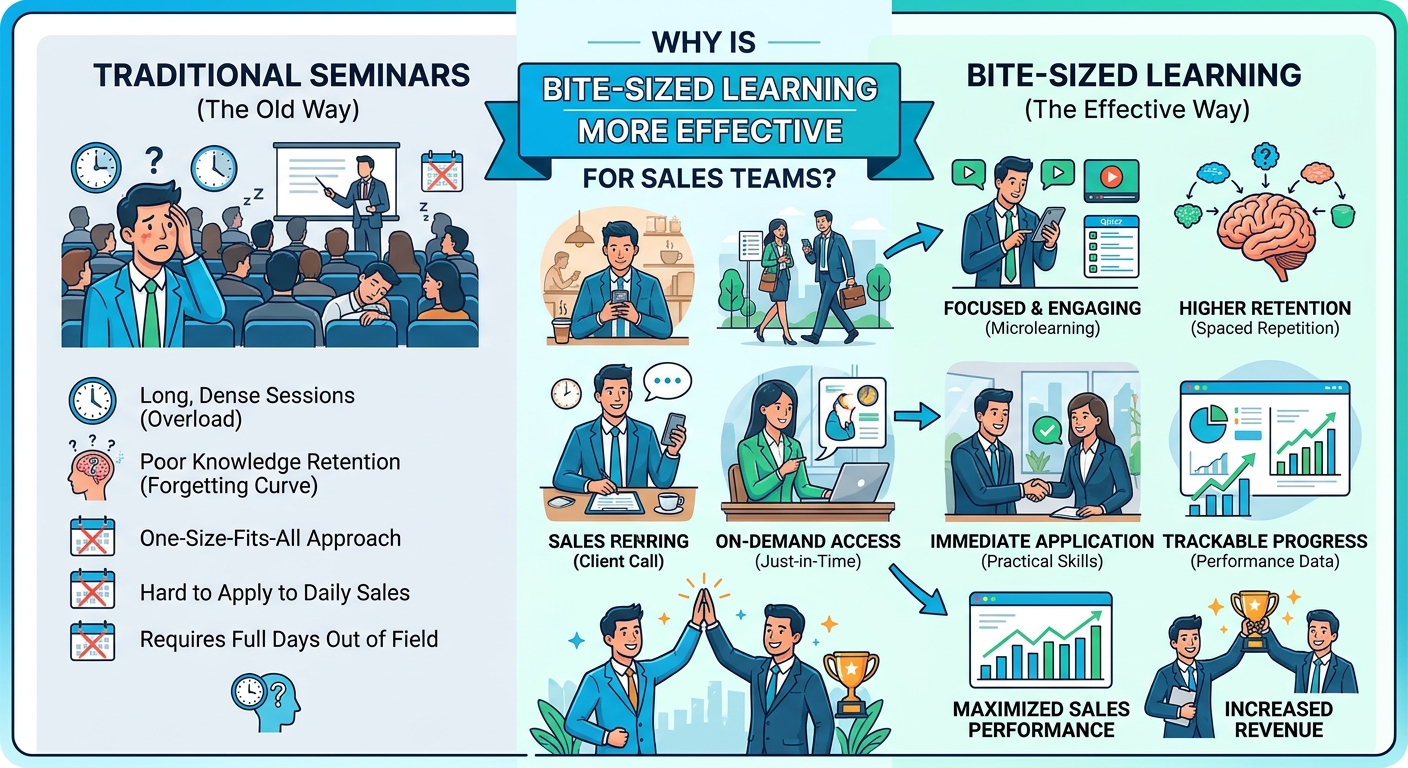
Traditional sales seminars, often spanning full days or even weeks, come with a litany of well-documented drawbacks:
- Information Overload: Cramming vast amounts of information into a short period leads to cognitive overload. Sales professionals are bombarded, struggling to process and retain everything.
- Poor Retention Rates: The "forgetting curve" is a harsh reality. Without immediate application and reinforcement, much of what's learned in a seminar is forgotten within days.
- Time Away from Selling: Every hour spent in a seminar is an hour not spent engaging with prospects, closing deals, or generating revenue. This opportunity cost is significant for sales teams.
- Lack of Personalization: One-size-fits-all training rarely addresses the specific skill gaps or individual learning styles of diverse sales professionals.
- Logistical Hurdles: Coordinating schedules, travel, and venue costs for large groups adds layers of complexity and expense.
Why do traditional long-form training sessions often fail to deliver lasting results for sales professionals? They frequently overlook the brain's natural capacity for processing new information and the practical demands of a sales role, leading to disengagement and rapid knowledge decay.
Embracing the Power of Bite-Sized Learning
Bite-sized learning, also known as microlearning, delivers content in short, focused bursts—typically 3-10 minutes long. These modules are designed to address a single learning objective, making them highly consumable and effective. This approach offers a compelling alternative to conventional training for numerous reasons.
Improved Retention and Recall
The human brain is better equipped to process and retain information in smaller chunks. Bite-sized modules prevent cognitive overload, allowing learners to fully grasp one concept before moving to the next. This segmented approach reinforces learning and improves long-term recall, making the training more effective. What is the most effective way to deliver complex sales information to busy professionals? By breaking it down into concise, self-contained modules that can be consumed quickly and on-demand.
Flexibility and Accessibility
Sales professionals are often on the go. Bite-sized learning thrives in a mobile-first environment, allowing access to training modules anytime, anywhere—during downtime between meetings, while commuting, or even during a quick break. This on-demand accessibility ensures that learning fits seamlessly into their busy schedules, rather than disrupting them.
Relevance and Personalization
With an advanced Microlearning LMS, learning paths can be tailored to individual needs, roles, or product lines. A new sales rep might need foundational product knowledge, while a veteran might need a refresher on a specific compliance regulation or a new CRM feature. This targeted approach ensures that every learner receives content directly relevant to their immediate needs, eliminating wasted time on irrelevant topics.
Immediate Application and Performance Support
Bite-sized content is often designed for immediate application. A module on handling a specific objection or demonstrating a new product feature can be accessed just before a client meeting, serving as instant performance support. This just-in-time learning reinforces skills exactly when they are needed, translating directly to improved sales interactions and outcomes.
Enhanced Engagement through Gamification
Short, engaging modules are often paired with gamification elements like quizzes, points, badges, and leaderboards. A Gamified LMS transforms learning into an interactive and competitive experience, boosting motivation and completion rates. This approach makes learning fun and encourages continuous engagement, which is crucial for sales teams.
Tangible Benefits for Sales Teams and Organizations
Adopting a bite-sized learning strategy delivers measurable benefits across the board:
- Faster Onboarding: New sales hires can quickly get up to speed on products, processes, and sales techniques through digestible modules, accelerating their time to productivity.
- Continuous Skill Development: Sales professionals can continuously hone their skills, learn about new product features, or refine their closing techniques without major interruptions to their selling activities.
- Increased Knowledge Retention: The spaced repetition inherent in microlearning significantly improves long-term retention compared to traditional methods.
- Improved Sales Performance: Better-trained, more confident sales teams naturally perform better, leading to increased conversions, higher average deal sizes, and improved customer satisfaction. How can training directly contribute to improved sales metrics and revenue generation? By providing timely, relevant, and easily digestible knowledge that can be immediately applied in real-world sales scenarios.
- Better ROI on Training: Reduced time away from the field, lower logistical costs, and higher engagement translate into a superior return on investment for L&D budgets.
- Effective Compliance and Risk-focused Training: For industries like Banking, Finance, Insurance, and Pharma, delivering critical compliance information in bite-sized, reinforced modules ensures understanding and adherence, significantly mitigating risks.
Leveraging Technology for a Seamless Learning Experience
The effectiveness of bite-sized learning is amplified by the right technology. A robust LMS (Learning Management System) is the backbone, providing a centralized platform for content delivery, learner tracking, and performance analytics. Modern learning management software goes beyond basic content delivery, offering sophisticated features that cater specifically to the needs of dynamic sales organizations.
An enterprise learning management system needs to be intuitive and powerful. Look for a cloud based learning management system that offers a comprehensive Learning content management system (LCMS) for easy content creation and organization. The best learning management solutions integrate seamlessly with existing CRM systems and provide insightful reporting. MaxLearn LMS, for example, is built with these principles in mind.
What technological solutions are available to implement highly effective, scalable sales training programs? Modern learning management systems offer a suite of features including mobile access, AI-driven personalization, gamification, and robust content authoring tools.
Consider features like:
- Adaptive Learning Paths: Utilizing AI to personalize content delivery based on a learner's progress, performance, and role.
- AI Powered Authoring Tool: Streamlining the creation of engaging, relevant bite-sized content, even for non-technical L&D professionals. This significantly reduces the time and resources required to develop high-quality training materials.
- Analytics and Reporting: Providing L&D leaders with insights into engagement, completion rates, and knowledge gaps, allowing for continuous optimization of training programs.
Conclusion: The Future of Sales Training is Bite-Sized
For L&D professionals seeking to empower their sales teams and drive tangible business results, the case for bite-sized learning is compelling. It addresses the inherent limitations of traditional seminars by aligning training with how people learn best and how sales professionals work. By embracing microlearning, organizations can foster a culture of continuous learning, ensure immediate knowledge application, and significantly boost sales performance across all segments and industries.
What strategic steps can L&D leaders take to transform their sales training landscape? By evaluating and implementing a modern lms learning management system designed for microlearning and adaptive content delivery, they can unlock unparalleled effectiveness and ROI for their sales training initiatives.
Investing in a sophisticated learning management system that supports a microlearning strategy is not just an upgrade to your training program; it's a strategic move to future-proof your sales force and ensure they remain agile, knowledgeable, and effective in an ever-changing market.
```


