

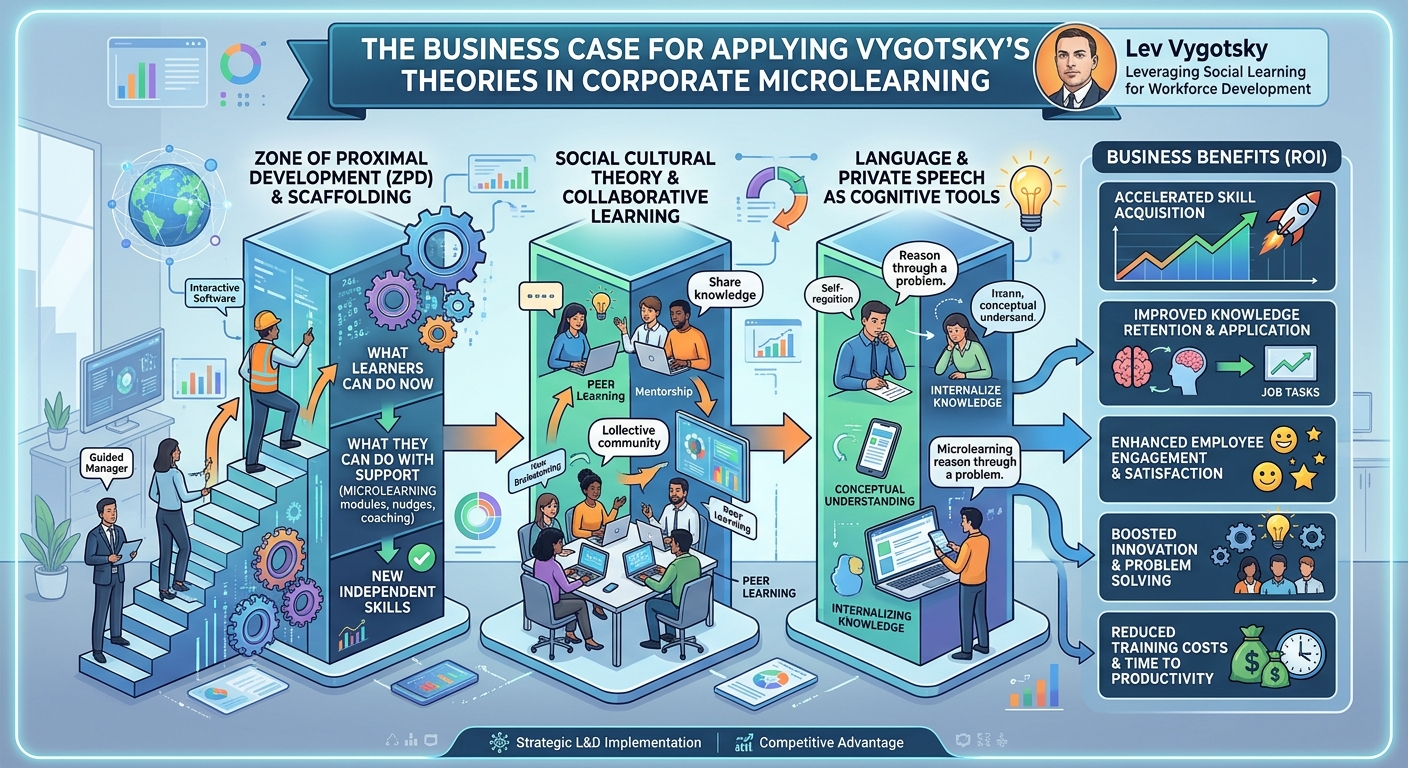
The Business Case for Applying Vygotsky’s Theories in Corporate Microlearning
In the dynamic landscape of corporate learning and development, the pursuit of more effective, engaging, and impactful training methodologies is relentless. For L&D Vice Presidents, Directors, and Managers, the challenge lies in equipping a diverse workforce with critical skills efficiently, ensuring high retention, and demonstrating a clear return on investment. While microlearning has emerged as a powerful solution for its agility and bite-sized delivery, its true potential is unlocked when grounded in robust pedagogical principles. This article makes a compelling business case for integrating the socio-cultural theories of Lev Vygotsky into corporate microlearning strategies, revealing how his insights can transform skill acquisition, foster collaboration, and drive measurable business outcomes.
Understanding Vygotsky's Core Principles in L&D
Lev Vygotsky, a foundational figure in developmental psychology, posited that learning is an inherently social process. His theories, though decades old, offer profound relevance to modern corporate training, particularly when delivered through a flexible learning management system (LMS).
The Zone of Proximal Development (ZPD)
Vygotsky's adaptive learning concept of the Zone of Proximal Development (ZPD) describes the sweet spot where learning occurs most effectively. It’s the gap between what a learner can achieve independently and what they can achieve with guidance from a more knowledgeable peer or instructor. In a corporate context, identifying an employee's ZPD means pinpointing precise skill gaps and delivering targeted training that is challenging but achievable. This avoids both overwhelming learners with overly complex material and boring them with content they already master, ensuring optimal engagement and progress. An effective learning management system can be instrumental in mapping these individual ZPDs across an organization.
Social Interaction and Collaborative Learning
Vygotsky argued that higher mental functions originate in social life. For organizations, this translates into the immense value of peer learning, mentorship, and team-based problem-solving. Learning isn't just about individual consumption of information; it's about sharing insights, discussing challenges, and co-constructing knowledge. This principle is vital for developing complex skills, fostering innovation, and building a cohesive corporate culture. A modern learning management system can facilitate these interactions seamlessly.
Scaffolding
Scaffolding, a direct application of the ZPD, involves providing temporary support structures that help learners master new skills. As the learner's competence grows, the support is gradually withdrawn until they can perform the task independently. This mirrors the iterative nature of microlearning delivery perfectly. Short, focused modules can introduce a concept, followed by guided practice, feedback, and increasingly complex scenarios. This systematic approach ensures mastery rather than superficial understanding, a crucial aspect for any enterprise learning management strategy.
Microlearning: The Ideal Canvas for Vygotsky
Microlearning, characterized by its short duration (typically 3-10 minutes), focus on a single learning objective, and multi-device accessibility, aligns exceptionally well with Vygotskyan principles. Its bite-sized nature inherently supports scaffolding, breaking down complex topics into manageable chunks that build upon each other. Moreover, modern microlearning platforms, often leveraging a robust learning content management system (LCMS), can be designed to integrate social features, enabling peer interaction and collaborative problem-solving within the flow of work, turning every learning moment into a potential social interaction and application within an enterprise learning management strategy.
The Business Imperative: Why Vygotsky Matters Now
Integrating Vygotsky’s theories into your microlearning strategy isn't merely an academic exercise; it’s a strategic business decision with tangible benefits across various industries, from compliance to healthcare, retail, and oil and gas. Implementing these principles through a sophisticated learning management software can significantly elevate your training outcomes.
- Improved Performance & Productivity: By precisely targeting ZPDs, employees acquire relevant skills faster and apply them immediately, leading to direct improvements in job performance and overall organizational productivity. This is critical for competitive advantage across all segments.
- Enhanced Engagement & Retention: Learning that is challenging but achievable, coupled with social support, significantly boosts learner motivation and engagement. This reduces training attrition and increases the long-term retention of critical knowledge, a key goal for any enterprise learning management solution.
- Faster Skill Acquisition: Scaffolding within microlearning accelerates the journey from novice to competent, ensuring your workforce is always up-to-date with the latest industry standards and technologies. This agility is invaluable in fast-evolving sectors like finance and pharma.
- Compliance & Risk Mitigation: Particularly in high-stakes industries like banking, healthcare, and mining, effective training is paramount for regulatory adherence and safety. Risk-focused Training, guided by Vygotsky's principles, ensures critical information is not just consumed but truly understood and applied, drastically reducing compliance gaps and operational risks. A well-designed learning management system can track and certify this mastery.
Leveraging Technology to Amplify Vygotskyan Microlearning
The synergy between Vygotsky’s theories and cutting-edge eLearning technology through a modern learning management system is profound. Modern platforms can operationalize these principles at scale, transforming corporate training.
Personalization and Adaptive Pathways
Technology allows us to move beyond one-size-fits-all training. Adaptive Learning algorithms can analyze a learner's performance, identify their ZPD, and dynamically deliver content, practice exercises, and feedback that is precisely tailored to their needs. This intelligent tailoring ensures each employee receives the right level of challenge and support at the right time.
- Consider this: How can our training programs dynamically adjust to individual learner needs and pace, ensuring everyone progresses efficiently through their unique skill development journey?
Fostering Collaboration
An advanced learning management system offers integrated forums, discussion boards, peer review capabilities, and collaborative project spaces. These features bring Vygotsky’s social interaction principle to life, allowing learners to support each other, share insights, and engage in meaningful dialogue, whether they are across the office or across the globe. This is especially vital for distributed teams in sales or hospitality.
- Ponder this: In what ways can advanced platforms facilitate meaningful interaction among diverse teams, regardless of their location, fostering a shared understanding and collaborative problem-solving environment?
Intelligent Content Creation
The development of learning content, especially for a large enterprise learning management system, can be resource-intensive. Today, tools are emerging that streamline this process. An AI Powered Authoring Tool can assist in generating microlearning modules, suggesting relevant content based on performance data, and even helping to craft scenarios that challenge learners within their ZPDs. This dramatically increases efficiency and ensures high-quality, relevant content.
- Ask yourself: Is it possible to accelerate the creation of highly relevant, context-specific learning modules with built-in intelligence, while maintaining pedagogical soundness and engagement?
Gamification for Engagement
While not explicitly Vygotskyan, gamification strategies inherently support engagement and motivation, which are critical for sustained learning within the ZPD. A Gamified LMS uses points, badges, leaderboards, and challenges to motivate learners, encouraging them to persist through difficult material and collaborate with peers to achieve goals. This adds a powerful layer of intrinsic motivation to the learning experience, making even complex compliance training more appealing.
Implementing a Vygotskyan Microlearning Strategy
For L&D leaders looking to harness these benefits, the journey begins with selecting the right infrastructure. A robust Microlearning LMS designed for enterprise-scale deployment is foundational. Focus on platforms that offer strong analytical capabilities to identify ZPDs, social learning features, and content delivery mechanisms that support scaffolding. The MaxLearn LMS, for example, is engineered to empower organizations in industries from banking to retail to deliver highly effective, Vygotsky-informed training solutions, functioning as a comprehensive learning content management system.
Conclusion
The business case for integrating Vygotsky’s socio-cultural theories into corporate microlearning is compelling. By focusing on the Zone of Proximal Development, leveraging social interaction, and employing scaffolding techniques, organizations can create a learning ecosystem that is not only highly effective but also deeply engaging and intrinsically motivating. In an era where continuous upskilling and reskilling are non-negotiable, a Vygotsky-inspired microlearning strategy, powered by a sophisticated learning management software, offers a clear path to enhanced performance, reduced risk, and a more adaptive, knowledgeable workforce. Embrace these timeless principles with modern tools to build a truly future-ready enterprise.


