

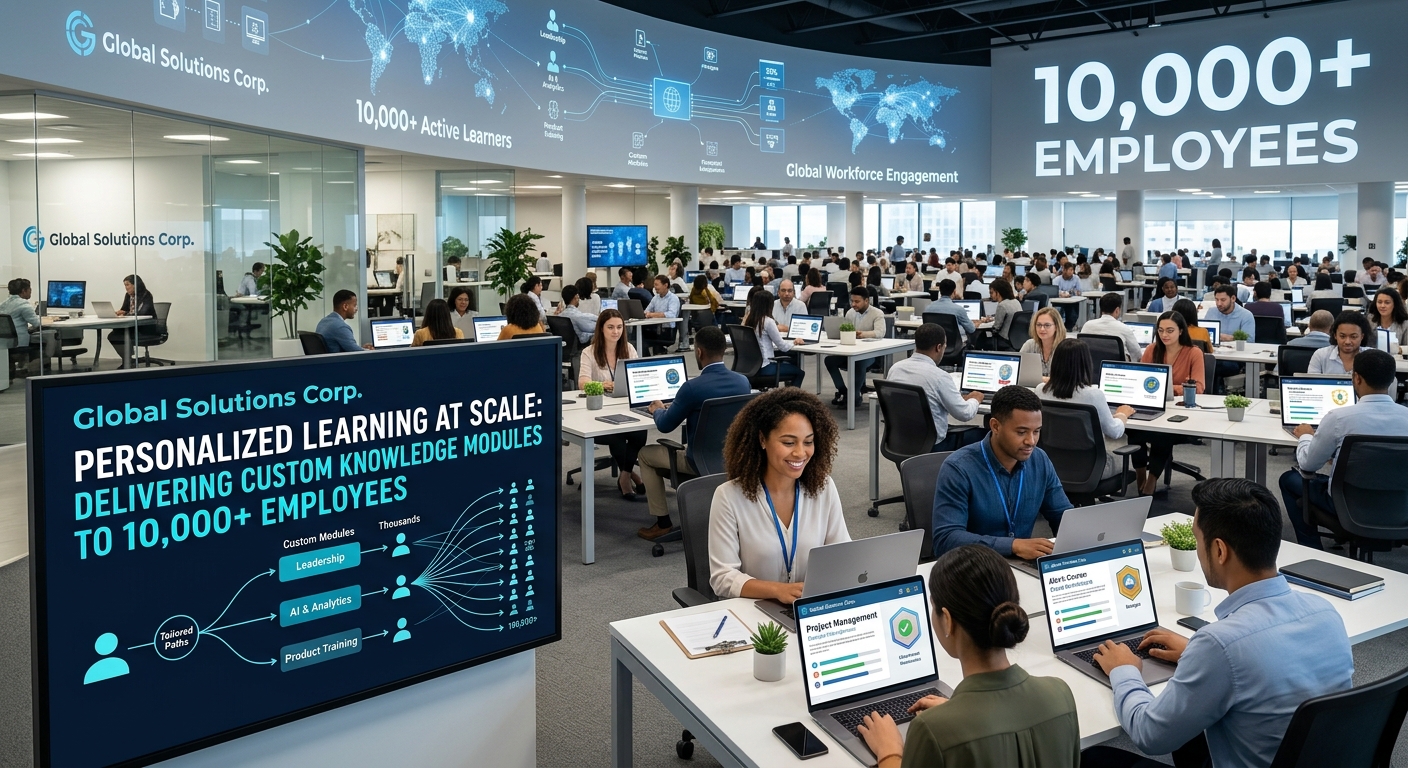
Personalized Learning at Scale: Delivering Custom Knowledge Modules to 10,000+ Employees
In today's fast-evolving corporate landscape, the demand for highly skilled and adaptable employees is greater than ever. For Learning & Development leaders overseeing vast workforces—10,000 employees or more—the challenge isn't just delivering training; it's delivering *effective*, *personalized* training at an unprecedented scale. Traditional one-size-fits-all approaches are no longer sufficient to meet diverse individual needs, optimize performance, and ensure compliance across complex organizations in industries from Banking and Pharma to Retail and Oil & Gas.
Imagine a scenario where every single employee, from a frontline sales associate to a senior compliance officer, receives learning content perfectly tailored to their role, skill level, and career aspirations. This isn't a futuristic dream; it's the strategic imperative of personalized learning at scale, powered by advanced LMS technology. The goal is to transform generic training into a powerful driver of individual and organizational success, ensuring every minute spent learning yields maximum impact.
The Imperative for Personalization in Large Enterprises
Managing the learning journey for thousands of employees presents unique hurdles. Diverse roles, varied prior knowledge, different learning styles, and scattered geographical locations all contribute to a complex training environment. A single compliance module, for example, might be critical for all, but its application and contextual examples will vary drastically for a finance analyst versus a hospitality manager. Without personalization, engagement drops, knowledge retention suffers, and the return on investment for training initiatives diminishes significantly.
- Diverse Skill Gaps: Employees enter with different competencies and require targeted upskilling or reskilling.
- Role-Specific Requirements: Training must align precisely with job functions and performance expectations.
- Engagement Challenges: Generic content often leads to learner disinterest and low completion rates.
- Compliance Complexity: Ensuring every employee understands and adheres to relevant regulations, especially in sectors like Health Care or Mining, requires precise, trackable learning.
Moving beyond these challenges requires a sophisticated learning management system (LMS) that can dynamically adapt to individual learner profiles, track progress, and recommend relevant content. This shift is crucial for fostering a culture of continuous learning and driving tangible business outcomes.
Leveraging Technology for Personalized Learning at Scale
Achieving personalization for 10,000+ employees isn't feasible through manual curation. It demands intelligent systems and strategic deployment of cutting-edge eLearning tools. The right Learning content management system (LCMS) is the backbone, enabling dynamic content delivery and robust administration.
What cutting-edge technologies are reshaping corporate training paradigms?
Modern training demands a dynamic approach, moving beyond static courses. Artificial intelligence (AI) and machine learning are revolutionizing how learning content is delivered and consumed. These technologies analyze learner data—such as performance on quizzes, completion rates, and preferred content formats—to create a truly individualized learning path. This predictive capability allows the system to recommend the next best learning module, ensuring relevance and maximizing engagement. Imagine an enterprise learning management solution that learns from your employees' interactions, continuously refining their educational journey.
How can organizations ensure their training initiatives are relevant across diverse operational environments?
Contextual relevance is paramount, especially for multinational corporations or those with varied operational segments. Adaptive Learning technologies are key here. By dynamically adjusting the difficulty, sequence, and even the content of learning modules based on an individual's responses and performance, these systems ensure that training is always challenging yet achievable. This prevents disengagement from content that's too easy or frustration from content that's too difficult, keeping learners in their optimal learning zone. For example, a module on safety protocols can present different scenarios for employees in a pharmaceutical lab versus those on an oil rig, all within the same overarching course framework.
In what ways can advanced analytical insights transform traditional learning content management?
Data is the new oil, and in L&D, it fuels superior training. Advanced analytics within a robust learning management software provide deep insights into learner behavior, content effectiveness, and skill gaps across the entire organization. This data isn't just for reporting; it drives continuous improvement. By understanding which modules lead to better performance outcomes or higher engagement, L&D teams can refine content, personalize recommendations further, and even proactively identify employees who might need additional support. This transforms the LCMS into an intelligent engine for growth.
The Power of Microlearning Modules
For large workforces, time is a precious commodity. Microlearning LMS solutions deliver knowledge in bite-sized, digestible modules, typically 3-5 minutes long. This format is ideal for busy professionals, allowing them to fit learning into their daily workflow without disruption. These modules can be strung together to form personalized learning paths, ensuring that an employee only accesses the specific pieces of information they need, when they need them. This boosts retention and makes learning feel less like a chore and more like a helpful resource.
Gamification for Enhanced Engagement
Keeping 10,000+ employees actively engaged requires more than just informative content. A Gamified LMS injects elements like points, badges, leaderboards, and challenges into the learning experience. This transforms training into an interactive and competitive endeavor, significantly boosting motivation and completion rates. When learning feels like a game, employees are more likely to participate enthusiastically, master new skills faster, and retain information longer, directly impacting performance in sectors like Sales and Customer Service.
AI-Powered Authoring Tools for Rapid Content Creation
Creating personalized content for thousands of employees can be an immense task. This is where an AI Powered Authoring Tool becomes indispensable. These tools can assist in rapidly generating, adapting, and localizing learning content, significantly reducing the time and resources required for development. They can suggest content variations, automate quiz generation, and even help translate modules, ensuring a consistent and personalized experience across diverse groups and regions. This dramatically scales content creation capabilities, making personalization at scale a reality.
Risk-Focused Training for Business Growth
In many industries, particularly Banking, Finance, Insurance, and Mining, specific training around compliance, safety, and operational risks is non-negotiable. Risk-focused Training, when personalized, ensures that critical information reaches the right individuals at the right time, minimizing exposure and promoting a culture of awareness. A personalized approach means that a financial advisor receives precise training on new regulatory changes, while a factory worker gets targeted modules on machinery safety, all tailored to their specific risk profile and role.
Implementing Personalized Learning at Scale: A Strategic Approach
Adopting personalized learning for a large workforce is a strategic undertaking that requires careful planning and the right technology partner. Here’s a roadmap:
- Needs Assessment: Begin with a comprehensive analysis of skill gaps, roles, and learning objectives across your organization. Understand what employees need to learn and how they learn best.
- Content Strategy: Develop or curate a rich library of modular content. Leverage learning management solutions that support various formats, including videos, simulations, quizzes, and interactive modules.
- Platform Selection: Choose a robust, cloud based learning management system capable of handling thousands of users, sophisticated personalization algorithms, and extensive reporting. Look for an lms learning management system that integrates AI, adaptive learning, and gamification features.
- Pilot Programs: Start with smaller groups or specific departments to gather feedback and refine your approach before a full-scale rollout.
- Continuous Optimization: Utilize the analytics provided by your MaxLearn LMS or similar platform to continuously monitor engagement, performance, and learning outcomes. Iterate and improve your content and personalization strategies based on data.
The MaxLearn Advantage in Scaling Knowledge
For L&D leaders aiming to implement personalized learning across 10,000+ employees, platforms like MaxLearn LMS offer the comprehensive features required. From an intuitive user interface that enhances the learner experience to powerful administrative tools for L&D teams, it provides the technological foundation to manage, deliver, and track personalized learning paths at an unprecedented scale. By combining microlearning LMS capabilities with adaptive learning and advanced analytics, MaxLearn empowers organizations to cultivate a highly skilled, engaged, and compliant workforce, driving growth and innovation.
Conclusion
Personalized learning at scale is no longer an aspirational goal; it's a critical component of talent development and organizational success in large enterprises. By embracing intelligent learning management system technology that offers adaptive learning, microlearning, gamification, and AI-powered content creation, L&D leaders can transform their training programs. The ability to deliver custom knowledge modules to 10,000+ employees not only boosts individual performance and engagement but also strengthens compliance, mitigates risks, and ultimately drives the strategic objectives of the entire organization. The future of corporate learning is personal, and it's scalable.


