

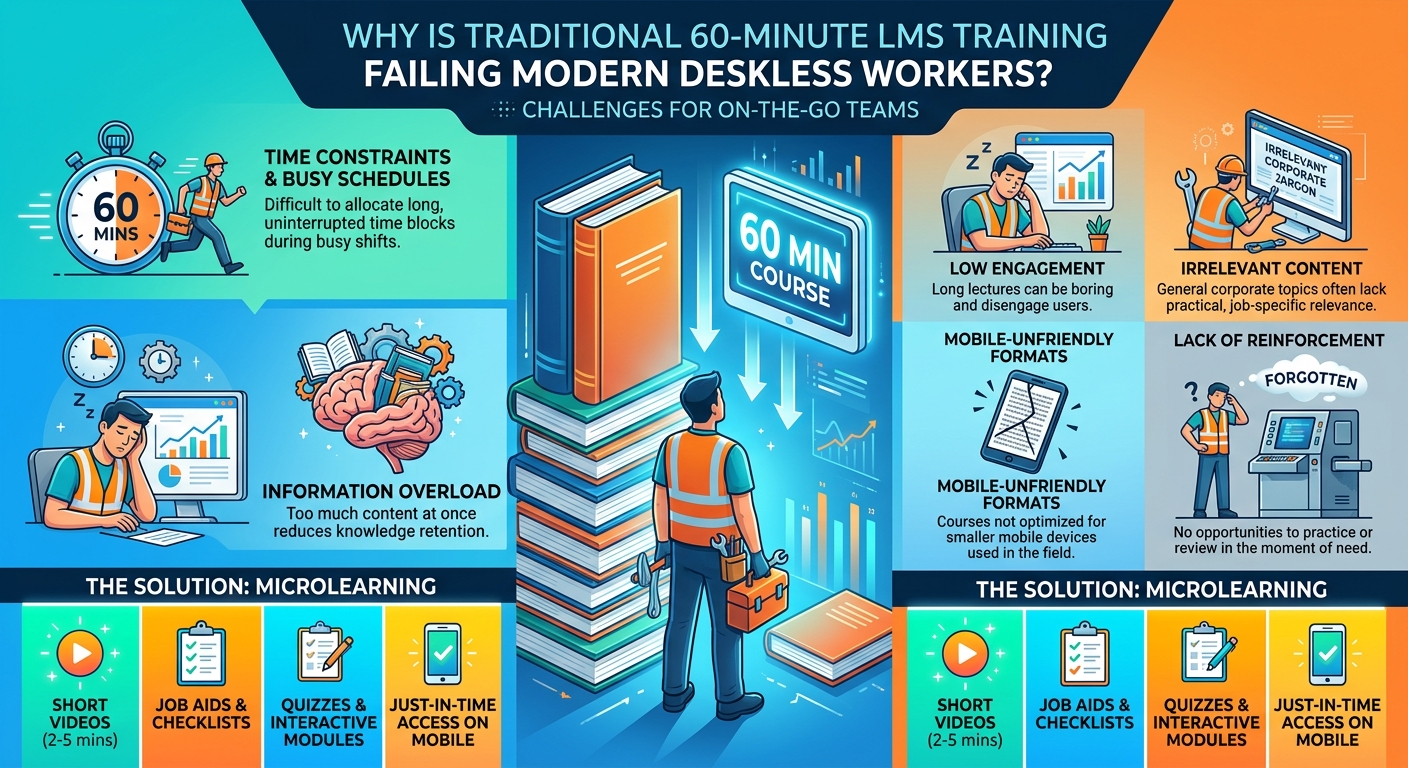
Why Is Traditional 60-Minute LMS Training Failing Modern Deskless Workers?
In today's fast-paced corporate landscape, the efficiency and effectiveness of employee training are paramount, especially for the rapidly expanding segment of deskless workers. For too long, the traditional 60-minute Microlearning LMS module, often delivered through a conventional learning management system, has been the default approach. However, for modern deskless professionals – from retail associates and healthcare providers to field service technicians and manufacturing personnel – this outdated model is not just inefficient; it's actively failing. This article will delve into why the conventional approach is obsolete and explore the transformative solutions that L&D leaders must embrace to empower their frontline teams.
The Evolving Workforce: Who Are Modern Deskless Workers?
Deskless workers represent approximately 80% of the global workforce, forming the backbone of numerous industries. Unlike their desk-bound counterparts, their work is dynamic, often physical, and frequently involves direct interaction with customers, products, or machinery. They operate in diverse environments such as factory floors, hospitals, retail stores, construction sites, and remote oil rigs. Their time is typically not their own; it's dictated by shifts, customer needs, production schedules, or emergencies. This distinct operational context renders traditional, lengthy training sessions impractical and often detrimental.
For these critical employees, a learning content management system must adapt to their reality, not the other way around. The conventional notion of setting aside an hour for a course often means pulling someone off the floor, disrupting service, or asking them to complete training outside paid hours, leading to resentment and disengagement. The need for an adaptive and flexible learning management software has never been more critical for enterprise learning management.
The Flaws of the 60-Minute Model in a Dynamic Environment
The shortcomings of hour-long training modules are numerous and pronounced when applied to deskless workers:
Time Constraints and Disruption
- Operational Interruption: Taking a deskless worker offline for an hour can significantly impact productivity, customer service, or safety protocols. In industries like healthcare or retail, this directly translates to reduced patient care or lost sales.
- Scheduling Headaches: Coordinating 60-minute blocks for a diverse workforce, often across multiple shifts and locations, is an administrative nightmare for L&D and operations managers.
- Forced Learning: Employees often resent being forced into lengthy training sessions during precious breaks or after hours, diminishing their motivation and learning retention.
Irrelevance and Information Overload
- Lack of Context: Generic, hour-long modules often contain information not immediately relevant to a worker's specific task or current challenge. Deskless workers need just-in-time, contextual knowledge.
- Cognitive Overload: Our attention spans are shrinking. Bombarding employees with a large volume of information in one sitting leads to poor retention. Much of the content is forgotten almost immediately after the session concludes.
- Outdated Content: In fast-evolving sectors like compliance, sales, or health care, content can become obsolete quickly. Updating a 60-minute module is a significant undertaking for an LCMS, leading to delays and irrelevant training.
Engagement Crisis
- Passive Learning: Traditional modules are often passive, relying on long videos or text slides. This fails to engage active, hands-on learners who thrive on interaction and practical application.
- Low Motivation: Without immediate relevance or interactivity, motivation plummets. Deskless workers, who are often problem-solvers in real-time, find generic, drawn-out sessions tedious and uninspiring.
Lack of Immediate Application
One of the biggest failures is the disconnect between learning and doing. A deskless worker might complete a module on a Monday but not encounter a situation requiring that knowledge until Friday. By then, the details are often forgotten, defeating the purpose of the training. What's needed is a learning management system that facilitates immediate application and performance support.
Why Traditional Learning Management Solutions Fail to Connect with Modern Needs
Beyond the format, the underlying architecture of many traditional learning management solutions struggles to meet the demands of the modern deskless workforce. These systems were often built for a different era, prioritizing content delivery over learner experience, flexibility, and real-time application. They often lack the agility to deploy content in diverse, remote environments or to track performance metrics that are meaningful for frontline roles. A truly effective lms learning management system needs to be cloud based, accessible, and designed for mobile-first consumption.
The Imperative for a Paradigm Shift: A New Era of Learning
To overcome these challenges, L&D leaders must move beyond the antiquated 60-minute model and embrace innovative, agile, and learner-centric approaches. The solution lies in designing training that mirrors the work environment of deskless employees – dynamic, on-demand, and highly practical.
Embracing Microlearning for On-Demand Knowledge
Microlearning delivers training in short, digestible bursts, typically 3-5 minutes long, focused on a single learning objective. This approach perfectly aligns with the limited attention spans and time constraints of deskless workers. It allows them to access critical information precisely when and where they need it – whether it's understanding a new product feature, reviewing a safety protocol, or learning a specific compliance procedure. A dedicated Microlearning LMS can be a game-changer.
Gamification: Boosting Engagement and Retention
Incorporating game-like elements into training, such as points, badges, leaderboards, and challenges, dramatically increases engagement and motivation. For deskless workers, this can transform mundane compliance training or product knowledge modules into interactive, competitive experiences. A Gamified LMS fosters a sense of achievement and makes learning enjoyable, leading to higher completion rates and better knowledge retention.
Adaptive Learning: Personalized Pathways to Proficiency
Not all learners start from the same knowledge base, and not all roles require the same depth of understanding. Adaptive Learning tailors the learning path to each individual based on their prior knowledge, role, performance, and learning style. This ensures that deskless workers receive only the most relevant content, preventing frustration from redundant information and accelerating skill acquisition. It’s about delivering personalized learning management system experiences.
Leveraging AI for Smarter Content and Delivery
Artificial intelligence is revolutionizing how we create and deliver learning content. An AI Powered Authoring Tool can rapidly generate relevant microlearning modules, personalize content recommendations, and even provide real-time performance support. AI can analyze learner data to identify knowledge gaps and suggest targeted interventions, making the entire training ecosystem more intelligent and responsive.
Risk-focused Training: Prioritizing Critical Skills
For many deskless roles, especially in industries like finance, pharma, or oil and gas, certain knowledge gaps can pose significant risks. Risk-focused Training identifies and prioritizes these critical areas, ensuring that employees receive comprehensive, highly effective training where it matters most. This approach helps mitigate operational, safety, and compliance risks, driving business growth and safeguarding reputations.
Integrating AI for Smarter, More Relevant Training
Leveraging advanced technology is no longer optional; it's essential for transforming how we educate the deskless workforce.
Question: What challenges do organizations face in training remote or distributed deskless teams effectively?
Answer: Organizations struggle with ensuring consistent access to training materials, maintaining engagement across diverse environments, and tracking individual progress accurately. Logistical hurdles in gathering teams for traditional sessions, combined with varying internet access and device availability, often lead to significant disparities in learning outcomes. Modern cloud based learning management systems, enhanced by artificial intelligence, can overcome these by delivering mobile-first content, enabling offline access, and providing real-time analytics on completion and comprehension.
Question: How can artificial intelligence personalize the learning experience for a diverse deskless workforce across various locations?
Answer: AI plays a pivotal role in personalization. By analyzing job roles, previous performance data, geographical requirements, and individual learning preferences, AI can dynamically curate content. It recommends specific microlearning modules, adjusts the difficulty of assessments, and provides contextual feedback. For a retail worker, this might mean AI prioritizing training on a new POS system, while for a field technician, it might suggest modules on troubleshooting a specific piece of equipment based on their service history, optimizing the overall MaxLearn LMS experience.
Question: What innovative strategies can improve immediate knowledge application for frontline employees?
Answer: Beyond formal training, organizations must integrate learning into the workflow. Innovative strategies include embedding QR codes on machinery or products that link to relevant microlearning videos, creating searchable knowledge bases accessible via mobile devices, and developing augmented reality (AR) apps for on-the-job guidance. These solutions, often powered by AI, provide just-in-time performance support, allowing deskless workers to quickly find and apply information precisely at the point of need, turning a learning management system into a performance support tool.
Conclusion
The traditional 60-minute training model delivered via outdated learning management software is a relic that no longer serves the needs of modern deskless workers. For L&D Vice Presidents, Directors, and Managers, the imperative is clear: embrace a new era of learning characterized by flexibility, relevance, and engagement. By adopting microlearning, gamification, adaptive learning, and intelligent automation, organizations can create a powerful learning ecosystem that truly empowers their frontline teams. Investing in an advanced learning content management system that supports these innovative methodologies is not just an expense; it's a strategic investment in productivity, compliance, employee retention, and ultimately, business success.


