

How Does Gamified Learning Actually Improve Knowledge Retention at Work?
For Vice Presidents, Directors, and Managers of Learning & Development, the challenge is perennial: how do we ensure employees don't just complete training, but genuinely retain and apply the knowledge? In high-stakes industries like Compliance, Sales, Banking, Finance, Insurance, Retail, Pharma, Healthcare, Hospitality, Oil and Gas, and Mining, knowledge retention isn't a luxury; it's a critical component of operational success and risk mitigation. Enter gamified learning – a methodology often praised for its engagement factor, but how precisely does it translate into superior knowledge retention?
This article delves into the cognitive science and practical application behind gamified learning, illustrating how its core mechanics fundamentally alter the learning process to enhance long-term recall and performance in the workplace.
The Science Behind Gamification: More Than Just Fun and Games
At its heart, gamification leverages principles from psychology and neuroscience to tap into our innate desires for achievement, mastery, social connection, and immediate feedback. When applied to corporate training, it transforms passive information consumption into an active, engaging experience, which is crucial for building robust memory traces.
Engagement and Motivation Drive Deeper Processing
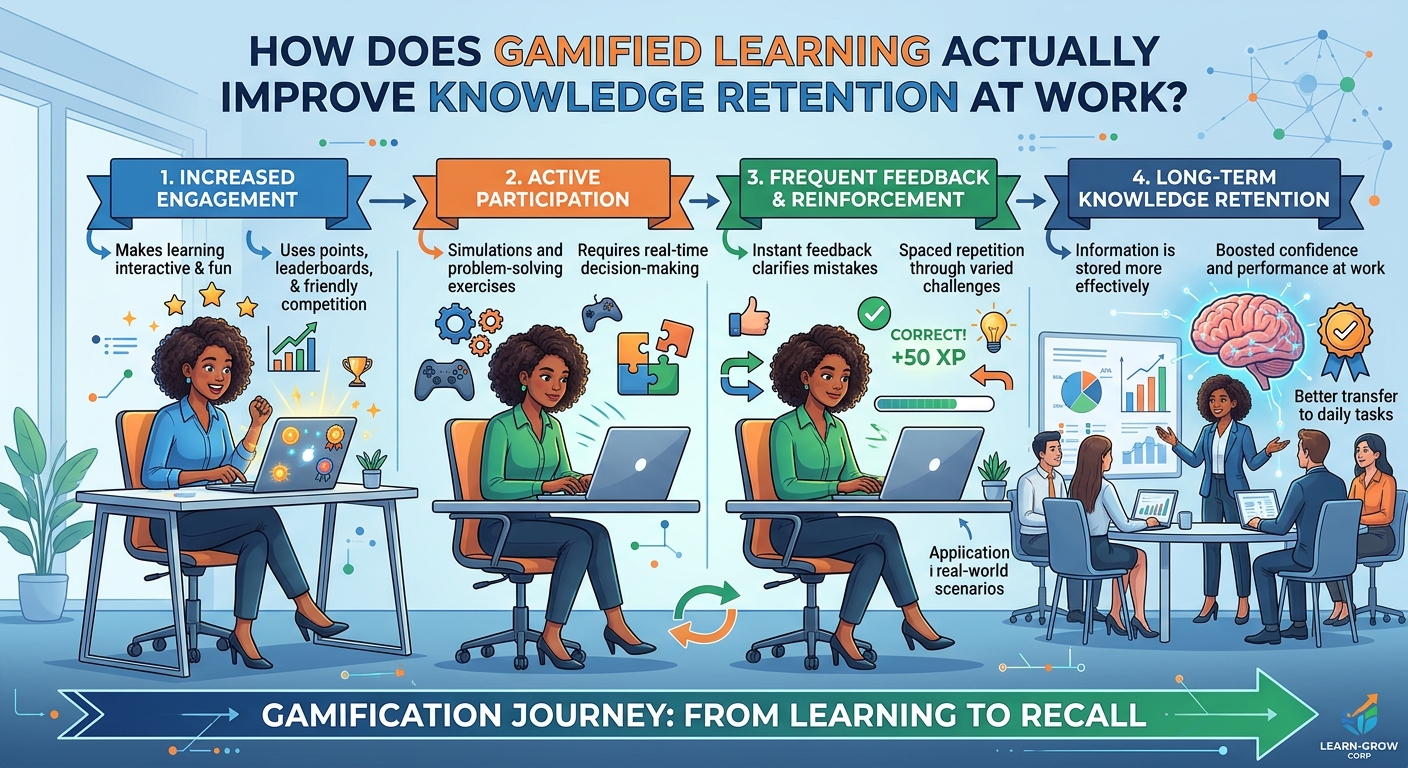
Traditional learning often struggles with learner disengagement. Gamification combats this by introducing elements like points, badges, leaderboards, levels, and progress bars. These mechanisms create a sense of purpose and reward, transforming mundane tasks into achievable challenges. When learners are motivated and actively engaged, their brains are more receptive to new information, leading to deeper cognitive processing and better encoding into long-term memory.
Repetition and Spaced Learning in a Dynamic Context
Effective knowledge retention relies on spaced repetition – revisiting information at increasing intervals. Gamified learning environments are ideal for this, often incorporating quizzes, challenges, and scenarios that require learners to recall and apply knowledge repeatedly over time. This dynamic, non-monotonous repetition, often delivered via a Microlearning LMS, reinforces neural pathways without feeling tedious, significantly improving recall. Such approaches, integral to a sophisticated learning content management system, ensure information isn't just learned but truly ingrained.
Immediate Feedback and Constructive Reinforcement
One of the most powerful aspects of gamification is instantaneous feedback. Unlike traditional training where feedback might be delayed, gamified modules provide immediate information on correctness or incorrectness. This allows learners to correct misunderstandings on the spot, preventing the consolidation of errors. Furthermore, positive reinforcement through rewards and recognition strengthens the learning experience, encouraging learners to continue their journey toward mastery. This continuous loop of action, feedback, and adjustment is a cornerstone of effective learning management software.
Competitive and Collaborative Elements Foster Social Learning
Gamification often incorporates competitive leaderboards or collaborative team challenges. Competition can spur individual effort and a desire for improvement, while collaboration encourages peer-to-peer learning and knowledge sharing. Both elements create a social learning environment that adds another layer of engagement and motivation, helping to solidify understanding through discussion and shared problem-solving. A comprehensive enterprise learning management system often facilitates these social learning dynamics.
Practical Applications in the Workplace
The theoretical benefits of gamified learning translate directly into tangible improvements across various corporate training segments. Implementing a Gamified LMS can revolutionize how organizations approach critical learning objectives.
- Compliance Training: Instead of dry policy documents, employees navigate interactive scenarios, earn badges for mastering regulations, and compete to understand complex legal frameworks. This makes otherwise unengaging Risk-focused Training memorable and impactful, significantly reducing compliance breaches.
- Sales Enablement: Sales teams can practice objection handling through role-playing simulations, compete in product knowledge quizzes, and unlock advanced selling techniques. This hands-on, low-stakes practice, often supported by an AI Powered Authoring Tool, ensures skills are sharp and readily applied in client interactions.
- Onboarding: New hires can embark on a "journey" to learn company culture, systems, and procedures, completing quests and earning points as they integrate. This turns what can be an overwhelming process into an exciting discovery.
- Skill Development: From leadership training to technical proficiency, gamified modules provide an environment for repeated practice and application, helping employees master new skills faster and retain them longer. An effective learning management system makes continuous skill development seamless.
Leveraging Modern Learning Technologies
The evolution of learning management solutions has made implementing robust gamified strategies more accessible than ever. A modern Microlearning LMS is not just a repository for content; it's a dynamic ecosystem designed to foster continuous engagement and superior retention.
Platforms offering a Gamified LMS integrate these powerful mechanics directly into the learning experience. This means progress tracking, leaderboards, achievements, and interactive challenges are built-in, making it easier for L&D teams to design and deploy compelling training programs. When seeking a new learning content management system or an upgraded lms learning management system, these features should be paramount.
Furthermore, technologies like Adaptive Learning personalize the gamified journey. An adaptive learning management software can dynamically adjust the difficulty of challenges, the frequency of repetition, and the content presented based on an individual's performance and knowledge gaps. This ensures that the learning experience is always optimally challenging and relevant, further boosting engagement and retention.
For organizations in specialized sectors, a cloud based learning management system tailored for their needs can provide the flexibility and scalability required to deploy sophisticated gamified training across global teams. Whether it's an LCMS focused on content development or an enterprise learning management system handling vast user bases, the underlying principle remains: making learning active, engaging, and memorable.
Artificial Intelligence's Role in Enhancing Gamified Learning
The integration of advanced computational intelligence elevates gamified learning to new heights, offering unprecedented personalization and effectiveness. L&D leaders are increasingly asking how intelligent systems can refine their training strategies.
How can intelligent systems personalize gamified challenges?
Advanced algorithms analyze learner performance, preferences, and even emotional responses to tailor game mechanics, story lines, and difficulty levels in real-time. This ensures that each employee receives a customized learning path that maximizes engagement and targets specific areas for improvement, making the experience uniquely relevant and effective for every individual.
Can sophisticated analytical tools predict and address individual knowledge gaps?
Yes, by processing vast amounts of data from learner interactions, intelligent systems can identify patterns, predict potential knowledge decay, and automatically trigger refresher modules or specific gamified challenges. This proactive approach helps to pre-empt retention issues before they impact performance, ensuring continuous competency.
What role does advanced computing play in optimizing the delivery of learning content?
Sophisticated computing power can optimize content delivery by recommending the most effective microlearning modules at optimal times, based on cognitive load principles and individual learning styles. This ensures that gamified content, whether created with an AI Powered Authoring Tool or curated otherwise, is delivered in a way that maximizes absorption and retention, making the learning journey highly efficient and impactful.
Key Benefits for L&D Leaders
Embracing gamified learning with a robust LMS like MaxLearn LMS offers significant advantages for L&D professionals seeking to demonstrate clear ROI:
- Improved Knowledge Retention: The primary benefit, leading to fewer errors and increased on-the-job competency.
- Higher Completion Rates: Engaging formats mean employees are more likely to finish training modules.
- Better Performance Outcomes: Enhanced retention directly translates into improved job performance and productivity.
- Greater Employee Engagement: A more enjoyable learning experience boosts morale and job satisfaction.
- Measurable ROI: Advanced analytics in modern learning management systems allow L&D to track engagement, progress, and performance improvements, providing clear data on training effectiveness.
Choosing the Right Solution
When considering a transition to more engaging and effective learning strategies, selecting the right learning management system is paramount. Look for a comprehensive learning management software that not only supports gamification but also offers adaptive learning capabilities, robust analytics, and a user-friendly interface for both learners and administrators. A powerful LCMS will empower your team to create and manage dynamic, retention-focused content with ease.
Conclusion
Gamified learning is far more than a passing trend; it's a scientifically backed methodology that fundamentally re-engineers how employees absorb and retain critical information. By harnessing intrinsic human motivators, providing immediate feedback, and facilitating active, personalized learning experiences through advanced learning management solutions, organizations can dramatically improve knowledge retention at work.
For L&D leaders, the opportunity to transform compliance training, sales enablement, and overall skill development into engaging, measurable, and highly effective programs is here. Investing in a powerful, gamified platform is not just about making learning fun; it's about building a more knowledgeable, competent, and resilient workforce.


