

Elevating Workplace Knowledge: What Is Spaced Repetition in Workplace Training, and Why Does It Work?
In the dynamic world of business, continuous learning is not just a buzzword; it's a strategic imperative. For Vice Presidents, Directors, and Senior Managers of Learning & Development, the challenge isn't merely delivering training, but ensuring that knowledge sticks, transforms into practical skills, and drives measurable business outcomes. Traditional training methods, while foundational, often struggle against the natural enemy of retention: the forgetting curve. Enter spaced repetition – a powerful, scientifically-backed technique poised to revolutionize how organizations approach talent development.
This article delves deep into the concept of spaced repetition, dissecting its mechanics, exploring its cognitive underpinnings, and showcasing why it’s an indispensable tool for enhancing learning efficacy across diverse industries like Compliance, Sales, Banking, Finance, Insurance, Retail, Pharma, Health care, Hospitality, Oil and Gas, and Mining.
The Forgetting Curve: A Universal Challenge
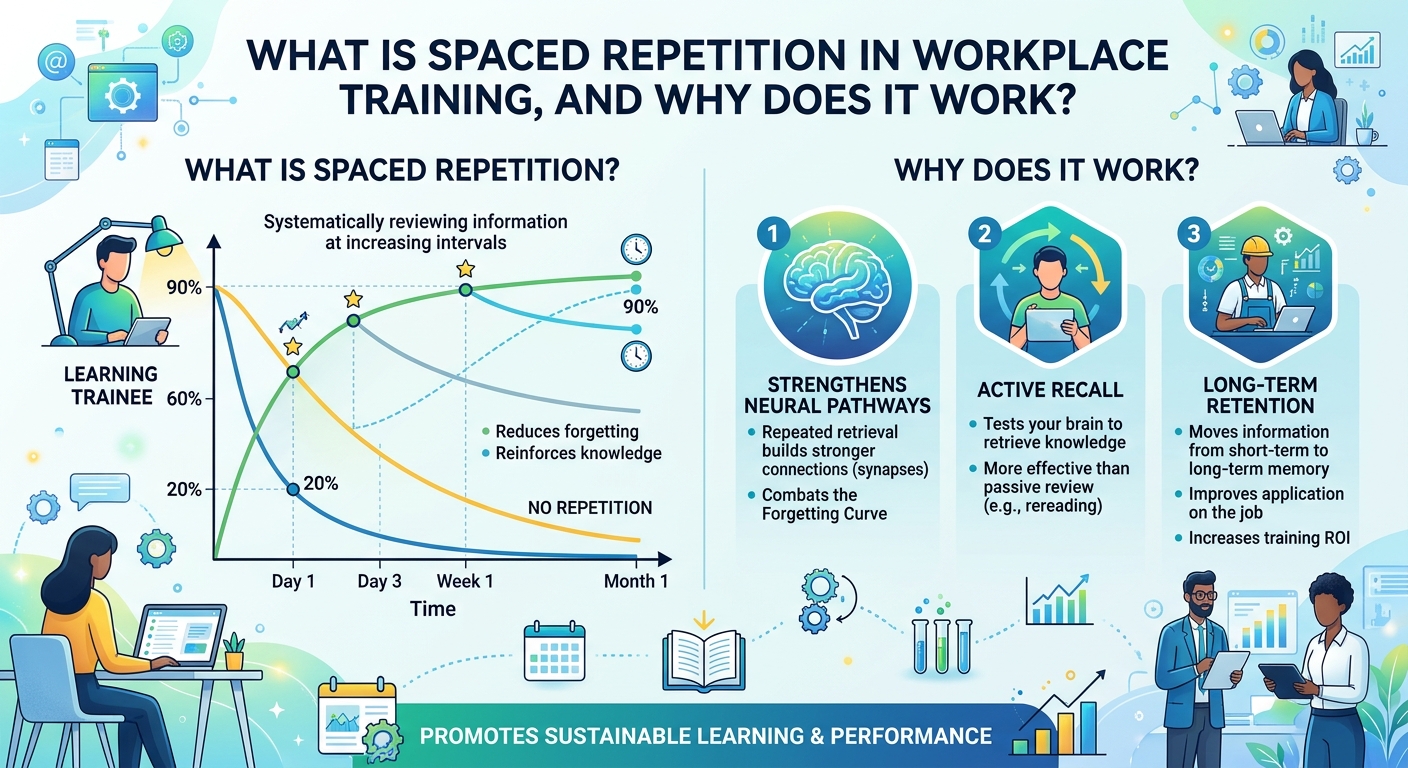
Hermann Ebbinghaus, a pioneering psychologist, introduced the concept of the "forgetting curve" over a century ago. His research demonstrated that people forget approximately 50% of newly learned information within an hour, and a staggering 70% within 24 hours, if that knowledge isn't reinforced. For L&D professionals investing significant resources in training programs, this statistic is a sobering reminder of the uphill battle against memory decay.
This rapid decline in recall directly impacts performance, compliance adherence, and overall productivity. It underscores the critical need for a more effective pedagogical approach that actively counters this natural human tendency.
What Exactly Is Spaced Repetition?
At its core, spaced repetition is an eLearning technique designed to combat the forgetting curve by strategically scheduling reviews of previously learned material at increasing intervals over time. Instead of cramming information in one sitting or simply repeating it immediately, spaced repetition leverages the brain's natural memory consolidation processes.
Imagine teaching a new compliance regulation, a complex financial product, or a critical healthcare protocol. With spaced repetition, learners would encounter the information initially, then review it a day later, then three days later, then a week later, then two weeks later, and so on. The intervals between reviews expand as the learner demonstrates mastery, ensuring that the knowledge is recalled just as it's about to be forgotten.
How Does This "Smart" Review System Work?
The efficacy of spaced repetition lies in its intelligent timing. When a piece of information is retrieved from memory, the neural pathways associated with that memory are strengthened. If this retrieval occurs just as the memory is starting to fade, the brain has to work harder, making the subsequent consolidation more robust. This phenomenon is known as "desirable difficulty."
- Initial Exposure: Learners first encounter new concepts or skills.
- Short-Term Recall: A brief review occurs shortly after initial learning (e.g., hours or a day later).
- Progressive Intervals: Subsequent reviews are scheduled at gradually longer intervals (e.g., 3 days, 7 days, 14 days, 30 days).
- Active Recall: Learners are encouraged to retrieve information from memory rather than just passively re-reading. This often involves quizzes, flashcards, or short simulations.
- Adaptive Adjustment: If a learner struggles with a concept, the review interval for that particular item shortens. If they recall it easily, the interval lengthens.
Why Does Spaced Repetition Work So Well? The Cognitive Science Behind It
The effectiveness of spaced repetition is deeply rooted in cognitive psychology and neuroscience:
- Memory Consolidation: Repeated exposure, especially at optimal intervals, allows the brain sufficient time to move information from short-term to long-term memory.
- Reduced Cognitive Load: Instead of overwhelming learners with vast amounts of information at once, spaced repetition breaks learning into manageable chunks, reducing cognitive overload and making complex topics more digestible. This aligns perfectly with the principles of Microlearning LMS.
- Enhanced Retrieval Practice: The act of recalling information strengthens its memory trace. Spaced repetition provides structured opportunities for this "retrieval practice," making memories more accessible and durable.
- Metacognition: By engaging in active recall, learners become more aware of what they know and what they don't, fostering better self-assessment and a deeper understanding of the subject matter.
Transformative Benefits for Workplace Training
For L&D leaders, the practical benefits of integrating spaced repetition into your learning content management system are substantial:
- Superior Knowledge Retention: Directly combats the forgetting curve, leading to significantly higher long-term retention of critical information, whether it's product specifications for sales teams or safety protocols for oil and gas personnel.
- Improved Performance and Productivity: Employees who retain more knowledge can apply it more effectively in their roles, leading to fewer errors, faster task completion, and enhanced decision-making.
- Reduced Retraining Costs: By solidifying knowledge the first time around, organizations minimize the need for costly refresher courses and remedial training.
- Enhanced Compliance and Risk Mitigation: Particularly vital in regulated industries like Banking, Finance, Pharma, and Health care, spaced repetition ensures that employees consistently remember and adhere to critical regulations, reducing legal and financial risks. This is a hallmark of effective Risk-focused Training.
- Higher ROI on Training Investments: When training leads to lasting knowledge and behavioral change, the return on investment for your learning management software becomes significantly clearer and more impactful.
- Adaptability for Diverse Industries: From onboarding new retail associates to upskilling hospitality staff, or ensuring frontline healthcare workers are current on best practices, spaced repetition provides a flexible and powerful learning management system solution.
Implementing Spaced Repetition in Your L&D Strategy
Integrating spaced repetition requires more than just knowing it exists; it demands a strategic approach, often supported by modern LMS platforms.
Consider how an enterprise learning management system, especially a cloud based learning management system, can facilitate this method. Look for learning management solutions that offer:
- Built-in Spaced Repetition Algorithms: Many modern MaxLearn LMS solutions, particularly those focused on Microlearning LMS, incorporate algorithms to automatically schedule reviews.
- Interactive Content Delivery: Support for quizzes, flashcards, short scenarios, and simulations that promote active recall. A Gamified LMS can make these review sessions more engaging.
- Personalized Learning Paths: The ability to adapt to individual learner progress, a core feature of Adaptive Learning.
- Analytics and Reporting: Tools to track learner performance over time, identify knowledge gaps, and measure the impact of spaced repetition.
The Role of Advanced Technology and Intelligent Systems
Modern learning content management systems have transformed spaced repetition from a manual flashcard system into a sophisticated, automated process. The integration of intelligent systems is crucial for scaling this methodology across an entire organization.
How do intelligent learning systems personalize training recall schedules?
Intelligent learning management software leverages sophisticated algorithms to analyze individual learner performance data – their responses to quizzes, completion times, and areas of struggle. Based on this analysis, the system dynamically adjusts the review intervals for each piece of content, for each learner. If a learner consistently answers questions correctly on a specific topic, the system will extend the review interval for that topic. Conversely, if a learner frequently makes mistakes, the system will shorten the interval, presenting the material more often until mastery is achieved. This level of personalization, often facilitated by an AI Powered Authoring Tool, ensures that every employee receives the optimal support needed to internalize critical information, making the learning process highly efficient and effective.
What measurable impact does this method have on employee performance across different industries?
The impact of a well-implemented lms learning management system incorporating spaced repetition is evident across various sectors. In Finance and Banking, employees demonstrate higher accuracy in recalling complex regulatory requirements and product details, reducing compliance breaches and improving customer service. For Pharma and Health care, critical safety protocols and drug information are retained longer, leading to better patient outcomes and fewer medical errors. Sales teams in Retail and other industries show improved product knowledge and objection handling skills, directly translating to increased sales figures. In heavy industries like Oil and Gas or Mining, adherence to safety procedures is paramount, and spaced repetition drastically improves recall of emergency protocols, contributing to a safer work environment and fewer incidents. Across the board, companies report a significant uplift in job competency and a reduction in errors related to forgotten information.
In what ways can advanced analytics predict and prevent knowledge decay in a large workforce?
Advanced analytics within a robust LCMS provide an invaluable predictive capability. By continuously monitoring learning patterns and performance data across a large workforce, these systems can identify early warning signs of knowledge decay. For example, if a significant number of employees start consistently failing recall questions on a particular module, or if certain topics haven't been reviewed in an extended period, the system can flag these as potential areas of risk. It can then proactively trigger refresher content, recommend targeted micro-learning modules, or even notify L&D managers to intervene. This proactive, data-driven approach, especially valuable in an enterprise learning management context, allows organizations to pre-empt widespread knowledge gaps, ensuring that critical skills and information remain sharp and current, thereby safeguarding operational efficiency and regulatory compliance.
Conclusion: A Smarter Approach to Workplace Learning
For L&D VPs, Directors, and Managers, the adoption of spaced repetition is not merely an enhancement to an existing learning management system; it’s a strategic pivot towards more intelligent, impactful, and sustainable talent development. By embracing this scientifically-proven method, powered by an advanced LMS, organizations can move beyond the limitations of traditional training, ensuring that vital knowledge is not just acquired, but truly internalized and applied.
Invest in solutions that understand the science of memory and leverage technology to deliver learning experiences that truly stick. The future of workplace training is here, and it’s smarter, more engaging, and incredibly effective.


