

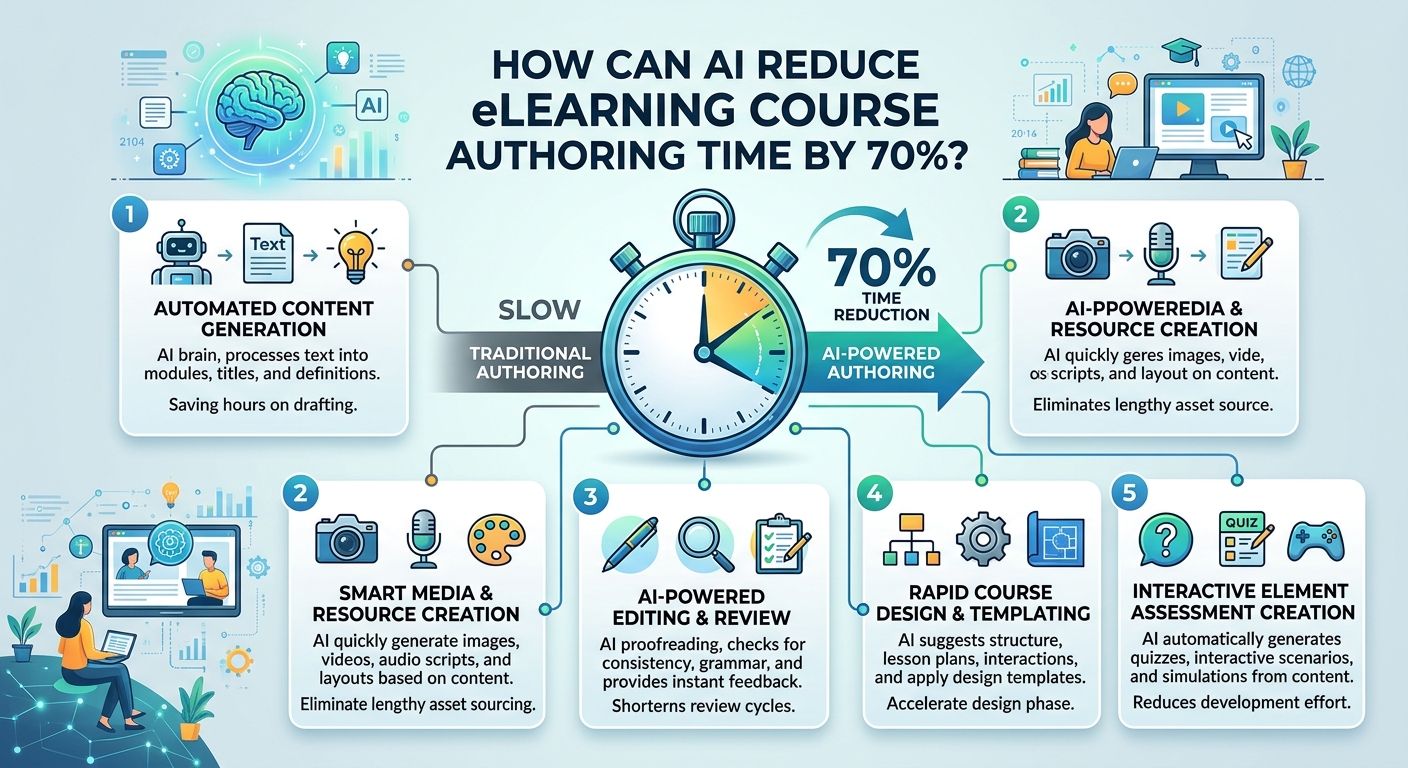
How Can AI Reduce eLearning Course Authoring Time by 70%?
In today's rapidly evolving corporate landscape, the demand for timely, relevant, and engaging eLearning content has never been higher. Learning and Development (L&D) teams, from Vice Presidents to Managers, are under constant pressure to deliver high-quality training faster and more efficiently. Yet, the traditional course authoring process remains notoriously time-consuming, often consuming valuable resources and delaying critical training initiatives. Imagine cutting that authoring time by a staggering 70% – a figure that, until recently, seemed like a distant dream. Thanks to advancements in Artificial Intelligence (AI), this ambitious goal is now within reach.
This article will explore the transformative power of AI in the realm of eLearning course authoring, detailing how intelligent technologies can drastically accelerate content creation, enhance engagement, and free up L&D professionals to focus on strategic initiatives rather than repetitive tasks.
The Current State of eLearning Authoring: A Bottleneck for Progress
Before diving into AI's solutions, it's crucial to understand the challenges L&D teams face. The typical course authoring workflow involves several labor-intensive stages:
- Content Research and Curation: Sifting through vast amounts of information, ensuring accuracy, and aligning with learning objectives.
- Instructional Design: Structuring content, writing scripts, developing learning activities, and designing assessments.
- Multimedia Production: Creating or sourcing graphics, videos, audio, and interactive elements.
- Review and Iteration: Multiple rounds of feedback, revisions, and approvals from subject matter experts (SMEs) and stakeholders.
- Localization: Adapting content for different regions and languages, a significant overhead for global organizations.
Each of these stages can be a significant time sink, leading to delayed course launches, outdated content, and increased operational costs. This inefficiency is particularly impactful in industries like Compliance, Sales, Banking, Finance, Insurance, and Healthcare, where training needs are urgent and frequently updated.
AI: A Game-Changer for Content Creation
What is the impact of artificial intelligence on training development? AI acts as a force multiplier, automating repetitive tasks, generating insights, and even creating content from scratch. This isn't about replacing human expertise, but rather augmenting it, allowing instructional designers to focus on higher-level strategic thinking and creativity.
Content Generation & Curation
AI algorithms can analyze vast datasets, internal documents, and existing training materials to generate initial course outlines, draft learning objectives, and even write complete text modules. From transforming lengthy compliance manuals into digestible Microlearning LMS snippets to summarizing complex financial regulations, AI significantly reduces the initial content drafting phase. It can identify key concepts, extract relevant data, and suggest structures that align with proven learning methodologies.
Personalization & Adaptive Learning
How can smart algorithms speed up instructional design while making it more effective? AI-driven platforms can analyze learner data, preferences, and performance to create personalized learning paths. This allows for the dynamic generation of content tailored to individual needs, skipping irrelevant sections for experienced learners or providing remedial support for those who struggle. This is the essence of Adaptive Learning, making every minute of training count more effectively.
Multimedia & Interactive Element Creation
Creating engaging multimedia is often one of the most time-consuming aspects of course authoring. AI can revolutionize this process:
- Image and Video Generation: AI can generate unique images, illustrations, and even short video clips based on text prompts, eliminating the need for extensive stock photo searches or costly custom productions.
- Voiceovers and Narration: Text-to-speech AI can produce natural-sounding voiceovers in multiple languages, saving hours of recording and editing time.
- Interactive Simulations: AI-powered tools can assist in building simple simulations or interactive scenarios, crucial for practical training in areas like sales techniques or customer service interactions.
Assessment & Feedback Automation
Developing effective assessments and providing timely feedback are vital for learning. AI can automate the creation of quizzes, multiple-choice questions, and even more complex scenario-based assessments. Furthermore, AI can analyze learner responses, provide instant feedback, and recommend additional resources or practice exercises. This significantly reduces the manual grading burden and accelerates the learning cycle, a key benefit for any enterprise learning management system.
The 70% Reduction: How it's Achieved
Can AI tools significantly reduce the time spent on developing online courses? Absolutely. The 70% reduction in authoring time stems from AI's ability to:
- Eliminate Repetitive Tasks: AI handles the mundane, data-heavy tasks that consume human instructional designers.
- Accelerate Content Generation: From initial outlines to full drafts, AI provides a powerful head start.
- Streamline Reviews: By generating higher-quality first drafts, AI reduces the number of review cycles and the volume of edits.
- Automate Localization: AI-powered translation and adaptation tools drastically cut down the time required to make courses globally accessible.
- Optimize Resource Allocation: L&D teams can repurpose existing content more effectively and focus human talent on creative problem-solving and strategic design.
This efficiency translates directly into faster time-to-market for critical training, ensuring that employees across industries – from Hospitality to Oil and Gas – have access to the latest knowledge when they need it most. When considering a Gamified LMS or a standard learning management system, the speed of content creation directly impacts the variety and timeliness of engaging courses.
Cost-Efficiency & ROI
Beyond time savings, the integration of an AI Powered Authoring Tool also delivers substantial cost savings. Reduced labor hours, lower content development costs, and faster deployment mean a higher return on investment for L&D initiatives. This is particularly attractive for organizations managing large-scale, complex training programs using a cloud based learning management system.
Practical Applications Across Industries
In which industries is AI most impactful for corporate training? AI's utility spans across virtually all sectors, addressing unique training needs with unprecedented efficiency.
Compliance & Risk-focused Training
For industries like Banking, Finance, Insurance, and Pharma, compliance training is mandatory, complex, and frequently updated. AI can swiftly parse regulatory documents, identify changes, and automatically update relevant course modules. This ensures that Risk-focused Training is always current, minimizing legal exposure and improving employee adherence.
Sales & Product Knowledge
In Sales and Retail, product knowledge and sales techniques need constant refreshing. AI can quickly generate training modules for new product launches, distill complex specifications into easily digestible content, and even create interactive scenarios for practicing sales pitches. This empowers sales teams with up-to-date information, directly impacting revenue.
Healthcare & Pharma
Healthcare professionals require continuous training on new procedures, medications, and patient care protocols. AI can help create detailed, accurate medical content, simulations for critical procedures, and rapid updates on health guidelines, ensuring high standards of patient safety and care. Pharmaceutical companies can leverage AI to accelerate training for drug development and regulatory adherence.
Choosing the Right AI-Powered Authoring Solution
What should L&D leaders consider when adopting AI for course authoring? The selection of an AI-powered solution is a strategic decision that demands careful consideration.
Integration with your Learning Content Management System
Ensure the AI tool seamlessly integrates with your existing LMS. Compatibility with your learning management software is paramount for a smooth workflow. A robust learning content management system will enhance the AI's capabilities, allowing for efficient content delivery and tracking. Look for solutions that complement your overall learning management solutions, including features found in a comprehensive learning management system like MaxLearn LMS, which offers powerful content management within an lms learning management system structure.
Scalability & Future-Proofing
The chosen solution should be able to scale with your organization's growing needs and adapt to future AI advancements. A future-proof LCMS solution will ensure your investment continues to pay dividends.
Addressing Common Concerns
While the benefits are clear, it's natural to have questions about the role of human oversight. AI is a tool, not a replacement for human creativity, empathy, and strategic thinking. Instructional designers will evolve into "AI curators," guiding the AI, refining its outputs, and ensuring the human touch remains in the learning experience. Ethical considerations, such as data privacy and bias in AI-generated content, must also be carefully managed with appropriate policies and human review processes.
Conclusion
The promise of reducing eLearning course authoring time by 70% with AI is not hyperbole; it's a tangible reality for L&D professionals ready to embrace this technological shift. By automating tedious tasks, accelerating content generation, and enabling unparalleled personalization, AI empowers L&D teams to deliver faster, more effective, and more engaging training across all industries. This allows organizations to stay competitive, agile, and well-equipped to meet the challenges of tomorrow. The future of corporate training is here, and it's intelligent.


