

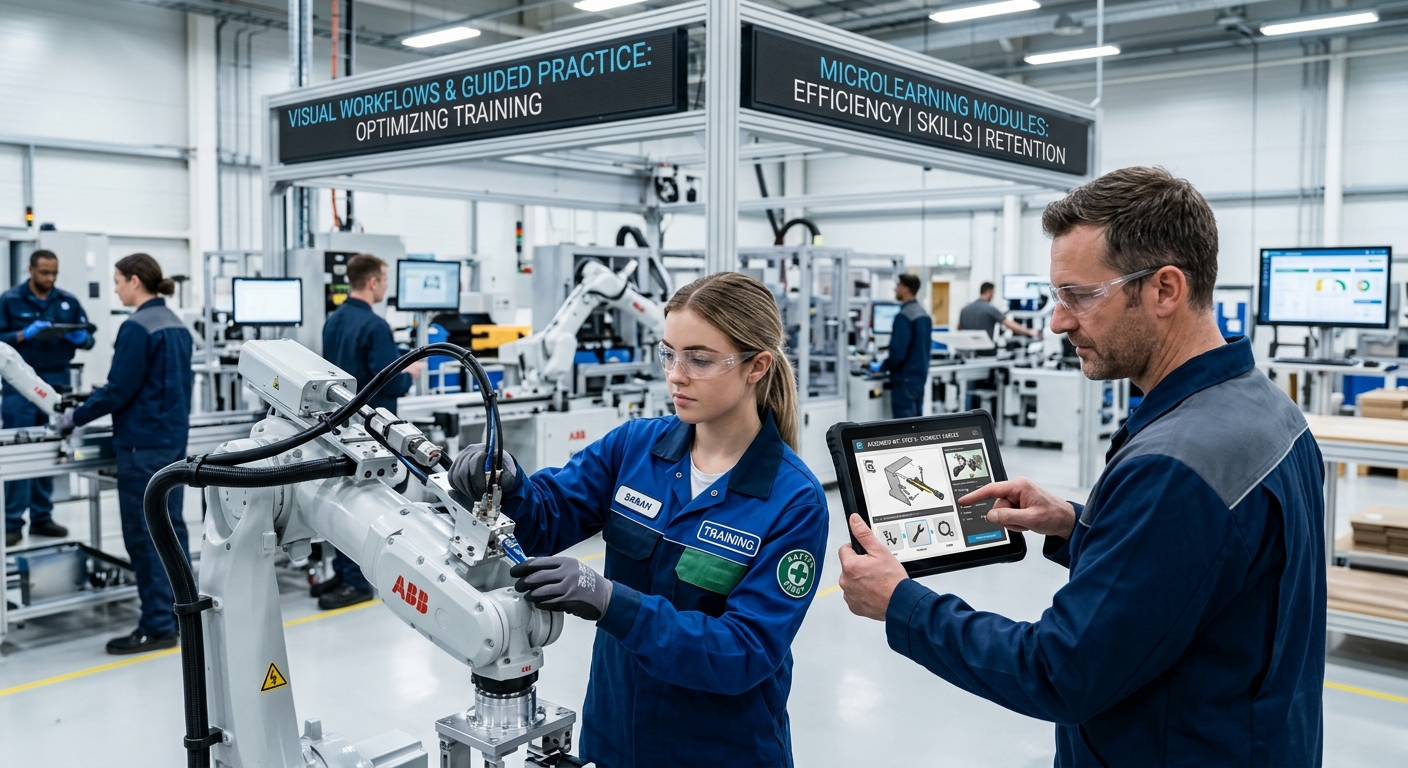
Visual Workflows and Guided Practice: Optimizing Manufacturing Training with Microlearning
For Vice Presidents, Directors, and Managers of Learning & Development, the landscape of manufacturing training presents a unique blend of critical challenges and immense opportunities. Ensuring a skilled, safe, and efficient workforce in sectors from Pharma and Health care to Oil and Gas, and even Banking and Finance (for their operational departments), demands more than just traditional classroom lectures or lengthy manuals. The need to rapidly upskill employees, reduce errors, and maintain strict compliance across complex processes calls for innovative solutions. Enter microlearning, visual workflows, and guided practice – a powerful trio poised to revolutionize how we approach industrial training.
This article explores how integrating these methodologies can unlock unprecedented levels of engagement, retention, and performance, ultimately driving operational excellence and mitigating risk in your manufacturing environment.
The Evolving Landscape of Manufacturing Training
Manufacturing environments, whether in Retail, Hospitality, Mining, or specialized production, are dynamic. Rapid technological advancements, increasing automation, stringent regulatory compliance, and a persistent skills gap demand agile and effective training. Traditional approaches often fall short:
- Information Overload: Long courses lead to decreased retention, especially for complex machinery or procedures.
- Lack of Engagement: Passive learning struggles to capture the attention of a hands-on workforce.
- Inconsistent Application: Knowledge gained in a classroom doesn't always translate seamlessly to the factory floor.
- High Training Costs: Lengthy downtime for training can impact productivity and profit margins.
L&D leaders are actively seeking solutions that are not only efficient but also deeply embedded in the operational reality of the business.
Microlearning: The Agile Approach to Skill Development
Microlearning delivers bite-sized, focused content designed to achieve specific learning outcomes. Rather than an hour-long module, think of 3-5 minute videos, interactive quizzes, or concise digital flashcards. Its benefits are particularly potent for manufacturing:
- Enhanced Retention: Smaller chunks of information are easier to absorb and recall.
- Flexibility & Accessibility: Employees can access training modules on-demand, at the point of need, directly on the factory floor or during brief breaks.
- Reduced Cognitive Load: Focus on one skill or concept at a time prevents overwhelm.
- Faster Time-to-Competency: Quick learning cycles accelerate skill acquisition.
What is the most effective way for L&D leaders to implement highly engaging and comprehensive manufacturing training that caters to diverse learning styles and operational needs across multiple facilities?
The key lies in adopting a flexible and modern Microlearning LMS. This approach allows for the creation of targeted content that addresses specific skill gaps, integrates various media types to suit different learning preferences, and can be easily deployed and tracked across an entire organization. By breaking down complex procedures into manageable micro-modules, an L&D team can craft a learning journey that is both thorough and digestible, ensuring that even the most intricate operational tasks are understood and mastered by every team member, regardless of their prior experience or learning style.
Visual Workflows: The Power of Seeing and Doing
In manufacturing, understanding "how" to do something is often more critical than merely knowing "about" it. Visual workflows leverage images, diagrams, videos, and even augmented reality (AR) to illustrate complex processes step-by-step. Imagine:
- A short video demonstrating the correct procedure for equipment setup.
- An interactive diagram highlighting safety checkpoints on a machine.
- AR overlays providing real-time instructions as a technician works.
Visuals cut through language barriers and technical jargon, making learning intuitive and immediate. They reduce ambiguity, minimize errors, and accelerate understanding, especially crucial for compliance-heavy industries like Pharma or Finance (for data center operations).
Guided Practice: Bridging the Gap Between Knowledge and Application
Learning is incomplete without practice. Guided practice involves providing learners with opportunities to apply their knowledge in a controlled environment, receiving immediate feedback. When combined with microlearning and visual workflows, it becomes incredibly powerful:
- Simulations: Digital simulations allow employees to practice operating machinery or troubleshooting scenarios without real-world risk.
- Interactive Checklists: Step-by-step guides with required inputs or confirmations reinforce correct procedures.
- Peer Coaching with Visual Aids: Experienced workers can use visual workflow documents to guide new hires, providing real-time feedback.
This hands-on, interactive approach ensures that theoretical knowledge translates into practical, confident execution, which is paramount for Risk-focused Training and maintaining high safety standards.
Synergy: Visual Workflows, Guided Practice, and Microlearning in Action
The true power emerges when these elements work in concert. A manufacturing training program might look like this:
- A microlearning video module (2 minutes) introduces a new safety protocol for a specific machine.
- This is followed by an interactive visual workflow that highlights each step of the protocol with annotated diagrams.
- Finally, a short guided practice simulation allows the employee to virtually "perform" the safety check, receiving instant feedback on their accuracy.
This integrated approach fosters deep understanding, muscle memory, and confidence, leading to fewer accidents, higher product quality, and increased operational efficiency across diverse industries from Retail to Oil and Gas.
How can a global manufacturing company ensure consistent, high-quality training across all its international plants, accounting for local regulations and language differences, while maintaining a unified learning experience?
Achieving global consistency requires a sophisticated learning management system that acts as a central hub. Such a system should support multi-language content localization for visual workflows and microlearning modules. By leveraging a robust learning content management system (LCMS), a company can create core visual workflow templates that are easily adapted for regional compliance and translated into local languages. This ensures that while the fundamental knowledge and best practices remain uniform, the delivery is culturally relevant and meets specific local needs, providing a truly unified yet adaptable learning management software solution for all employees, from the factory floor to the corporate office, anywhere in the world.
Leveraging Technology for Optimal Training Delivery
Implementing these strategies requires a robust technological backbone. A modern, cloud based learning management system is indispensable. Key features to look for include:
- Intuitive Content Authoring: An AI Powered Authoring Tool can dramatically speed up the creation of engaging microlearning modules, visual workflows, and interactive simulations.
- Mobile Accessibility: Ensuring training is available on any device, anywhere, is crucial for frontline workers.
- Analytics & Reporting: A comprehensive LMS provides insights into learner progress, skill gaps, and training effectiveness, allowing L&D managers to continuously optimize programs.
- Engagement Features: A Gamified LMS can boost motivation and completion rates through points, badges, and leaderboards.
- Personalization: Adaptive Learning paths can tailor content to individual learner needs and performance, ensuring that employees receive the most relevant training.
An enterprise learning management solution like MaxLearn LMS offers the comprehensive tools necessary to manage, deliver, and track such sophisticated training programs, transforming traditional learning management solutions into dynamic skill-building platforms.
The Future of Manufacturing Training: A Strategic Imperative
For L&D VPs, Directors, and Managers, adopting visual workflows and guided practice within a microlearning framework isn't just about improving training; it's about embedding a culture of continuous learning and operational excellence. This strategic shift leads to:
- Increased safety and compliance, particularly critical in heavily regulated sectors like Pharma, Health care, and Finance.
- Reduced errors and rework, boosting productivity and product quality.
- Faster onboarding for new hires and quicker upskilling for existing employees.
- Higher employee engagement and satisfaction.
- A measurable return on investment (ROI) for training initiatives.
By investing in a modern lms learning management system that champions these methodologies, organizations can build a resilient, adaptable, and highly skilled workforce ready to meet the demands of tomorrow's industrial landscape.
The era of passive, one-size-fits-all training is over. Embrace the power of visual workflows, guided practice, and microlearning to forge a future where every employee is not just trained, but truly proficient, contributing directly to your organization's success and competitive edge.
.jpg)


