

Safety Drills and Kinesthetic Learning: Applying Gardner’s Framework to Aviation Training
For Learning & Development leaders, ensuring effective training that translates into real-world performance is paramount. In high-stakes environments like aviation, where precision and rapid response are non-negotiable, traditional didactic methods often fall short. This article delves into how kinesthetic learning, framed by Howard Gardner’s Multiple Intelligences, can revolutionize safety drills, not just in aviation but across all industries requiring robust compliance and operational excellence. We’ll explore how modern eLearning solutions, including a sophisticated Microlearning LMS, amplify this powerful approach to create truly impactful training experiences.
The Criticality of Aviation Safety Training
Aviation training is a benchmark for excellence. The industry demands an unwavering commitment to safety, driven by rigorous regulations and the ultimate consequence of failure. Pilots, cabin crew, ground staff, and maintenance teams must not only understand complex procedures but also be able to execute them flawlessly under pressure. This goes beyond theoretical knowledge; it necessitates practical, ingrained skills. While this example focuses on aviation, the principles extend directly to compliance training in banking, critical procedures in healthcare, emergency protocols in oil and gas, and risk management in finance and insurance – all industries where a single misstep can have profound repercussions. An effective LMS is crucial for managing and delivering this vital training.
Beyond Rote: Understanding Kinesthetic Learning
Kinesthetic learning, often referred to as "learning by doing," emphasizes physical activity and tactile experiences. It's about engaging the body to understand and internalize information, fostering muscle memory and practical competence. Instead of merely reading about an emergency landing procedure or watching a video on fire suppression, a kinesthetic learner performs the actions, handles the equipment, and experiences the scenario firsthand. This active engagement enhances retention, improves problem-solving skills, and builds confidence in execution, which is vital for safety drills. For any organization looking to optimize its training delivery, integrating a comprehensive learning management system is the first step.
Gardner’s Framework: A Lens for Diverse Learning
Howard Gardner's theory of Multiple Intelligences posits that intelligence is not a single, monolithic entity but rather a range of distinct capabilities. Among these is Bodily-Kinesthetic Intelligence, which relates to the ability to use one's body to solve problems, create products, or present ideas. Individuals strong in this intelligence thrive through hands-on activities, movement, and physical interaction with their environment. Recognizing and catering to this intelligence is key to designing training that resonates deeply and effectively. In a corporate setting, a robust lms learning management system can help track and personalize learning paths based on these varied intelligences.
Applying Gardner to Aviation Safety Drills
Aviation safety drills are inherently kinesthetic. Consider these examples:
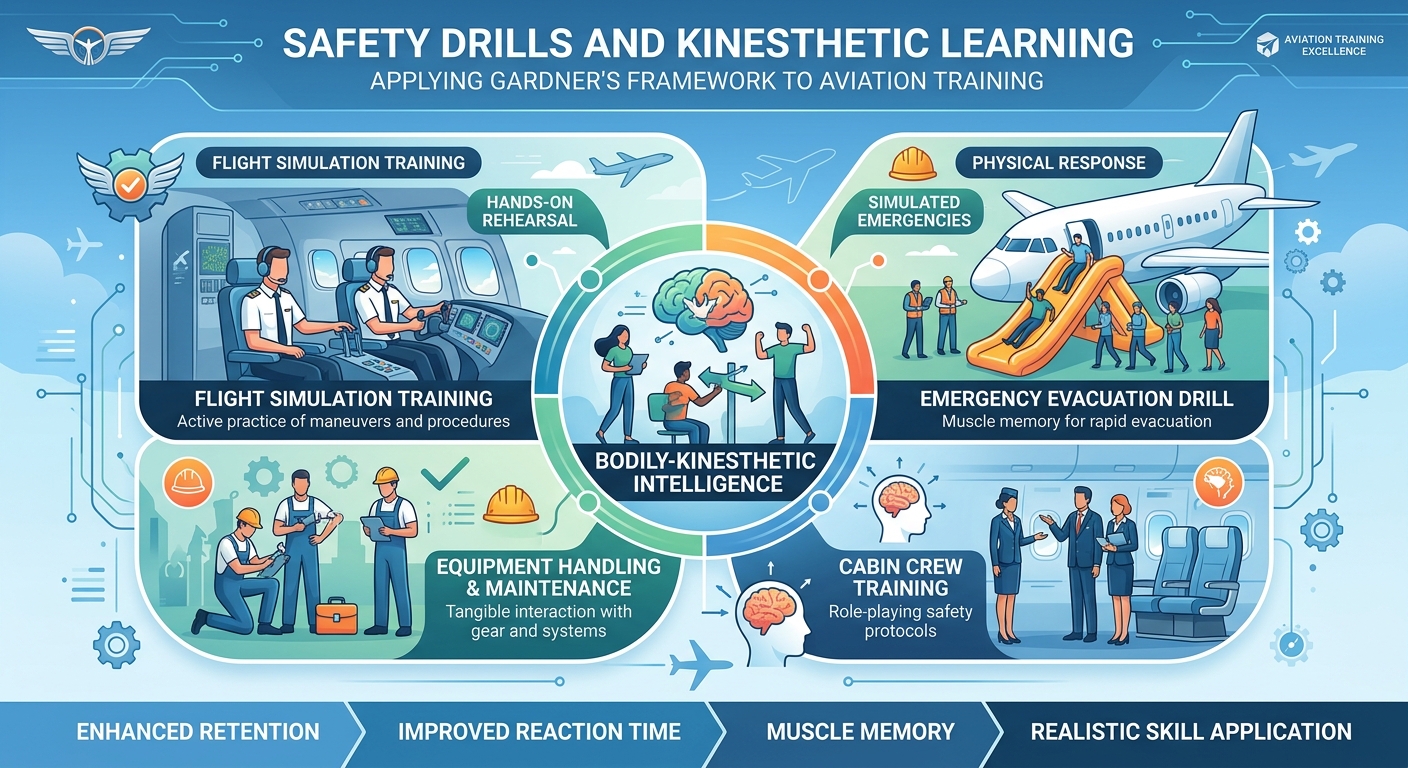
- Cockpit Simulations: Pilots don't just study checklists; they spend countless hours in flight simulators, physically manipulating controls, responding to simulated emergencies, and practicing intricate maneuvers. This builds muscle memory for critical actions.
- Emergency Egress Training: Cabin crew and passengers physically practice opening emergency exits, inflating slides, and evacuating aircraft. They learn the motions and spatial awareness required for swift, safe evacuation.
- Fire Suppression Drills: Crew members don real protective gear, handle fire extinguishers, and practice the "P.A.S.S." (Pull, Aim, Squeeze, Sweep) technique on live or simulated fires.
These drills directly engage Bodily-Kinesthetic Intelligence, allowing learners to internalize complex procedures through physical repetition and sensory feedback. The result is a workforce capable of executing critical safety functions instinctively, even under extreme pressure. Such practical applications can be supported by modern learning management solutions that incorporate simulations and interactive elements.
Enhancing Kinesthetic Learning with Modern eLearning Solutions
While traditional drills are vital, modern eLearning offers powerful avenues to extend and reinforce kinesthetic learning, especially for the distributed workforce. A sophisticated enterprise learning management system can be instrumental here:
- Virtual and Augmented Reality (VR/AR): These technologies create immersive environments where learners can virtually interact with equipment, practice procedures, and experience high-fidelity simulations without physical constraints. Imagine a healthcare professional performing a virtual surgery or an oil rig worker practicing maintenance on a digital twin of equipment.
- Interactive Simulations and Serious Games: A Gamified LMS can transform routine safety compliance into engaging, interactive challenges. These platforms allow learners to make decisions, see the consequences of their actions in a safe environment, and refine their responses through iterative practice.
- Microlearning Modules: Short, focused Microlearning LMS modules can provide quick refreshers on specific kinesthetic tasks, perfect for reinforcing knowledge just before a practical drill or a critical operation. This ensures consistent competency.
- Personalized Learning Paths: An Adaptive Learning system can identify a learner's strengths and weaknesses in kinesthetic tasks, recommending targeted practice exercises or virtual drills. This ensures every learner gets the specific reinforcement they need.
- AI-Powered Content Creation: An AI Powered Authoring Tool can swiftly generate realistic scenarios and interactive content for safety drills, simulating various real-world conditions relevant to specific roles or operational contexts. This enhances the relevance and effectiveness of the training.
- Risk-focused Training: By using data analytics from a robust learning management software or LCMS, organizations can identify common errors or high-risk areas in practical tasks and design training specifically to mitigate those risks. This targeted approach is highly effective for improving safety outcomes. A cloud based learning management system makes these advanced features accessible from anywhere. MaxLearn LMS provides all these capabilities in one integrated platform, serving as an excellent learning content management system.
AI-Driven Insights for Optimized Training
Leveraging artificial intelligence can significantly enhance the effectiveness of kinesthetic training programs by providing data-driven insights and personalized experiences.
Personalized Pathways for Practical Skills
Question: How can AI help tailor practical training pathways for individual learners?
Answer: AI systems can analyze performance data from various safety drills, simulations, and real-world scenarios. By identifying individual strengths and weaknesses in kinesthetic tasks, AI can recommend specific, targeted exercises. For example, if a trainee struggles with the precise hand movements required for a particular maintenance procedure, the AI can assign additional virtual reality modules or microlearning segments focusing on that specific motor skill, ensuring an individualized learning journey.
Contextual Relevance in Safety Scenarios
Question: What role can AI play in ensuring safety training scenarios are contextually relevant to diverse operational environments?
Answer: AI can process vast amounts of data related to different operational sites, equipment configurations, environmental conditions, and local regulatory requirements. Based on this analysis, it can dynamically generate or adapt safety drill scenarios to be highly relevant to a learner's specific role and location. This ensures that a healthcare professional's emergency drill content reflects their specific hospital layout and equipment, or an offshore worker's training includes scenarios pertinent to their particular rig and its environmental challenges, enhancing the practical applicability of their kinesthetic learning.
Predicting and Preventing Skill Gaps
Question: How can artificial intelligence systems be leveraged to predict potential skill gaps in practical safety procedures and suggest proactive interventions?
Answer: By continuously monitoring employee performance in drills, simulations, and even daily tasks (where data is available), AI can identify subtle trends or emerging patterns that indicate potential skill degradation or gaps in practical safety knowledge. For instance, if several team members consistently make a specific error during a simulated evacuation, the AI can flag this and recommend proactive refreshers, targeted kinesthetic practice, or modified safety protocols to prevent future incidents before they occur, maintaining a consistently high level of safety readiness.
Implementing a Kinesthetic-Centric Approach Across Industries
The lessons from aviation are universally applicable. In healthcare, nurses and doctors benefit from high-fidelity simulations for surgical procedures and emergency response. In manufacturing, workers can practice operating heavy machinery or executing precise assembly tasks in VR before touching physical equipment. Retail and hospitality staff can refine customer service scenarios, including handling difficult situations, through role-playing and interactive simulations. Financial institutions can use interactive platforms for compliance training, where employees physically navigate ethical dilemmas or risk scenarios. The core idea is to move beyond passive learning and create active, hands-on experiences that develop not just knowledge, but practical, performable skills.
Conclusion
By consciously incorporating kinesthetic learning, guided by Gardner's framework, into safety drills and compliance training, L&D leaders can unlock unprecedented levels of employee competence and confidence. Modern eLearning platforms, particularly an advanced LMS, provide the tools to scale this approach, delivering immersive, personalized, and highly effective training that directly impacts safety, performance, and regulatory adherence across every industry. Embrace "learning by doing" – your organization's safety and success depend on it.
.jpg)


