

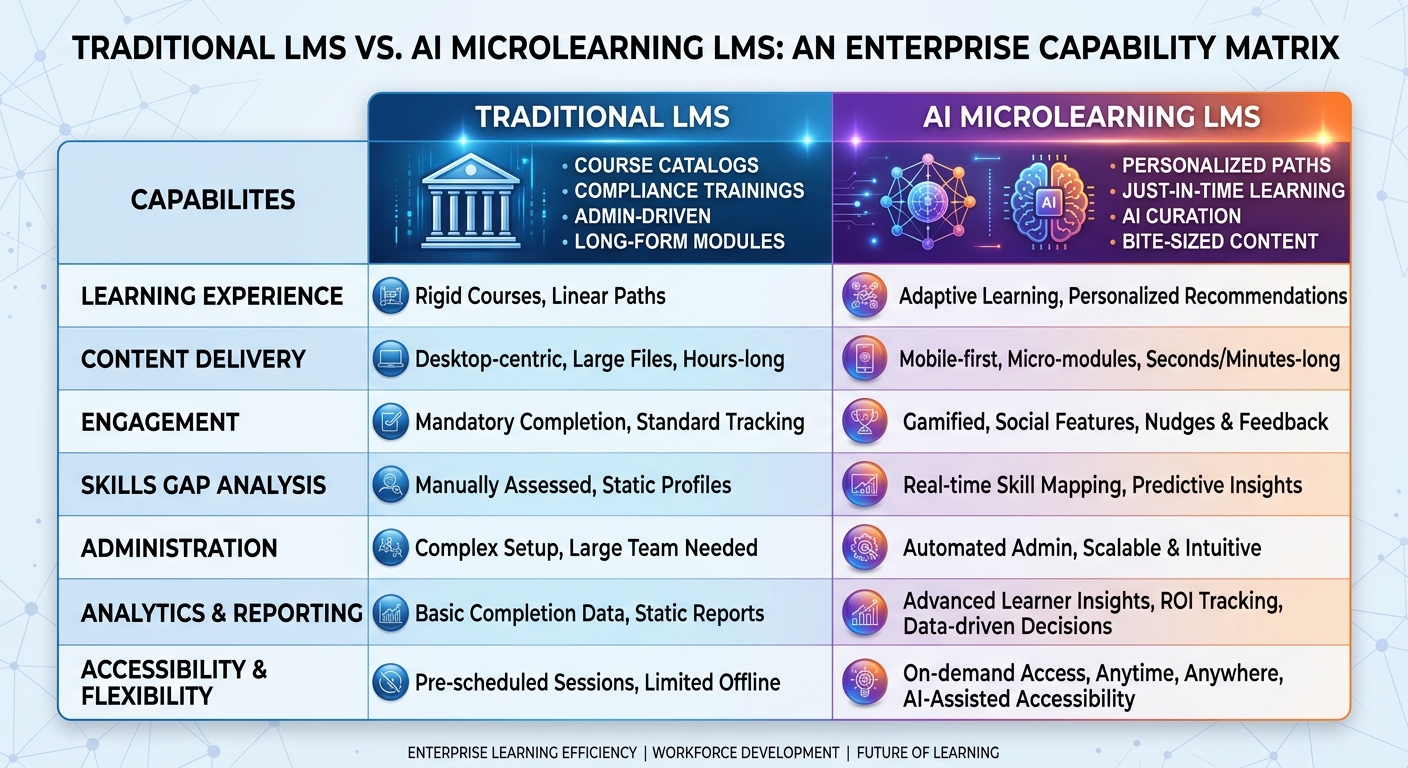
Traditional LMS vs. AI Microlearning LMS: An Enterprise Capability Matrix
In the dynamic landscape of enterprise learning and development, the foundational choice of a learning management system (LMS) can significantly impact an organization's ability to educate, upskill, and retain its workforce. For VPs, Directors, and Managers of L&D, the decision often boils down to balancing established reliability with cutting-edge innovation. This article delves into a crucial comparison: the traditional Microlearning LMS versus the advanced AI Microlearning LMS, presenting an enterprise capability matrix to guide your strategic choices across various industries, from compliance and finance to healthcare and oil & gas.
The Stalwart: Traditional Learning Management System
For decades, the traditional Microlearning LMS has been the backbone of corporate training. These platforms excel at centralizing learning content, managing user profiles, tracking progress, and generating reports. A typical learning management software solution provides a structured environment for delivering courses, often relying on SCORM or xAPI standards for interoperability.
Strengths of Traditional LMS:
- Centralized Content Repository: An efficient learning content management system that consolidates all training materials.
- Robust Tracking & Reporting: Essential for compliance training, tracking completions, and generating audit trails.
- Scalability for Standardized Training: Capable of deploying uniform courses to large employee populations, crucial for sectors like retail or banking.
- Established Workflows: Familiar interfaces and administrative processes, reducing the learning curve for L&D teams.
Limitations of Traditional LMS:
- Generic Learner Experience: Content is often one-size-fits-all, leading to low engagement and decreased knowledge retention.
- Content Stagnation: Updating comprehensive courses can be slow and resource-intensive, a challenge for industries with rapidly changing regulations like pharma or healthcare.
- Lack of Personalization: Struggles to adapt to individual learning styles, prior knowledge, or job roles, which is critical for specialized roles in finance or sales.
- Passive Learning: Often focuses on completion rates rather than demonstrable skill acquisition or behavioral change.
The Innovator: AI Microlearning Learning Management System
Enter the AI Microlearning LMS, a paradigm shift that marries the power of artificial intelligence with the efficacy of microlearning. This approach delivers bite-sized, focused content at the moment of need, significantly enhancing engagement and application. An AI-powered learning management system leverages machine learning to personalize the learning journey, making it highly relevant and adaptive.
Key Advantages of AI Microlearning LMS:
- Personalized Learning Paths: AI algorithms analyze learner data to recommend specific modules, ensuring relevance and maximizing knowledge gain. This is invaluable for complex roles in industries like oil and gas or insurance.
- Adaptive Content Delivery: Content adjusts based on learner performance, providing remediation for weaknesses and advanced material for strengths. This Adaptive Learning approach is particularly effective for highly technical or regulated fields.
- Enhanced Engagement: Incorporates elements like gamification and interactive challenges, transforming passive consumption into active participation. A Gamified LMS drives motivation and competition, ideal for sales training.
- Just-in-Time Learning: Delivers precise information exactly when it's needed, whether on a sales call, a factory floor, or a customer service interaction, boosting productivity.
- Agile Content Creation: AI Powered Authoring Tool capabilities drastically speed up content development and updates, keeping training current in fast-evolving sectors.
Enterprise Capability Matrix: Traditional vs. AI Microlearning
Let’s compare these two approaches across critical enterprise capabilities:
1. Learner Engagement & Retention
- Traditional LMS: Often struggles with engagement due to static, lengthy content. Retention can be low without strong extrinsic motivators.
- AI Microlearning LMS: High engagement through interactive, bite-sized content and Gamified LMS features. Adaptive Learning reinforces concepts, leading to superior long-term retention.
2. Content Delivery & Personalization
- Traditional LMS: Delivers standardized content to all. Customization is minimal and manual.
- AI Microlearning LMS: Intelligent content delivery tailors learning paths based on roles, performance, and preferences. It's a truly personalized enterprise learning management solution.
3. Agility & Content Updates
- Traditional LMS: Updates are typically slow, manual, and costly, hindering responsiveness to market changes or new regulations.
- AI Microlearning LMS: Rapid content creation and iteration using an AI Powered Authoring Tool. Essential for industries with dynamic compliance requirements.
4. Data Analytics & Insights
- Traditional LMS: Provides basic completion and assessment scores. Insights are largely descriptive.
- AI Microlearning LMS: Offers deep, predictive analytics on learner behavior, knowledge gaps, and content effectiveness, allowing for proactive intervention and strategic L&D adjustments.
5. Compliance & Risk Mitigation
- Traditional LMS: Excellent for documenting compliance training completion and maintaining records.
- AI Microlearning LMS: Not only tracks compliance but also identifies and addresses high-risk knowledge areas proactively through adaptive assessments and targeted refreshers. Offers Risk-focused Training to mitigate potential issues before they arise, critical for finance, healthcare, and mining.
6. Scalability & Cost-Efficiency
- Traditional LMS: Scales well for uniform content but can become cost-prohibitive for customization or frequent updates.
- AI Microlearning LMS: Highly scalable for personalized learning with automated content adaptation. Reduces training time and improves outcomes, leading to long-term cost savings and higher ROI. Many are cloud based learning management system solutions, offering flexible deployment.
Industry-Specific Applications of AI Microlearning LMS
- Compliance & Finance: Ensures employees stay current with complex regulations through Risk-focused Training and adaptive refreshers, reducing audit risks.
- Sales & Retail: Provides just-in-time product knowledge, sales techniques, and customer service skills via a Gamified LMS, directly impacting revenue.
- Healthcare & Pharma: Delivers critical updates on new protocols, medications, and patient care best practices, minimizing errors and improving patient outcomes.
- Hospitality: Trains staff quickly on service standards, new procedures, and guest experience best practices, enhancing brand reputation.
- Oil & Gas / Mining: Offers safety training and operational procedure refreshers in remote locations, crucial for minimizing accidents and ensuring operational efficiency.
Making the Strategic Choice for Your Enterprise Learning Management Needs
The choice between a traditional learning management system and an AI Microlearning LMS isn't about discarding the old but strategically embracing the new. While a traditional learning management software might suffice for basic record-keeping, an AI Microlearning LMS offers a powerful competitive advantage by truly transforming how your organization learns. Platforms like MaxLearn LMS exemplify this next generation of enterprise learning solutions, offering an LCMS that delivers personalized, engaging, and impactful training.
For L&D leaders looking to drive measurable business outcomes, improve employee performance, and future-proof their workforce, the capabilities of AI-powered microlearning are increasingly indispensable. Evaluate your current challenges: Are your employees engaged? Is your training truly effective? Can you adapt quickly to change? The answers will likely point towards the intelligent, agile future of learning.
Addressing Common Questions About Intelligent Learning Systems
As organizations consider evolving their learning technology, several questions frequently arise regarding the impact and implementation of advanced systems:
How does artificial intelligence enhance learning personalization?
Intelligent systems analyze individual learner data, including performance, preferences, and progress, to dynamically recommend tailored content modules, quizzes, and learning paths. This ensures that each employee receives the most relevant and effective training for their specific needs and role, optimizing knowledge acquisition and skill development.
What impact does intelligent content creation have on training agility?
Systems leveraging advanced content tools significantly accelerate the development and updating of training materials. By automating aspects of content generation, curation, and adaptation, these tools allow L&D teams to respond rapidly to evolving business needs, market changes, or new regulatory requirements, keeping training consistently relevant and current.
Can advanced learning platforms improve a company's financial performance?
Yes, by improving employee competency, reducing training time, and increasing knowledge retention, these platforms contribute directly to productivity gains and error reduction. This leads to better operational efficiency, enhanced customer satisfaction, and ultimately, a positive impact on the organization's bottom line and competitive standing.
How do these systems support global training initiatives?
Advanced learning solutions are designed with scalability and localization in mind. They can deliver personalized content in multiple languages and formats, adapting to cultural nuances and regional compliance requirements. This ensures consistent, effective training across diverse geographical locations, unifying global workforces under common learning objectives.


