

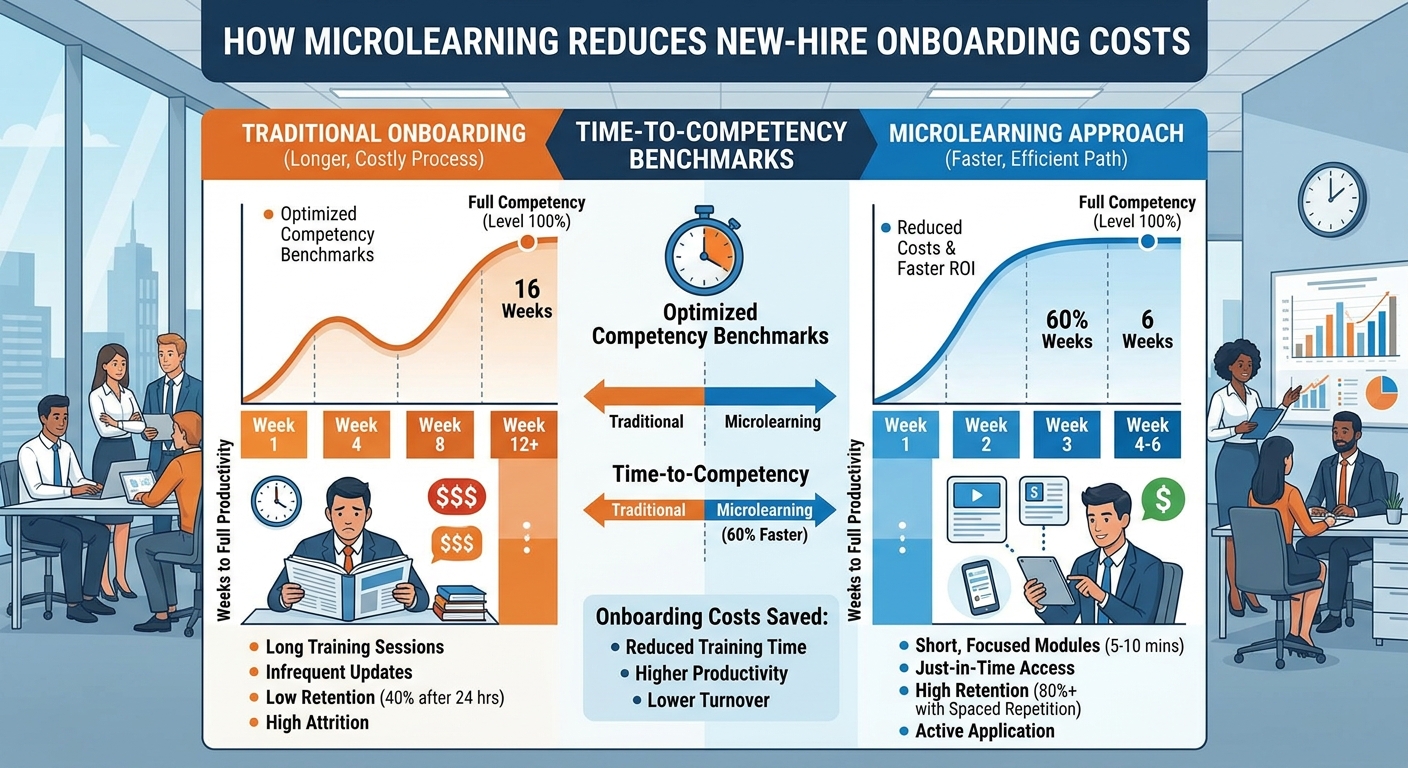
Time-to-Competency Benchmarks: How Microlearning Reduces New-Hire Onboarding Costs
In today's fast-paced corporate landscape, the efficiency of new-hire onboarding directly impacts an organization's bottom line. For Vice Presidents, Directors, and Senior Managers in Learning & Development, optimizing the journey from 'new hire' to 'fully competent' is a critical challenge. High onboarding costs, prolonged learning curves, and inconsistent performance benchmarks can erode profitability and stifle growth. This article delves into the transformative power of microlearning, demonstrating how it dramatically reduces new-hire onboarding expenses by accelerating time-to-competency across diverse industries, from compliance-heavy sectors like banking and healthcare to dynamic environments like sales and retail.
The Critical Importance of Time-to-Competency Benchmarks
Time-to-Competency (TtC) refers to the duration it takes for a new employee to acquire the necessary skills, knowledge, and behaviors to perform their job duties effectively and independently. Establishing clear TtC benchmarks is vital for several reasons:
- ROI Optimization: Every day an employee spends in onboarding is an investment. A shorter TtC means a faster return on that investment, as new hires contribute productively sooner.
- Reduced Turnover: A structured, efficient onboarding process improves employee satisfaction and engagement, significantly lowering early-stage attrition rates, which are notoriously costly.
- Consistent Performance: Clear benchmarks ensure all new hires meet a standardized level of proficiency, leading to predictable performance and quality of service. This is particularly crucial in sectors like healthcare (patient safety), finance (regulatory compliance), and hospitality (customer experience).
- Cost Savings: Shorter training periods reduce the direct costs associated with trainers, materials, and facility usage, as well as the indirect costs of lost productivity.
- Compliance Assurance: In heavily regulated industries such as pharmaceuticals, banking, and oil & gas, achieving competency swiftly helps meet critical compliance requirements, mitigating risks and potential legal ramifications.
The Burden of Traditional Onboarding Methods
Traditional onboarding programs often rely on lengthy classroom sessions, dense manuals, and extensive e-learning modules. While well-intentioned, these methods frequently fall short in accelerating TtC and driving down costs:
- Information Overload: New hires are bombarded with too much information at once, leading to poor retention and cognitive overload.
- Lack of Engagement: Passive learning experiences result in disinterest and a disconnect between training content and real-world application.
- Inflexibility: One-size-fits-all training often fails to address individual learning styles or prior knowledge, slowing down those who could learn faster and frustrating those who need more support.
- High Resource Consumption: Significant time and resources are allocated to developing and delivering comprehensive courses that may not be fully utilized or retained.
These inefficiencies translate into higher onboarding costs, delayed productivity, and, ultimately, a slower path to achieving business objectives.
Microlearning: Revolutionizing the Onboarding Experience
Microlearning is a game-changer for new-hire onboarding. It delivers bite-sized, focused learning content designed for specific learning objectives. Instead of a multi-hour course, new hires engage with 3-5 minute modules addressing a single concept, skill, or process. This approach directly addresses the shortcomings of traditional methods, propelling new hires to competence faster and more cost-effectively.
How Microlearning Drives Down Onboarding Costs:
-
Accelerated Skill Acquisition and Productivity
By delivering information in digestible chunks, microlearning allows new hires to grasp concepts quickly and apply them immediately. This reduces the time spent away from their core duties, shortening the non-productive phase of onboarding. Whether it's a sales professional learning a new CRM feature, a bank teller understanding a specific transaction protocol, or a healthcare worker mastering a critical safety procedure, microlearning facilitates rapid application.
A robust Microlearning LMS provides the platform for delivering this content efficiently, making it accessible on demand.
-
Enhanced Knowledge Retention and Application
Research shows that spaced repetition and immediate application significantly improve long-term retention. Microlearning facilitates this by breaking down complex topics into manageable units that can be revisited as needed. This "just-in-time" learning model is invaluable for reinforcing knowledge and ensuring it translates into real-world performance, directly impacting industries where precision and memory are key, such as compliance and technical roles in mining or oil & gas.
-
Reduced Training Time and Resource Allocation
Microlearning significantly cuts down on the hours required for formal training. This means less time spent in classrooms, fewer facilitator costs, and reduced need for extensive printed materials. The modular nature of microlearning content also makes it easier and faster to update, ensuring that training remains relevant without extensive overhaul costs – a crucial advantage for industries with evolving regulations like finance and pharmaceuticals.
-
Increased Engagement and Motivation
Short, interactive modules are inherently more engaging than lengthy courses. When combined with elements of a Gamified LMS, microlearning can transform onboarding into an exciting, rewarding experience. This boosts learner motivation, encourages active participation, and ultimately leads to faster skill mastery and higher completion rates, reducing the need for costly re-training.
-
Improved Compliance and Risk Mitigation
For industries heavily reliant on compliance—banking, insurance, pharma, healthcare, and retail with specific product handling—microlearning ensures that critical regulatory information is absorbed and retained effectively. Focused modules on specific policies, ethical guidelines, or safety protocols can be delivered and tracked with precision. This approach to Risk-focused Training minimizes errors, reduces legal exposure, and helps organizations meet audit requirements more effectively, preventing costly penalties and reputational damage.
Leveraging Technology for Optimal Microlearning Onboarding
The success of a microlearning strategy for onboarding is amplified by the right technology. A modern learning management system (LMS) is essential for delivering, tracking, and managing microlearning content. A robust LMS learning management system or learning management software, particularly a cloud based learning management system, provides the infrastructure for seamless learning experiences.
Intelligent Solutions for Enhanced Onboarding:
Question: How can artificial intelligence (AI) enhance the effectiveness of microlearning onboarding across diverse global teams?
AI plays a pivotal role in personalizing and optimizing the microlearning experience. An advanced enterprise learning management platform can leverage AI to analyze a new hire's progress, identify knowledge gaps, and recommend personalized micro-modules. This Adaptive Learning approach ensures that each learner receives precisely the content they need, when they need it, accelerating their path to competency. For a globally distributed workforce, AI can also provide content in multiple languages and adapt to local compliance nuances, ensuring consistent and effective training regardless of geographic location. This ensures that a learning content management system serves diverse needs efficiently.
Question: What are the immediate benefits for L&D teams adopting AI in their microlearning strategy for content creation?
For L&D teams, the integration of an AI Powered Authoring Tool can dramatically streamline content creation. This reduces the time and resources required to develop high-quality microlearning modules. AI can assist in content generation, automatically chunking larger content into micro-modules, suggesting relevant assessments, and even personalizing pathways based on role or skill level. This significantly lowers content development costs and accelerates the deployment of new training materials, which is a huge advantage for rapidly changing industries like technology or retail. Such a learning management system offers substantial operational efficiencies.
Question: Beyond content delivery, how can a comprehensive learning solution support talent development throughout an employee's lifecycle?
A comprehensive learning management software, or LCMS, extends its utility far beyond initial onboarding. By continuously offering just-in-time micro-modules for upskilling and reskilling, it supports ongoing professional development. For instance, in sales, a new product launch can be quickly communicated via microlearning. In healthcare, updated protocols can be deployed instantly. This continuous learning environment, supported by a system like MaxLearn LMS, ensures employees remain competent and adaptable throughout their careers, further maximizing the long-term ROI of training investments and reducing the need for costly, large-scale retraining initiatives.
Implementing Microlearning in Your Organization
To successfully implement a microlearning strategy for onboarding, consider the following:
- Content Audit & Chunking: Break down existing onboarding materials into bite-sized, single-concept modules. Focus on creating engaging, media-rich content.
- Platform Selection: Choose a modern Microlearning LMS that supports adaptive learning, gamification, and robust analytics.
- Pilot Programs: Start with a pilot group, gather feedback, and iterate before a full rollout.
- Measure & Optimize: Continuously track key metrics like TtC, completion rates, knowledge retention, and job performance to demonstrate ROI and refine the program.
Conclusion
The journey from new hire to a fully competent, productive employee can be long and expensive. However, by embracing microlearning, L&D leaders have a powerful tool to significantly reduce these costs and accelerate time-to-competency. Across all industries—from ensuring compliance in banking and pharma to boosting sales effectiveness in retail and driving safety in mining—microlearning offers a scalable, engaging, and highly effective solution. By leveraging cutting-edge technology, including AI-powered authoring and adaptive learning within a sophisticated learning management system, organizations can future-proof their onboarding processes, cultivate a highly skilled workforce, and achieve substantial savings. It's time to redefine your onboarding benchmarks with the precision and power of microlearning.
.jpg)


