

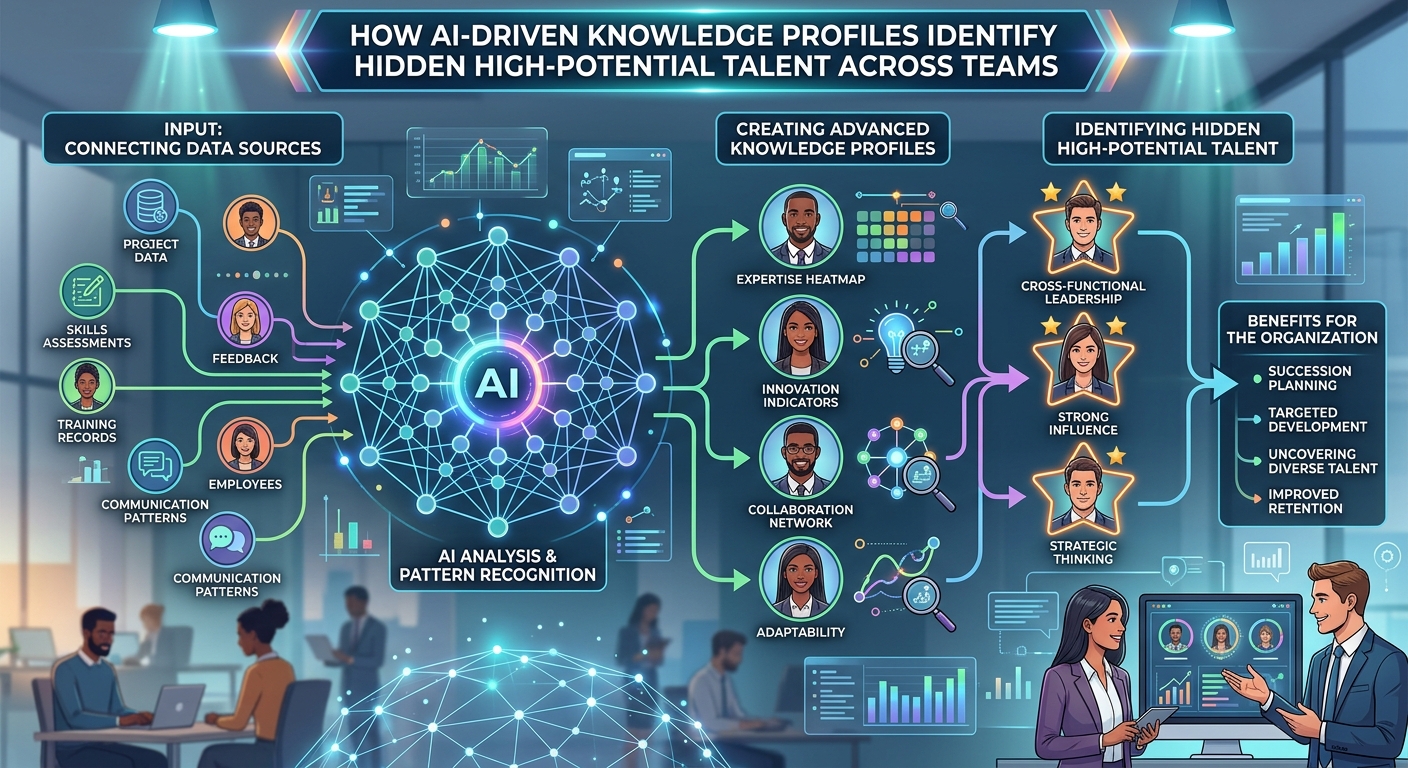
How AI-Driven Knowledge Profiles Identify Hidden High-Potential Talent Across Teams
In today’s rapidly evolving business landscape, the ability to identify and nurture high-potential talent is no longer a luxury but a strategic imperative. Traditional methods, often reliant on performance reviews, manager recommendations, or self-nomination, frequently overlook invaluable skills and capabilities buried deep within an organization. Many L&D leaders, VPs, Directors, and Managers are grappling with the challenge of systematically uncovering these hidden gems. What if there was a way to move beyond subjective assessments and proactively identify individuals poised for greater impact? The answer lies in the transformative power of AI-driven knowledge profiles.
For organizations spanning Compliance, Sales, Banking, Finance, Insurance, Retail, Pharma, Health Care, Hospitality, Oil and Gas, and Mining, understanding internal talent pools is critical for succession planning, innovation, and maintaining a competitive edge. This article delves into how artificial intelligence is revolutionizing talent identification, creating dynamic knowledge profiles that bring an unprecedented level of insight into your workforce's true capabilities and potential.
The Evolving Challenge of Talent Identification
Identifying high-potential employees has always been a complex endeavor. Human biases, limited visibility across departments, and the sheer volume of data make it difficult to get a holistic view of an individual's skills, aspirations, and contributions. Often, the most valuable talent isn't the loudest voice in the room but rather the quiet innovator, the cross-functional problem-solver, or the emerging leader whose potential hasn't been fully recognized by existing structures. This 'invisible' talent represents a significant untapped resource for organizational growth and resilience.
Enter AI-Driven Knowledge Profiles
AI-driven knowledge profiles fundamentally change this paradigm. By leveraging advanced algorithms, machine learning, and natural language processing, these profiles create a comprehensive, dynamic, and objective representation of an employee's professional identity within the organization. They move beyond static resumes and performance scores, constructing a living portfolio of an individual's capabilities.
What Exactly are AI-Driven Knowledge Profiles?
Think of an AI-driven knowledge profile as a sophisticated digital twin of an employee's professional self. It's an aggregation of data points from various sources – project contributions, completed training modules, certifications, internal communications, peer reviews, skill endorsements, and even informal learning activities. AI analyzes these diverse inputs to construct a nuanced understanding of an individual’s explicit and implicit skills, knowledge areas, work preferences, and growth trajectories. This process goes far beyond what a typical LMS or learning content management system might capture alone.
How AI Goes Beyond the Resume
Traditional talent identification often focuses on past roles and formal qualifications. AI, however, excels at identifying latent skills and potential. It can detect patterns in project data that indicate a knack for leadership, an aptitude for complex problem-solving, or an emerging expertise in a critical area, even if these haven't been formally recognized or explicitly stated. For instance, an employee consistently contributing innovative solutions in project discussions, even if not in a designated "innovation" role, would have this attribute highlighted by an AI-driven profile.
The Mechanics of AI Talent Identification
The magic of AI in talent identification lies in its ability to process vast amounts of unstructured and structured data, identifying correlations and predicting outcomes that human analysis might miss. Many organizations are now seeking more advanced learning management solutions that incorporate these AI capabilities.
Skills Mapping and Gap Analysis
One of the primary functions of AI-driven profiles is precise skills mapping. By analyzing an individual’s work output, learning history, and peer interactions, AI can create a detailed map of their current proficiencies. This isn't just about listed skills; it's about demonstrated ability. Simultaneously, it identifies skill gaps in relation to future organizational needs or specific roles, paving the way for targeted development plans. This dynamic mapping capability is a core feature of an advanced lms learning management system.
Behavioral and Performance Insights
AI can uncover behavioral traits and performance indicators often overlooked. By analyzing how individuals collaborate on projects, communicate within teams, or respond to challenges, AI can infer characteristics such as resilience, adaptability, leadership potential, or problem-solving approaches. For instance, an employee who consistently takes initiative to learn new tools or proactively shares knowledge across teams demonstrates traits indicative of high potential.
Predictive Analytics for Future Leaders
Perhaps the most exciting aspect is AI's predictive capability. Based on an individual's current profile, learning velocity, and demonstrated attributes, AI can forecast potential career paths and identify individuals most likely to excel in future leadership roles or critical projects. This foresight allows L&D teams to proactively invest in Adaptive Learning programs and mentorship, nurturing talent before a critical need arises.
Benefits for L&D Leaders
For VPs, Directors, and Managers of L&D, integrating AI-driven knowledge profiles translates into tangible strategic advantages:
- Improved Succession Planning: Proactively identify a robust pipeline of internal candidates for critical roles, reducing reliance on external hires.
- Personalized Development Paths: Offer tailored learning experiences based on individual skill gaps and career aspirations identified by AI. This enhances engagement and accelerates skill development.
- Enhanced Internal Mobility: Facilitate intelligent internal transfers and promotions by matching employees with roles that align with their hidden talents and growth potential, fostering a culture of opportunity.
- Reduced Time-to-Fill: Quickly identify qualified internal candidates for new projects or critical roles, significantly shortening recruitment cycles. Leveraging an AI Powered Authoring Tool further speeds up content creation for rapid upskilling.
- Objective and Unbiased Assessment: Mitigate human biases in talent identification, ensuring a fairer and more equitable process based on data, not perception.
Industry-Specific Applications
The versatility of AI-driven knowledge profiles extends across diverse industries:
- Compliance & Banking: Identify employees with an innate understanding of complex regulations or a strong aptitude for Risk-focused Training, crucial for roles in regulatory affairs or fraud detection. A sophisticated learning management software can track this development.
- Sales & Retail: Pinpoint sales associates who consistently achieve targets through innovative approaches or excel in customer engagement, irrespective of their formal title, and groom them for leadership or specialized product roles.
- Healthcare & Pharma: Uncover clinical staff with a natural affinity for new technologies, research methodologies, or patient education, vital for adopting cutting-edge treatments or improving patient outcomes.
- Oil and Gas & Mining: Identify engineers or field workers who demonstrate exceptional problem-solving skills in complex operational scenarios, even if not explicitly part of their job description, preparing them for critical project leadership.
- Hospitality: Discover staff members who consistently go above and beyond in guest satisfaction or operational efficiency, nurturing them for management or specialist customer experience roles.
Many organizations are exploring how a cloud based learning management system can make these capabilities accessible globally, fostering talent discovery across continents and diverse operational hubs. This makes sophisticated talent identification tools available to a broader range of businesses, not just large enterprises.
The Future of Talent Management
How can organizations effectively implement AI for talent identification? The key lies in integrating AI capabilities within existing talent infrastructure, especially within a robust enterprise learning management system or LCMS. This ensures that learning and development initiatives are directly informed by talent insights. What specific platforms facilitate this? Modern Gamified LMS platforms, for example, often embed AI to personalize learning paths and identify skill acquisition, indirectly contributing to knowledge profiles. Furthermore, robust data privacy and ethical AI practices are paramount to ensure trust and compliance when leveraging such powerful tools.
AI-driven knowledge profiles are not about replacing human judgment but augmenting it. They provide L&D professionals with a powerful lens to see beyond the surface, understand the true depth of their workforce's capabilities, and proactively develop the leaders and innovators of tomorrow. By embracing this technology, organizations can unlock hidden potential, foster a culture of continuous growth, and ensure they are always one step ahead in the race for talent.
.jpg)


