

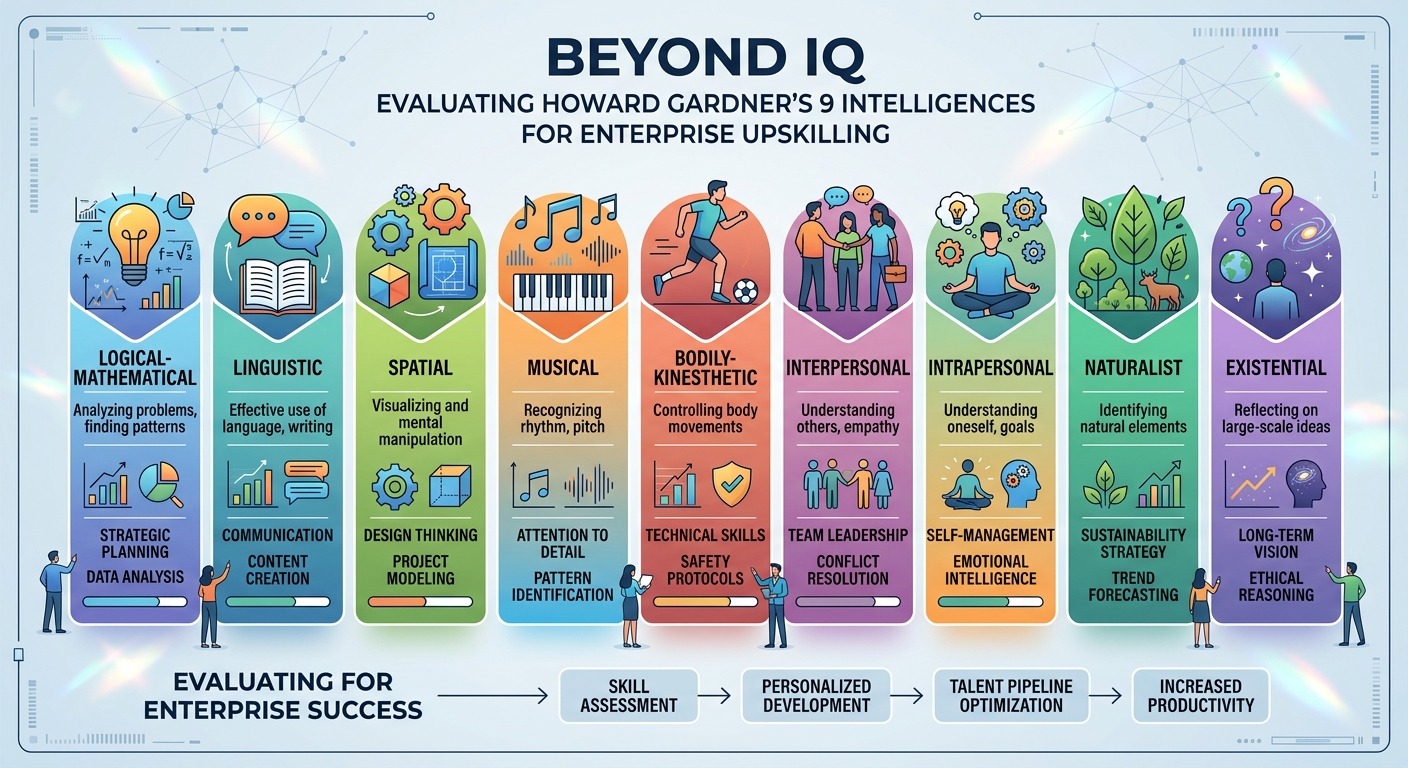
Beyond IQ: Evaluating Howard Gardner’s 9 Intelligences for Enterprise Upskilling
For decades, the concept of intelligence was largely dominated by the IQ score – a single metric purporting to measure an individual's cognitive ability. While useful in its time, this narrow definition often overlooked the multifaceted talents crucial for success in dynamic professional environments. In today’s rapidly evolving enterprise landscape, where upskilling and reskilling are constant imperatives, L&D leaders recognize the need for a more comprehensive understanding of human potential.
Enter Howard Gardner’s Theory of Multiple Intelligences (MI). Gardner proposed that intelligence is not a singular entity but rather a diverse range of abilities, each reflecting a different way of interacting with the world. For Vice Presidents, Directors, and Senior Managers of L&D, embracing this richer perspective offers a powerful framework for designing more effective, engaging, and inclusive learning experiences that truly prepare employees for the challenges ahead, from compliance and sales to complex operations in pharma and oil & gas.
The Spectrum of Human Potential: Gardner's Nine Intelligences
Gardner initially outlined seven intelligences, later expanding to nine. These distinct cognitive abilities provide a blueprint for understanding how individuals learn best and excel in different domains. By recognizing and nurturing these diverse strengths, organizations can unlock hidden potential and foster a culture of continuous growth.
- Linguistic Intelligence: The ability to use language effectively, both orally and in writing. Ideal for roles in sales, marketing, legal (compliance), and corporate communications. Upskilling often involves public speaking, negotiation skills, and effective report writing.
- Logical-Mathematical Intelligence: The capacity for logical thinking, problem-solving, and abstract reasoning. Crucial for roles in finance, IT, engineering, data analysis, and strategic planning in any industry from banking to mining. Training focuses on analytical frameworks, coding, and statistical interpretation.
- Spatial Intelligence: The ability to think in three dimensions and visualize the world accurately. Essential for designers, architects, surgeons (health care), engineers, and anyone involved in logistics, product display (retail), or interpreting complex diagrams in manufacturing or oil & gas.
- Bodily-Kinesthetic Intelligence: Expertise in using one's body to express ideas and feelings, and a facility for using hands to produce or transform things. Relevant for surgeons, skilled technicians (hospitality, mining), product assembly, customer service (body language), and any hands-on operational role.
- Musical Intelligence: The capacity to discern pitch, rhythm, timbre, and tone. While seemingly niche, this intelligence can relate to pattern recognition, auditory learning, and even understanding the "rhythm" of a team or a process. It can be subtly leveraged in creating memorable learning jingles or audio cues.
- Interpersonal Intelligence: The ability to understand and interact effectively with others. Vital for leadership roles, sales, customer service, HR, and team-based projects across all industries, including insurance and retail. Training emphasizes communication, empathy, and conflict resolution.
- Intrapersonal Intelligence: The capacity to understand oneself – one's own emotions, motivations, and goals. Essential for personal development, self-management, ethical decision-making (compliance), and fostering resilience. Training focuses on mindfulness, goal setting, and self-reflection.
- Naturalist Intelligence: The ability to recognize and categorize elements of the natural world. Relevant for environmental scientists, botanists, and even those who identify patterns in complex data sets or understand ecosystem dynamics in industries like agriculture or resource management.
- Existential Intelligence: The propensity to ponder deep questions about life, death, and existence. This intelligence drives strategic vision, ethical leadership, and a sense of purpose, particularly relevant for senior leadership navigating complex organizational changes or defining corporate values in any sector.
Bridging Theory to Practice: Applying Multiple Intelligences in Enterprise Upskilling
Tailoring Learning for Diverse Teams
Moving beyond a one-size-fits-all approach is critical. For instance, learning management solutions designed with MI in mind can transform how employees in critical sectors like healthcare, finance, or compliance acquire new skills. Consider sales training: individuals with strong Linguistic intelligence might thrive with engaging narratives and role-playing, while those high in Interpersonal intelligence benefit from collaborative exercises and peer feedback. For sectors like Pharma or Health care, where complex procedures are common, leveraging Spatial intelligence through 3D simulations or Bodily-Kinesthetic intelligence through virtual reality practicals can be transformative.
Enhancing Engagement and Retention
When training aligns with an individual's natural intelligence, engagement skyrockets, and knowledge retention improves dramatically. A Gamified LMS, for example, appeals to Logical-Mathematical intelligence through strategy, Bodily-Kinesthetic through interactive challenges, and Interpersonal through team-based competitions. Similarly, Adaptive Learning paths, where content adjusts based on a learner's performance and preferences, directly supports Intrapersonal intelligence by empowering individuals to learn at their own pace and in their preferred style.
The Technological Edge: Enabling MI-Centric Upskilling
Modern eLearning technologies are perfectly poised to deliver training that caters to Gardner's diverse intelligences. A robust LMS or a sophisticated Learning content management system (LCMS) provides the infrastructure to host varied content formats and track learner progress effectively. An enterprise learning management system needs to be flexible, scalable, and intuitive.
- A Microlearning LMS excels at delivering concise, targeted content suitable for quick consumption and reinforcement. This format often appeals to Logical-Mathematical and Linguistic learners who prefer focused information chunks.
- A Gamified LMS transforms learning into an engaging experience with points, badges, and leaderboards, tapping into Bodily-Kinesthetic (interaction), Logical-Mathematical (strategy), and Interpersonal (team challenges) intelligences.
- Adaptive Learning methodologies use algorithms to tailor learning paths based on individual progress and preferences, greatly benefiting learners with strong Intrapersonal intelligence who thrive on personalized journeys.
- An AI Powered Authoring Tool dramatically speeds up the creation of diverse content – from interactive simulations for Spatial learners to rich audio narratives for Linguistic and Musical learners. This is critical for keeping training fresh and relevant across all nine intelligences.
- Risk-focused Training, essential in industries like Banking, Insurance, and Mining, can be designed to appeal to Logical-Mathematical intelligence through scenario analysis and Existential intelligence through discussions of ethical implications and long-term consequences.
Implementing a comprehensive MaxLearn LMS empowers L&D professionals to move beyond generic training, embracing a truly personalized and impactful approach to upskilling.
The Future of Personalized Learning: AI and Multiple Intelligences
As L&D leaders, you're constantly seeking innovative ways to optimize learning. The intersection of AI and Multiple Intelligences offers exciting possibilities for ultra-personalized development. But what does this look like in practice?
Consider this common challenge: "How can artificial intelligence identify and leverage individual intelligence profiles for enterprise upskilling across different global locations?" An advanced learning management system can utilize AI to analyze user interaction data – which content formats they engage with most, their performance in different types of assessments, and their navigation patterns. For example, if an employee in a remote mining operation consistently performs well in visual simulations and spatial puzzles, the AI can recommend more diagram-heavy modules or 3D models for future technical training, regardless of their geographical location. It can also identify patterns in collective data to suggest localized content or training methods that resonate culturally and intellectually with a specific region, making learning more relevant and effective globally. A cloud based learning management system facilitates this global reach and data aggregation.
Another pressing question for L&D professionals is: "What advanced analytical insights can AI provide to help L&D leaders optimize training programs for diverse learning preferences, particularly in specialized industries?" AI within a modern lms learning management system can go beyond simple completion rates. It can track which content types (videos, interactive exercises, written guides) lead to higher comprehension scores, faster skill acquisition, or better on-the-job application. For a financial institution, AI might reveal that Logical-Mathematical learners respond best to interactive case studies for risk management training, while Interpersonal learners excel in peer-led discussion groups for ethical conduct, allowing L&D to fine-tune future curriculum design based on actual, measurable impact across various intelligences. This level of insight transforms a standard learning management software into a strategic asset.
Finally, L&D teams often wonder: "How can we efficiently create varied content that caters to all nine intelligences, especially for complex topics like compliance or advanced technical skills, without overwhelming our resources?" This is where the power of an AI Powered Authoring Tool becomes invaluable. It can rapidly generate multiple versions of a single compliance module – a text-based version for Linguistic learners, a flowchart-based version for Logical-Mathematical, an interactive scenario for Interpersonal, or a video demonstration for Bodily-Kinesthetic. This significantly reduces content development time and ensures that comprehensive learning management solutions can consistently offer diverse, engaging options.
Conclusion: Beyond the Scorecard
In the quest for effective enterprise upskilling, limiting our view of potential to a single IQ score is a disservice to both individuals and organizations. Howard Gardner’s theory of Multiple Intelligences offers a profoundly richer, more accurate lens through which to view and nurture talent. By understanding and catering to the diverse cognitive strengths within your workforce, L&D leaders can design truly transformative learning experiences.
The strategic implementation of an intelligent MaxLearn LMS, equipped with adaptive features, gamification, microlearning capabilities, and AI-powered tools, is not just an investment in technology; it's an investment in holistic human development. Embrace the power of multiple intelligences to unlock unprecedented levels of engagement, performance, and innovation across your enterprise, forging a future where every employee can thrive and contribute their unique genius.
.jpg)


