

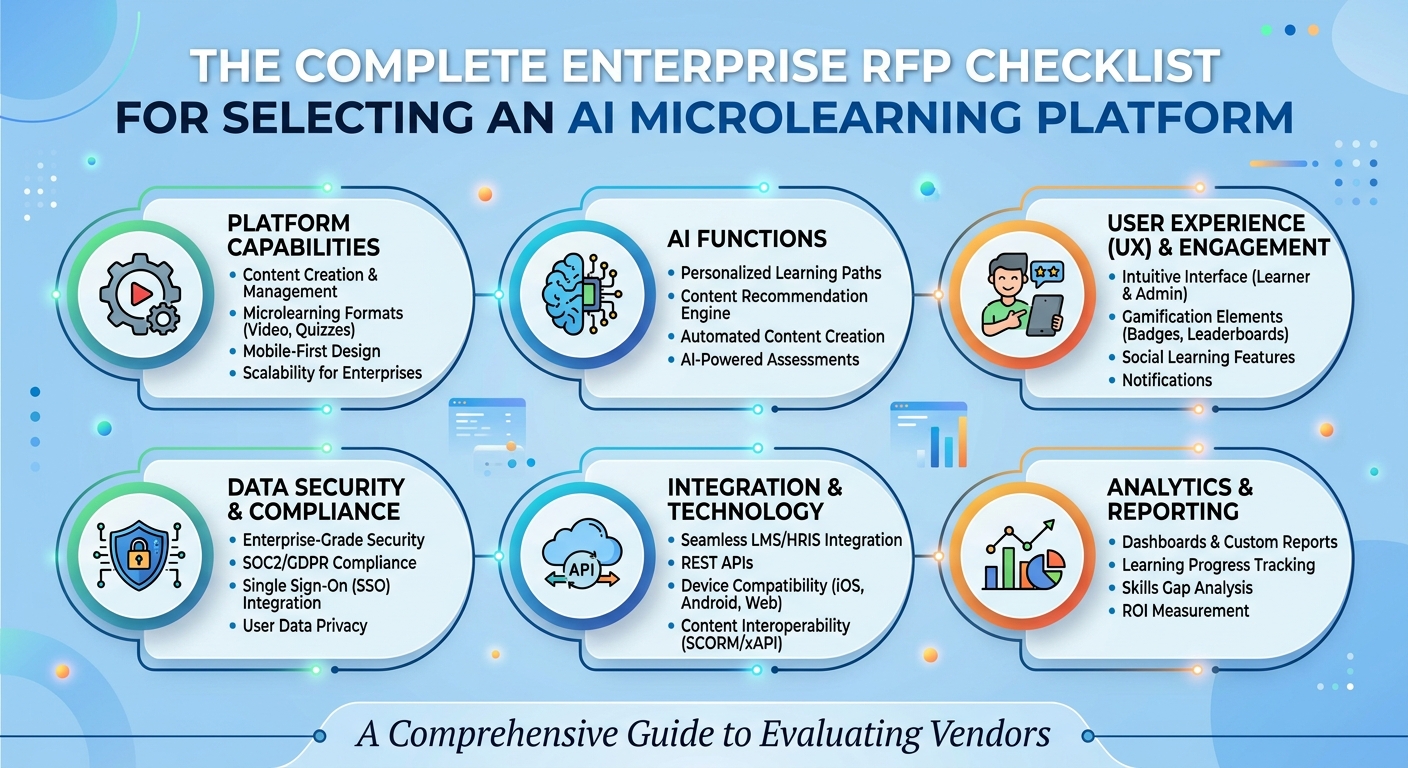
The Complete Enterprise RFP Checklist for Selecting an AI Microlearning Platform
In today's fast-paced corporate environment, continuous learning isn't just a benefit; it's a strategic imperative. For L&D Vice Presidents, Directors, and Managers across sectors like Banking, Pharma, Retail, and Oil & Gas, the challenge is immense: how do you deliver engaging, effective, and compliant training at scale to a diverse and often dispersed workforce? Traditional learning management software often falls short in meeting the agile demands of modern enterprises.
Enter Artificial Intelligence (AI) microlearning platforms. These innovative solutions promise to revolutionize corporate training by delivering bite-sized, personalized content precisely when and where it's needed. But selecting the right Microlearning LMS for your enterprise is a complex undertaking, requiring a meticulous Request for Proposal (RFP) process. This comprehensive checklist will guide you through the critical considerations to ensure you choose a platform that truly empowers your workforce and aligns with your strategic objectives.
Why AI Microlearning is a Game-Changer for Enterprises
Enterprise learning management faces unique hurdles. Whether it's ensuring compliance in Financial Services, upskilling sales teams in Technology, or enhancing patient care in Healthcare, the need for efficient, impactful training is constant. AI microlearning addresses these by:
- Boosting Engagement: Short, focused modules prevent overload and improve completion rates.
- Personalizing Paths: AI tailors content to individual learner needs, roles, and performance gaps.
- Driving Retention: Spaced repetition and interactive elements solidify knowledge.
- Ensuring Agility: Rapid content updates keep training relevant in dynamic industries.
Many L&D leaders wonder: "How does artificial intelligence enhance enterprise training personalization?" The answer lies in AI's ability to analyze learner data – performance, roles, past interactions, and even cognitive styles – to recommend the most relevant micro-lessons, quizzes, and resources. This ensures every learner's journey is unique and highly effective, moving beyond a one-size-fits-all approach common in traditional learning management systems.
Your Enterprise RFP Checklist: Key Evaluation Categories
A successful RFP is your blueprint for a long-term strategic partnership. Here are the essential categories and detailed questions to include:
1. Platform Capabilities & User Experience
The foundation of any successful learning management system is its usability and core functionality. Your chosen platform must be intuitive for learners and administrators alike.
- User Interface & Experience (UI/UX): Is the platform intuitive, clean, and engaging? Does it offer a truly mobile-first design, accessible on any device?
- Scalability: Can the platform seamlessly handle tens of thousands, or even hundreds of thousands, of users across multiple departments, regions, and languages? Describe its architecture for high availability and performance.
- Microlearning Delivery: What specific features support microlearning content (e.g., short video players, interactive quizzes, flashcards, spaced repetition, drip campaigns)?
- Gamification: Does the platform incorporate elements of a Gamified LMS (points, badges, leaderboards, challenges) to enhance engagement and motivate learners, particularly for compliance or sales training?
- Reporting & Analytics: What real-time dashboards and reporting tools are available? Can you track completion rates, performance metrics, skill proficiency, and learner engagement at granular and aggregate levels?
2. AI and Adaptive Learning Prowess
This is where an AI microlearning platform truly distinguishes itself. Dig deep into its intelligent capabilities.
- Personalized Learning Paths: How does the AI engine dynamically adapt content recommendations and learning paths based on individual learner progress, performance, role, and pre-assessment results? Provide examples of Adaptive Learning in action.
- Skill Gap Identification: Can the AI identify specific skill gaps within a team or individual and recommend targeted micro-lessons to address them?
- Content Recommendation Engine: Describe the algorithms used for suggesting relevant content. Is it based solely on past interactions or does it leverage broader data points?
- Intelligent Assessment: How does the platform use AI to create adaptive assessments, provide immediate feedback, and suggest remedial content?
3. Content Creation and Management
An enterprise learning content management system (LCMS) must support efficient content development and curation.
- Authoring Capabilities: Does it include an integrated AI Powered Authoring Tool? How easy is it for instructional designers or even subject matter experts to create, upload, and update microlearning content?
- Content Formats: What types of content are supported (SCORM, xAPI, video, audio, PDFs, interactive simulations, VR/AR)?
- Content Versioning & Localization: How does the platform handle multiple versions of content and facilitate translation/localization for global teams in industries like Pharma or Hospitality?
- Content Curation: Can administrators easily curate, organize, and tag content for discoverability?
4. Integration and Ecosystem
Your new learning management system needs to play well with your existing technology stack.
- HRIS/HCM Integration: Describe standard integrations with major HR systems (e.g., Workday, SAP SuccessFactors) for user provisioning and data synchronization.
- CRM Integration: For sales organizations, how does the platform integrate with CRM systems (e.g., Salesforce) to track sales training completion and impact on performance?
- APIs & Webhooks: Does the platform offer robust APIs and webhooks for custom integrations with other enterprise systems?
- Single Sign-On (SSO): Support for SAML, OAuth, or other SSO protocols for seamless user access.
5. Security, Compliance, and Data Privacy
For industries like Banking, Insurance, and Healthcare, security and compliance are non-negotiable. Considering global teams, a common query is "What data security measures should an enterprise look for in a cloud based learning management system to ensure compliance across different regions?"
- Data Encryption: What encryption protocols are used for data at rest and in transit?
- Access Controls: Describe your role-based access control (RBAC) features to manage administrator and user permissions.
- Regulatory Compliance: Detail compliance with GDPR, CCPA, HIPAA, ISO 27001, SOC 2 Type 2, and any other industry-specific regulations relevant to your sector (e.g., FINRA for finance, GxP for pharma). How does the platform support Risk-focused Training and audit trails?
- Data Hosting: Where are your servers located? Do you offer data residency options to comply with regional data governance laws?
- Disaster Recovery & Business Continuity: Outline your strategy for data backup, disaster recovery, and ensuring continuous service availability.
6. Vendor Support, Implementation, and Pricing
A strong partnership is key to long-term success with your enterprise learning management solution.
- Implementation & Onboarding: Describe the implementation process, timeline, and resources provided for initial setup, data migration, and administrator training.
- Customer Support: What levels of support are offered (24/7, dedicated account manager, online portal, phone, email)? What are your typical response times and SLAs?
- Training & Documentation: What training resources are available for administrators and end-users? Is there comprehensive documentation and a knowledge base?
- Pricing Model: Provide a detailed breakdown of your pricing structure (e.g., per user, tier-based, enterprise license). Include all potential costs: setup, training, support, custom development. What is the total cost of ownership (TCO) over 3-5 years?
- Roadmap & Innovation: Share your product roadmap for the next 12-24 months, particularly focusing on AI enhancements and upcoming features.
Making the Final Decision
After evaluating the technical and functional aspects, consider a pilot program with a subset of your target audience. Gather feedback from diverse stakeholders – learners, L&D administrators, IT, and business unit leaders. A platform like MaxLearn LMS, known for its powerful microlearning capabilities, often allows for such pilots to demonstrate real-world impact before full-scale deployment.
The right AI microlearning platform isn't just another lms learning management system; it's a strategic investment in your organization's future. It should empower your employees, drive performance, and help you navigate the complexities of your industry, whether it's regulatory compliance in Mining or customer service excellence in Hospitality.
Conclusion
Selecting an AI microlearning platform for your enterprise is a pivotal decision. By meticulously following this comprehensive RFP checklist, L&D leaders can cut through the noise, objectively evaluate solutions, and identify a partner that aligns with their strategic vision for learning and development. A thoughtfully chosen platform will not only transform your training initiatives but also significantly contribute to your organization's agility, resilience, and sustained success in an ever-evolving market.


