

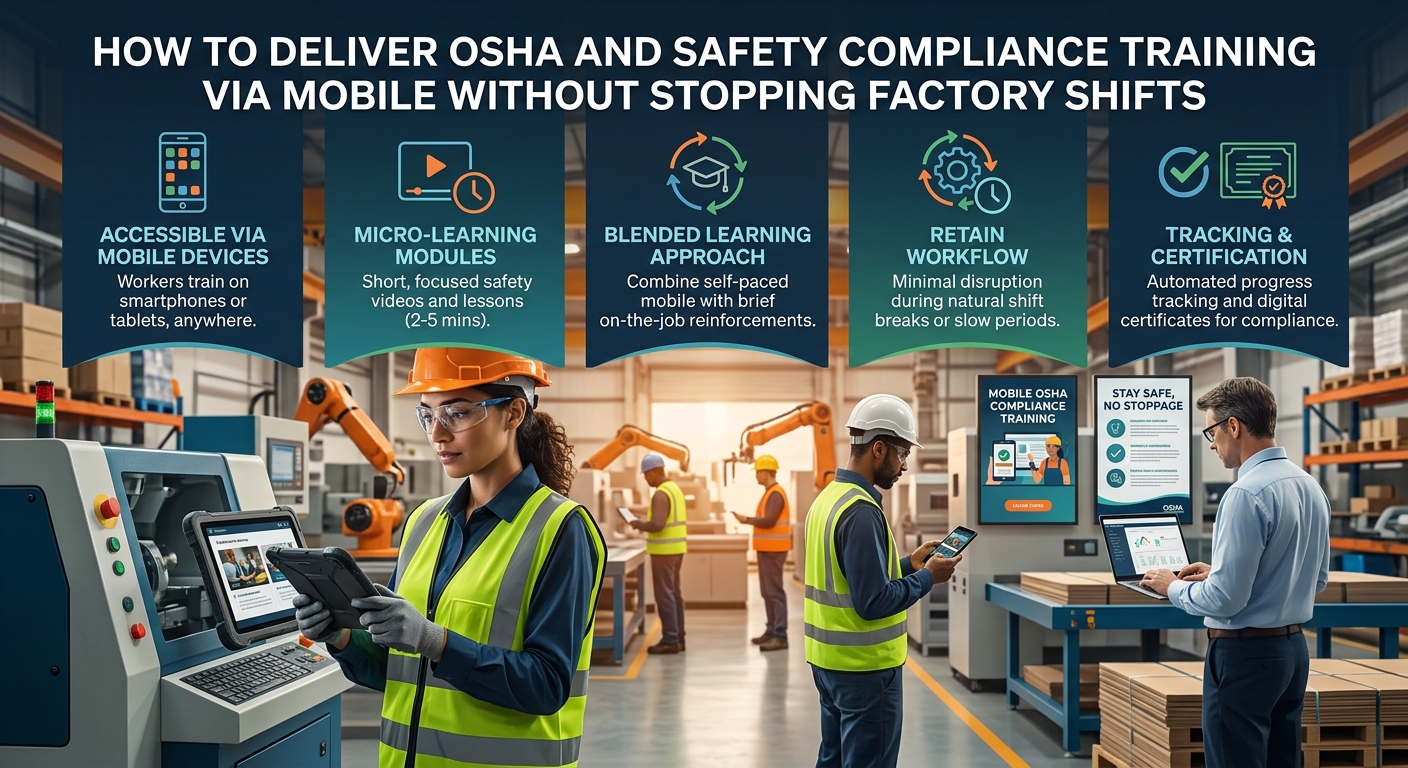
How to Deliver OSHA and Safety Compliance Training via Mobile Without Stopping Factory Shifts
In today's fast-paced industrial landscape, maintaining continuous operations is paramount. For Vice Presidents, Directors, and Senior Managers in L&D, the challenge often lies in reconciling critical compliance requirements, particularly OSHA and safety training, with the operational imperative to avoid production downtime. The traditional model of classroom-based training, requiring workers to leave their stations, has become a significant bottleneck, leading to lost productivity and substantial costs. Many leaders are now asking: what is the most effective way to provide mandatory safety training without halting production lines?
The answer lies in embracing mobile-first learning solutions. This approach allows organizations to not only meet regulatory obligations but also enhance worker engagement and retention of vital safety information, all without impacting factory shifts. This article explores how modern eLearning strategies, powered by sophisticated platforms, enable seamless, on-the-go compliance training.
The Persistent Challenge of Traditional Compliance Training
For decades, safety training often meant gathering employees in a conference room, away from their tasks, for hours-long sessions. While well-intentioned, this method presents several critical drawbacks for industries spanning manufacturing, oil and gas, mining, pharma, and healthcare.
Cost Implications and Lost Productivity
Every minute a production line is idle, or an employee is off the floor, directly impacts the bottom line. Calculating the true cost involves not just instructor fees and facility rentals, but also the quantifiable loss of output. For large organizations, these figures can escalate rapidly, making traditional training an expensive necessity rather than a strategic investment. The constant push for efficiency compels L&D leaders to seek innovative alternatives.
Logistical Nightmares and Scheduling Complexities
Coordinating training for a large, diverse workforce across multiple shifts, often in environments with strict operational schedules, is a logistical headache. Juggling shift rotations, equipment availability, and trainer schedules often results in fragmented training experiences or, worse, delayed compliance due to an inability to accommodate everyone efficiently. This can leave organizations vulnerable to regulatory penalties.
Engagement Deficits and Knowledge Retention Issues
Long, passive classroom sessions are notoriously ineffective at holding adult learners' attention, especially for practical subjects like safety. Monotonous presentations can lead to disengagement, where employees merely "check the box" without truly internalizing the safety protocols. This lack of retention poses a significant risk, potentially undermining the very purpose of the training: preventing accidents and injuries.
The Mobile-First Revolution in Compliance Training
Enter the era of mobile learning, a game-changer for OSHA and safety compliance. By leveraging the omnipresence of smartphones and tablets, organizations can transform how they deliver critical training, turning a disruptive necessity into a continuous, integrated part of the workday.
Flexibility and Uninterrupted Operations
The core advantage of mobile training is its flexibility. Employees can access short, targeted training modules during natural lulls in their shifts, during breaks, or even commute time. This "anytime, anywhere" access eliminates the need to halt production, ensuring operational continuity while employees fulfil their training requirements. This approach is particularly valuable in sectors like retail and hospitality, where staff availability can fluctuate rapidly.
Enhanced Engagement and Knowledge Application
Mobile platforms, especially when combined with modern instructional design principles, can deliver highly engaging content. Interactive quizzes, simulations, and real-world scenarios presented in bite-sized formats resonate better with today's learners. This active engagement leads to superior knowledge retention and, crucially, a greater likelihood of applying safety protocols effectively on the factory floor.
Consistent Delivery and Robust Tracking
A sophisticated LMS (Learning Management System) or Learning content management system designed for mobile ensures consistency in training delivery across all employees, regardless of their shift or location. Furthermore, these platforms offer robust tracking and reporting capabilities, providing L&D leaders with real-time insights into completion rates, performance, and compliance status. This capability helps address questions like: how can we ensure consistent safety education across our geographically dispersed workforce?
Key Technologies for Seamless Mobile Delivery
The success of mobile safety training hinges on the right technological infrastructure. Advanced learning management solutions are now equipped with features that make this transformation possible.
- Microlearning LMS: Breaking down complex safety topics into short, digestible modules (2-5 minutes) is crucial for mobile consumption. MaxLearn LMS excels in delivering these focused bursts of information, making it easy for employees to learn without feeling overwhelmed or taking extended breaks from work.
- Gamified LMS: Incorporating game-like elements such as points, badges, leaderboards, and challenges can significantly boost motivation and engagement in compliance training. A Gamified LMS transforms routine safety lessons into an interactive and rewarding experience.
- Adaptive Learning Paths: Not all learners are the same. An adaptive system adjusts the content and pace based on an individual's prior knowledge and performance, ensuring that training is personalized and efficient. This targeted approach helps answer the question: how can we tailor safety training to individual worker needs without creating an administrative nightmare?
- AI Powered Authoring Tool: Creating engaging mobile-friendly content quickly can be a challenge. AI-powered tools streamline the development process, allowing L&D teams to rapidly convert existing materials into interactive, responsive formats suitable for mobile devices, or even generate new content based on specific learning objectives.
- Risk-focused Training: Tailoring training to address specific risks prevalent in a particular work environment ensures relevance and impact. Mobile platforms can deliver modules that directly address common hazards or near-misses, providing immediate, context-specific knowledge.
Implementing Mobile OSHA Training: A Step-by-Step Approach
For L&D leaders looking to transition to mobile compliance training, a structured approach is key.
Content Conversion and Optimization
Begin by auditing existing OSHA and safety content. Prioritize converting critical modules into microlearning formats. Ensure all content is responsive, meaning it adapts seamlessly to various screen sizes – from smartphones to tablets – and is optimized for offline access where connectivity might be an issue. Utilizing an AI Powered Authoring Tool can significantly accelerate this process.
Platform Selection
Choosing the right learning management software is crucial. Look for a cloud based learning management system that offers robust mobile capabilities, offline access, strong analytics, and supports diverse content types. A comprehensive enterprise learning management system like MaxLearn LMS, which functions as both an LMS and an LCMS, can manage not just delivery but also the creation and storage of your learning content efficiently.
Phased Rollout and Pilot Programs
Instead of a full-scale launch, consider piloting the mobile training with a smaller group of employees. Gather feedback, identify pain points, and refine your approach before rolling it out company-wide. This ensures a smoother transition and greater acceptance.
Continuous Monitoring and Optimization
Leverage the analytics provided by your lms learning management system to monitor engagement, completion rates, and assessment scores. Use this data to continually optimize content, identify areas for improvement, and ensure the training remains effective and up-to-date with evolving regulations and workplace hazards. This proactive approach helps answer: what adjustments should be made based on learner performance data?
Addressing Common Concerns
Some leaders express concerns about device availability or connectivity. Many modern factory floors are equipped with Wi-Fi, and organizations can provide shared tablets or implement a Bring Your Own Device (BYOD) policy with appropriate security measures. For areas with limited connectivity, robust mobile learning management system applications often include offline sync capabilities, allowing content to be downloaded and completed without an internet connection, with progress syncing once online again.
Strategic Advantages for L&D Leaders
Embracing mobile for OSHA and safety compliance positions L&D departments as strategic partners in business operations, not just cost centers. It demonstrates innovation, improves ROI on training investments, enhances safety culture, and significantly reduces the administrative burden associated with traditional methods. By adopting solutions like MaxLearn LMS, L&D can ensure that critical safety knowledge is absorbed, understood, and applied, leading to a safer, more productive workforce without ever needing to stop the factory shifts.
Conclusion
The imperative to deliver OSHA and safety compliance training effectively without disrupting operations is no longer an insurmountable challenge. With the advent of advanced mobile learning management software and innovative instructional design, organizations across all industries can achieve continuous compliance and a stronger safety culture. By investing in a mobile-first eLearning strategy, L&D leaders can ensure their workforce is well-trained, productive, and safe, driving both operational excellence and employee well-being.
`


