

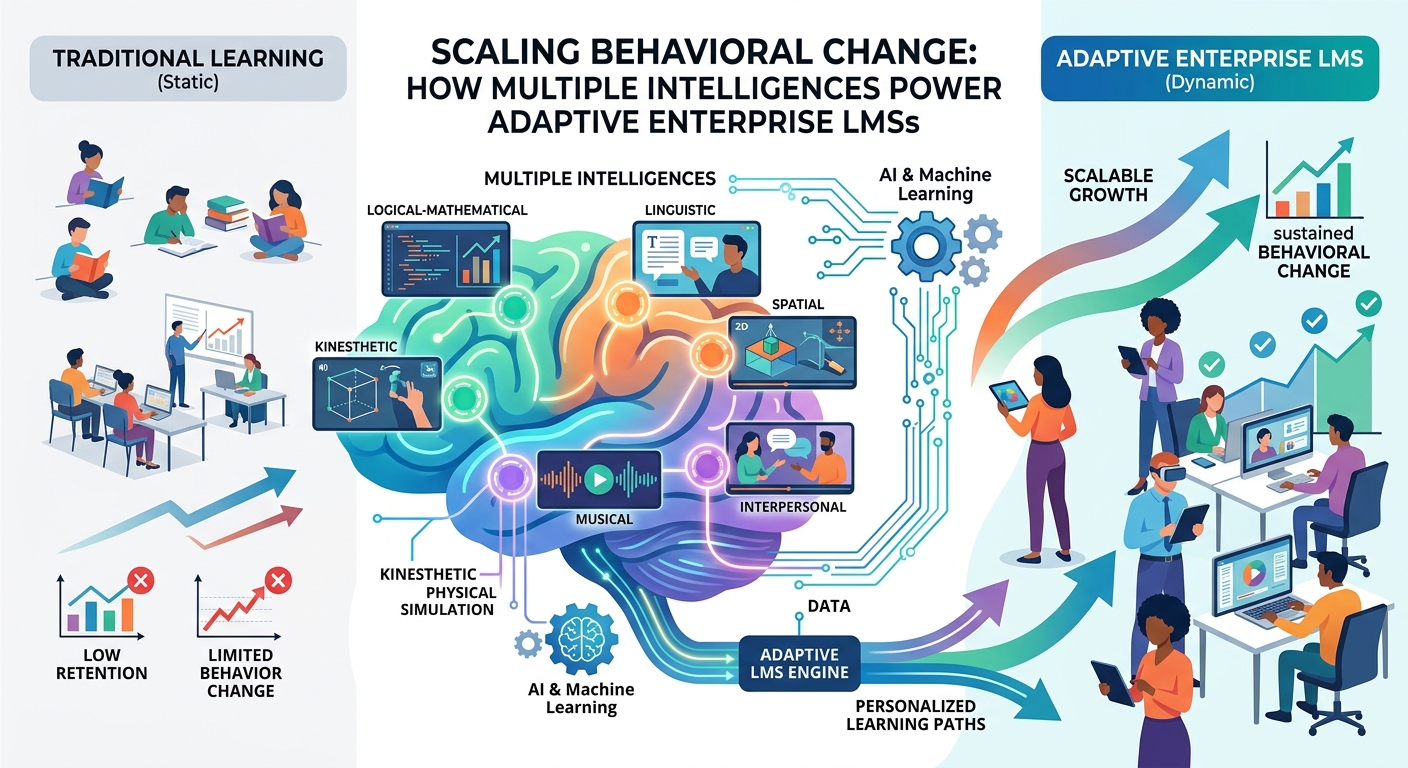
Scaling Behavioral Change: How Multiple Intelligences Power Adaptive Enterprise LMSs
In today's fast-evolving corporate landscape, the ability to foster genuine behavioral change within an organization is not just a desirable trait; it's a critical competitive advantage. For Vice Presidents, Directors, and Senior Managers in Learning & Development (L&D), the challenge lies not only in delivering effective training but in ensuring that new skills translate into sustained, positive actions across the entire enterprise. From compliance and sales to banking, healthcare, and oil & gas, every industry grapples with the need for employees to adapt, learn, and perform differently. This is where an adaptive learning management system, powered by the principles of Multiple Intelligences, becomes an indispensable tool.
Traditional learning content management systems often adopt a one-size-fits-all approach, which, while efficient for content delivery, falls short in addressing the diverse learning styles and cognitive strengths of individuals. The result? High completion rates but low application, leading to a significant gap between training investment and real-world behavioral impact. Imagine an enterprise learning management solution that not only delivers content but intuitively understands and adapts to each learner's unique intelligence profile, optimizing their path to mastery and behavioral transformation. This is the promise of an intelligent, adaptive LMS.
The Elusive Nature of Behavioral Change in the Enterprise
Achieving lasting behavioral change is notoriously difficult. Employees might understand a new process or policy, but internalizing it and consistently applying it under pressure is another matter. Consider the nuances required in Risk-focused Training in finance, the empathy needed in hospitality, or the precise protocols in pharmaceuticals. The human element, with its myriad motivations, cognitive biases, and diverse ways of processing information, often presents the biggest hurdle.
- Cognitive Overload: Too much information delivered uniformly.
- Lack of Engagement: Content that fails to resonate with individual learning preferences.
- Irrelevance: Training that doesn't clearly connect to a learner's role or intelligence.
- Absence of Reinforcement: No sustained practice or feedback mechanisms.
- Measurement Challenges: Difficulty in tracking actual behavioral shifts post-training.
A static learning management software often perpetuates these issues. What's needed is a dynamic system that treats each learner not as an empty vessel to be filled, but as an individual with pre-existing strengths and preferred modes of engagement.
Howard Gardner's Multiple Intelligences: A Blueprint for Personalization
Psychologist Howard Gardner's theory of Multiple Intelligences posits that intelligence is not a single, monolithic entity but rather a collection of distinct capabilities. While individuals typically possess a blend of these, they often exhibit pronounced strengths in one or two areas. An adaptive learning management system leverages this theory to craft highly personalized learning journeys:
- Linguistic Intelligence: Strong in words, language, reading, writing. (Essays, debates, detailed instructions)
- Logical-Mathematical Intelligence: Adept with numbers, reasoning, patterns, problem-solving. (Case studies, data analysis, simulations)
- Spatial Intelligence: Good at visualizing, interpreting maps, graphics, and designs. (Infographics, interactive diagrams, virtual reality scenarios)
- Bodily-Kinesthetic Intelligence: Learns best through doing, movement, hands-on experience. (Role-playing, simulations, practical exercises)
- Musical Intelligence: Sensitive to rhythm, sound, patterns in music. (Mnemonic devices, jingles, background music for focus)
- Interpersonal Intelligence: Skilled in understanding others, collaboration, communication. (Group projects, peer feedback, discussions)
- Intrapersonal Intelligence: Strong self-awareness, introspection, understanding one's own motivations. (Reflective journals, self-assessment, goal setting)
- Naturalistic Intelligence: Connects with nature, patterns in the environment, categorizing. (Field studies, real-world examples, ecological analogies)
By identifying a learner's dominant intelligences, an adaptive LCMS can present content in the most digestible and engaging format, significantly increasing comprehension, retention, and ultimately, the likelihood of behavioral change.
Adaptive Learning: The Engine of Personalized Behavioral Change
Adaptive Learning isn't just about offering choices; it's about intelligently guiding the learner based on their performance, preferences, and progress. An adaptive learning management system continuously assesses the learner, then dynamically adjusts the learning path, content difficulty, and even the presentation style. When combined with Multiple Intelligences, this creates a powerful synergy:
- A learner strong in Logical-Mathematical intelligence might receive more complex problem-solving scenarios.
- A Spatial learner could be presented with animated explanations and interactive 3D models.
- A Bodily-Kinesthetic learner might engage with more simulations and hands-on virtual labs.
This level of personalization, driven by sophisticated algorithms, transforms a generic training module into a bespoke learning experience, making the acquisition of new behaviors feel natural and impactful.
Leveraging Artificial Intelligence for Profound Behavioral Change
The integration of artificial intelligence supercharges the adaptive capabilities of an enterprise learning management solution. Intelligence allows the platform to move beyond simple rule-based adaptation to predictive and proactive learning optimization.
How can intelligent systems optimize learning pathways for individual employees?
Intelligent platforms analyze a vast array of data points – learner performance, engagement metrics, past learning history, and even stated preferences – to construct the most effective and efficient learning journey for each person. This dynamic tailoring ensures that content aligns with their cognitive strengths and addresses their specific gaps, pushing them through personalized challenges and reinforcing positive habits. For example, in a sales training scenario, an intelligent system could identify that a particular salesperson responds best to role-playing simulations for objection handling (Bodily-Kinesthetic) and struggles with product specification recall (Linguistic), then dynamically adjust content delivery to focus on interactive demonstrations and visual aids for product knowledge, while increasing the frequency of virtual sales calls.
How do advanced platforms ensure consistent behavioral change across diverse global workforces?
Modern learning management solutions utilize sophisticated algorithms to understand regional nuances, cultural differences, and diverse proficiency levels. By analyzing data from different geographical locations and demographic segments, these platforms can adapt training content and delivery methods to resonate locally while maintaining core learning objectives. This could involve offering content in multiple languages, presenting case studies relevant to local markets, or adjusting the blend of synchronous and asynchronous learning activities to accommodate time zones and cultural learning preferences, ensuring that desired behaviors are understood and adopted universally, whether in a European financial institution or an Asian manufacturing plant.
What role does sophisticated algorithmic intelligence play in continuously improving learning outcomes and real-world application?
Algorithmic intelligence is crucial for continuous improvement. It not only personalizes the learning experience but also monitors the impact of training on actual job performance. By integrating with HR systems, performance reviews, and even operational data, the platform can identify whether new behaviors are being consistently applied in the workplace. If a specific behavioral change isn't sticking, the system can automatically trigger targeted refresher modules, provide just-in-time support, or recommend different learning modalities. This continuous feedback loop allows the lms learning management system to evolve, becoming more effective over time at driving and sustaining desired employee behaviors and measurable business outcomes across sectors like retail compliance or healthcare protocols.
Building Behavioral Impact with Key Learning Management Solutions Features
To truly scale behavioral change, an adaptive cloud based learning management system must incorporate a suite of features that cater to the diverse needs of the modern enterprise learner:
- Microlearning LMS: Delivering content in bite-sized, focused chunks that are easily digestible and immediately applicable, ideal for just-in-time learning and reinforcement across all intelligence types.
- Gamified LMS: Incorporating game mechanics like points, badges, leaderboards, and challenges to boost engagement, motivation, and healthy competition, particularly appealing to Intrapersonal and Interpersonal intelligences.
- AI Powered Authoring Tool: Enabling L&D teams to quickly create, curate, and adapt content that aligns with different intelligence profiles, automating content suggestions and personalization.
- Analytics and Reporting: Providing deep insights into learner progress, behavioral trends, and the ROI of training initiatives, crucial for L&D leaders to demonstrate impact and optimize strategies.
- Integration Capabilities: Seamlessly connecting with other HR and business systems for a holistic view of employee development and performance.
The Future is Adaptive: Sustained Behavioral Impact for the Enterprise
For L&D professionals, the goal is no longer just knowledge transfer, but observable and sustainable behavioral transformation. An adaptive learning management system, thoughtfully designed around the principles of Multiple Intelligences and enhanced by artificial intelligence, offers a clear path to achieving this. It ensures that every employee, whether a frontline worker in retail or a compliance officer in banking, receives a learning experience that speaks directly to their strengths, empowers them to adopt new behaviors, and contributes directly to the organization's strategic objectives.
By embracing these intelligent, personalized learning management solutions, enterprises can move beyond mere training to cultivate a culture of continuous adaptation and excellence, driving genuine change at scale and securing a competitive edge in any industry. This shift represents a paradigm leap in how organizations approach learning and development, transforming it from a cost center into a powerful engine for growth and innovation with MaxLearn LMS.
.jpg)


