

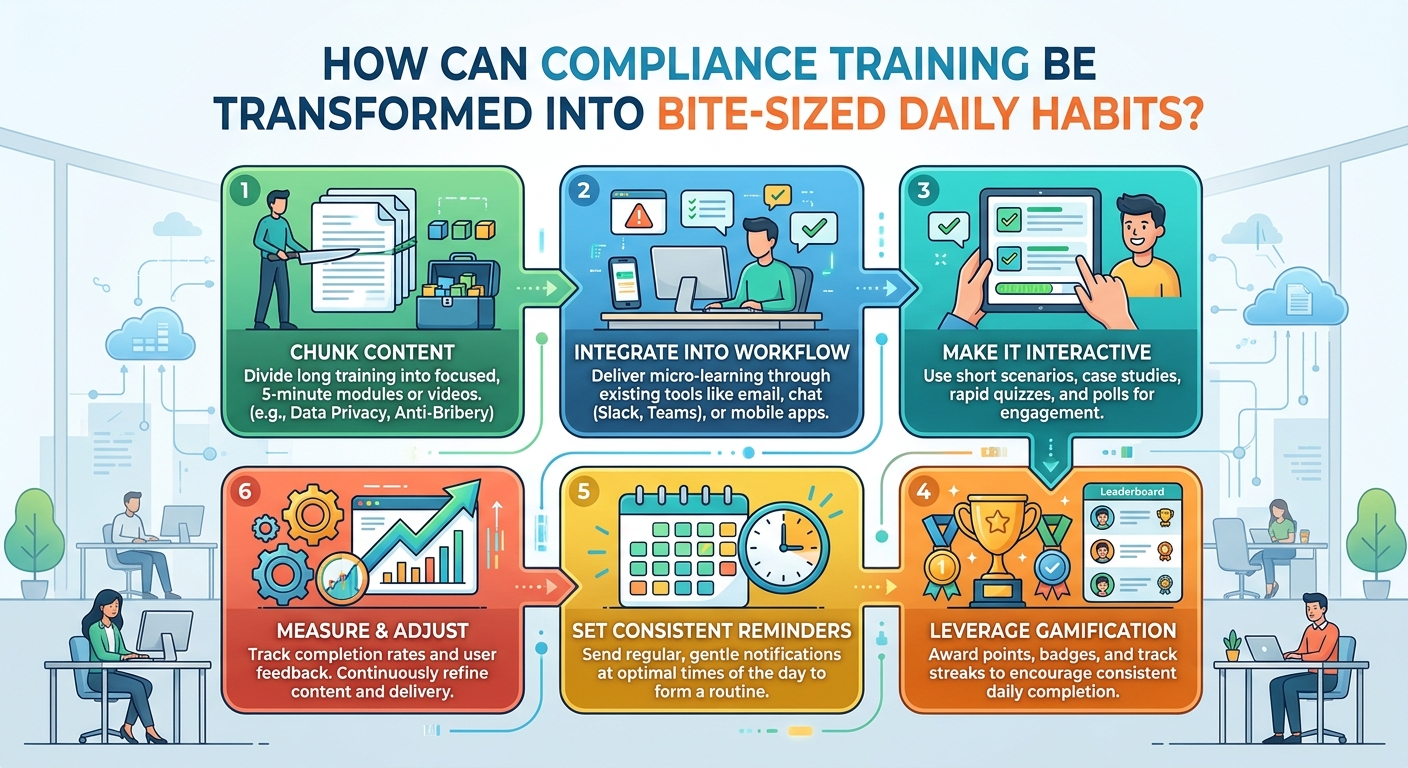
Transforming Compliance Training: Bite-Sized Habits for Daily Excellence
For too long, compliance training has been viewed as a necessary evil – a tedious, annual checkbox exercise that employees dread and often forget soon after completion. In today’s rapidly evolving regulatory landscape, this traditional approach is not just inefficient; it’s a significant risk to your organization. As leaders in Learning & Development, you understand the critical need to move beyond rote memorization towards genuine behavioral change and continuous adherence.
Imagine a world where compliance isn't a burden but an integrated part of daily operations, absorbed through quick, relevant interactions. This isn't a futuristic dream; it's the promise of transforming compliance training into bite-sized daily habits. This article explores how L&D professionals can leverage modern eLearning strategies to foster a culture of continuous compliance, boosting retention, engagement, and ultimately, reducing organizational risk.
The Pitfalls of Traditional Compliance Training
The standard model of compliance training, often delivered through lengthy modules or annual classroom sessions, is fundamentally flawed in several ways:
- Information Overload: Bombarding employees with hours of content leads to cognitive overload and poor retention. Key regulations get lost in a sea of information.
- Lack of Engagement: Generic, one-size-fits-all training rarely resonates with diverse employee roles and learning styles, resulting in disinterest and passive participation.
- "Set It and Forget It" Mentality: Annual refreshers are insufficient to embed complex rules and ethical considerations into daily decision-making. Knowledge decays rapidly.
- Disconnection from Daily Work: The theoretical nature of traditional training often fails to provide practical guidance for real-world scenarios, making it difficult for employees to apply what they've learned.
- Difficulty in Tracking Effectiveness: Beyond completion rates, it's challenging to measure whether employees truly understand and are applying compliance principles.
These challenges highlight a clear need for a paradigm shift. We must move from an event-based approach to a continuous learning journey that empowers employees to embrace compliance naturally.
Embracing the Power of Microlearning for Compliance
The solution lies in microlearning – delivering critical information in short, focused bursts. When applied to compliance, microlearning transforms daunting regulations into manageable, digestible pieces that can be consumed quickly and repeatedly. This approach is perfectly suited for building daily habits.
Key Benefits of Bite-Sized Compliance Learning:
- Enhanced Retention: Shorter modules reduce cognitive load, allowing learners to focus on and better absorb specific concepts. Repeated exposure to bite-sized content reinforces learning over time.
- Increased Engagement: Concise, targeted content is more appealing and less intimidating, encouraging active participation rather than passive viewing.
- Flexibility and Accessibility: Employees can access training anytime, anywhere, on any device, fitting learning into their busy schedules without disruption. This is especially crucial for a diverse workforce utilizing an Microlearning LMS.
- Immediate Application: Microlearning modules can be designed to address specific scenarios or tasks, enabling employees to apply knowledge directly to their work, thereby making compliance a practical skill.
- Cost-Effectiveness: Developing and updating smaller modules is often more agile and less resource-intensive than overhauling lengthy courses, ensuring training stays current with regulatory changes.
Strategies to Transform Compliance into Daily Habits
How do L&D leaders actually implement this transformation? It requires a strategic blend of technology, instructional design, and a shift in organizational mindset. Here are actionable strategies:
1. Segment Content into Granular Modules
Break down complex compliance topics into 3-5 minute modules. Each module should focus on a single learning objective, such as "Understanding Data Privacy for Customer Interactions" or "Identifying Red Flags for Insider Trading." Utilize an advanced Adaptive Learning methodology to ensure content is tailored to individual needs.
2. Gamify the Learning Experience
Inject elements of game design into compliance training to boost motivation and engagement. Leaderboards, points, badges, and challenges can turn mundane topics into an interactive experience. A robust Gamified LMS can facilitate this, making the learning journey more enjoyable and competitive. Imagine daily quizzes or scenario-based mini-games that test understanding of crucial regulations.
3. Implement Spaced Repetition and Nudge Learning
Regular, scheduled reminders and short refreshers are key to embedding knowledge. After initial training, send out daily or weekly "compliance nudges" – a quick question, a scenario, or a fun fact related to a past module. This spaced repetition combats the forgetting curve and keeps compliance top of mind.
4. Personalize Learning Paths with AI
Not all employees face the same compliance risks. Leverage an AI Powered Authoring Tool to create adaptive learning paths based on an employee's role, previous performance, and identified knowledge gaps. This ensures that training is highly relevant and efficient, focusing on Risk-focused Training specific to their operational context. An intelligent system can analyze data and recommend the next logical bite-sized module.
5. Integrate Learning into Workflow
Make compliance knowledge accessible at the point of need. Integrate short compliance guides or quick FAQs directly into operational tools or internal wikis. This allows employees to quickly reference policies when making decisions, turning learning into a practical, daily habit rather than a separate activity. A comprehensive enterprise learning management solution or an efficient LCMS can help manage and distribute such content effectively.
6. Foster Peer-to-Peer Learning and Discussion
Create forums or discussion groups where employees can share compliance dilemmas, ask questions, and learn from each other's experiences. Facilitate short case studies or ethical dilemmas for daily discussion prompts, encouraging critical thinking and collective understanding.
Intelligent Insights: Leveraging Data for Daily Compliance Habits
The journey to daily compliance habits is significantly enhanced by smart data utilization. Here's how advanced analytics provide crucial insights:
How can intelligent systems predict compliance knowledge gaps?
By analyzing engagement patterns, quiz results, and performance data from an Microlearning LMS, intelligent systems can identify specific areas where an individual or a team consistently underperforms or struggles. This predictive capability allows L&D to proactively push targeted microlearning modules or interventions, addressing potential risks before they materialize into issues. It moves beyond reactive training to proactive skill building.
How can adaptive learning platforms optimize compliance content delivery across diverse locations?
Adaptive platforms leverage location-specific data, role profiles, and regulatory updates to tailor compliance content. For instance, a global bank might have different privacy regulations in various regions. An intelligent system can automatically deliver the relevant, localized microlearning modules to employees based on their geographical location and role, ensuring compliance is contextually accurate and highly pertinent, minimizing irrelevant information.
How can AI-driven analytics measure the real-world impact of daily compliance habits on individual performance?
Beyond course completion, AI-driven analytics connect compliance training data with actual business outcomes. For example, for a sales team, analytics could correlate daily microlearning on ethical selling practices with reduced customer complaints or improved adherence to sales protocols. In healthcare, it might link daily HIPAA refreshers to fewer data breaches. This helps L&D demonstrate the tangible ROI of a continuous, habit-forming compliance program, validating the effectiveness of the chosen learning management software.
Implementing a Modern Compliance Learning Ecosystem
To successfully transform compliance training, organizations need a robust and flexible learning management system (LMS). A modern Microlearning LMS serves as the backbone, enabling content delivery, tracking progress, and facilitating engagement. Look for a solution that offers:
- Mobile-first design for on-the-go learning.
- Powerful analytics to track engagement and comprehension.
- Integration capabilities with existing HR and operational systems.
- Support for various content types (videos, quizzes, scenarios).
- Scalability for a growing workforce, making it a true lms learning management system for the entire organization.
Many organizations find success with a cloud based learning management system like MaxLearn LMS, which provides the flexibility and advanced features necessary for dynamic compliance training. An integrated learning content management system (LCMS) is also crucial for efficiently creating, storing, and updating the vast array of bite-sized content required for continuous compliance.
Measuring Success and Continuous Improvement
Transitioning to daily compliance habits isn't a one-time project; it's an ongoing process of refinement. Continuously monitor key metrics:
- Engagement Rates: Are employees actively participating in daily challenges and consuming microlearning modules?
- Knowledge Retention Scores: Are post-module quizzes and periodic assessments showing improved understanding over time?
- Compliance Incident Reduction: Is there a measurable decrease in non-compliance incidents, errors, or regulatory violations?
- Employee Feedback: Gather qualitative insights on the effectiveness and usability of the new approach.
Use these insights to iteratively improve content, delivery methods, and personalization algorithms, ensuring your learning management solutions remain effective and impactful.
Conclusion
The future of compliance training is not about ticking boxes; it's about embedding a culture of ethical behavior and regulatory adherence into the very fabric of your organization. By transforming compliance into bite-sized, daily habits, L&D leaders can empower employees, mitigate risks, and foster a proactive approach to maintaining integrity. Embrace microlearning, leverage the power of an intelligent learning management system, and commit to continuous improvement. Your organization's reputation and resilience depend on it.


