

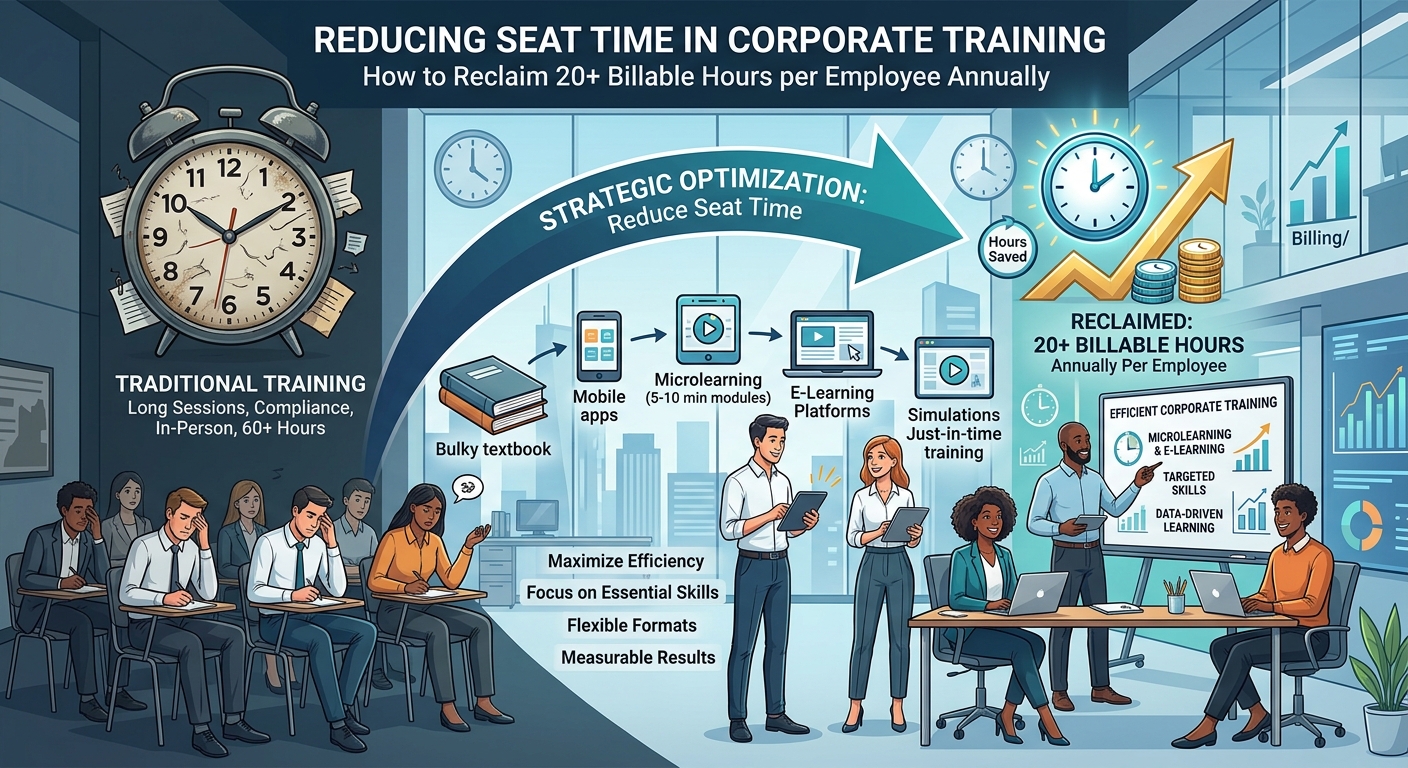
Reducing Seat Time in Corporate Training: Reclaim 20+ Billable Hours Annually
In today’s fast-paced corporate environment, every minute counts. For Vice Presidents, Directors, and Managers of Learning & Development, the challenge of equipping employees with essential skills and knowledge while minimizing disruption to their core responsibilities is paramount. Traditional, lengthy training sessions often lead to significant "seat time" – hours spent away from revenue-generating or critical operational tasks. This isn't just an inconvenience; it's a measurable drain on productivity and profitability. Imagine reclaiming 20 or more billable hours per employee, every single year. This isn't a fantasy; it's an achievable reality with strategic shifts in your corporate training approach.
Across diverse sectors such as Compliance, Sales, Banking, Finance, Insurance, Retail, Pharma, Healthcare, Hospitality, Oil and Gas, and Mining, the demand for efficient and effective training is universal. The goal is clear: maximize learning outcomes while drastically reducing the time employees spend "in training."
The Hidden Cost of Traditional Training Formats
The conventional model of classroom-based or multi-hour e-learning modules often suffers from several drawbacks. Beyond the direct cost of content development and instructor fees, the most significant expense is often the indirect one: lost productivity. Each hour an employee spends in a lengthy training session is an hour they're not engaging with clients, closing deals, managing projects, or providing essential services. For a company with hundreds or thousands of employees, this quickly escalates into hundreds of thousands, if not millions, of lost billable hours annually.
Moreover, extended training sessions can lead to reduced engagement and information retention. Human attention spans are finite, and cramming too much information into a single sitting often results in cognitive overload, making the training less effective despite its length. The opportunity cost of employees disengaged or struggling to recall information later is substantial.
Modern Methodologies for Maximized Efficiency
The good news is that advancements in eLearning technology and instructional design offer powerful solutions to this dilemma. By adopting innovative learning methodologies, L&D leaders can dramatically cut down seat time without compromising on learning quality.
Embracing Microlearning for Focused Impact
One of the most effective strategies for reducing seat time is Microlearning LMS. This approach breaks down complex topics into bite-sized, easily digestible modules, typically lasting 2-10 minutes. Instead of a 2-hour course on a new sales strategy, employees might complete six 15-minute modules spread over a week. The benefits are numerous:
- Increased Retention: Shorter bursts of information are easier to process and remember.
- Flexibility: Employees can fit learning into their workflow, during downtime, or between tasks, minimizing disruption.
- Higher Engagement: Less daunting than long courses, microlearning boosts completion rates.
- Targeted Learning: Focus on exactly what's needed, eliminating irrelevant content.
Personalization with Adaptive Learning
Not all employees learn at the same pace or require the same level of detail on every topic. Adaptive Learning tailors the learning path to each individual's needs, knowledge gaps, and learning style. By leveraging pre-assessments and real-time performance data, an adaptive system can:
- Bypass content learners already know, saving valuable time.
- Provide additional resources or remedial modules for areas where learners struggle.
- Optimize the learning sequence for maximum efficiency and engagement.
This personalization ensures that employees spend time only on what they truly need to learn, significantly trimming unnecessary seat time.
Gamification for Engaged & Efficient Learning
Making learning enjoyable can dramatically improve engagement and accelerate knowledge acquisition. Gamified LMS integrates game-like elements such as points, badges, leaderboards, and challenges into the learning experience. This transforms what could be a mundane compliance module into an interactive challenge, encouraging participation and healthy competition.
- Boosts Motivation: Learners are more likely to start and complete training.
- Enhances Recall: Interactive scenarios and challenges reinforce learning more effectively than passive consumption.
- Provides Immediate Feedback: Learners understand their progress and areas for improvement instantly.
By making learning more engaging, employees often process information faster and retain it longer, further reducing the need for repeat training or refreshers.
Leveraging Technology for Unprecedented Efficiency
The backbone of these modern learning strategies is a robust LMS. An advanced learning management system goes beyond simply hosting content; it's a comprehensive learning content management system (LCMS) that facilitates content delivery, tracks progress, and provides invaluable analytics. A modern learning management software solution, particularly a cloud based learning management system, offers the scalability and accessibility required for today's distributed workforce. For enterprise learning management, a sophisticated learning management system (LMS) like MaxLearn LMS is indispensable.
The Power of Artificial Intelligence in Training
Artificial Intelligence (AI) is rapidly transforming corporate training, making it smarter, faster, and more effective. L&D leaders frequently ask critical questions about how AI can elevate their initiatives:
How can advanced intelligence systems optimize learning pathways for individual employees?
AI-powered platforms analyze learner data to identify strengths, weaknesses, and learning preferences. They can then dynamically recommend content, sequence modules, and even predict future learning needs, ensuring that each employee follows the most efficient and relevant path. This hyper-personalization means less time spent on redundant or irrelevant information, directly translating to reduced seat time.
In a global enterprise, how can training be made relevant to diverse regional compliance standards and market conditions?
AI plays a pivotal role in contextualizing content. By integrating with existing HR systems and geographic data, AI can automatically serve up region-specific compliance training (e.g., GDPR for Europe, CCPA for California) or market-specific sales techniques. This eliminates the need for employees to sift through universally applicable but regionally irrelevant content, ensuring they only receive the information pertinent to their location and role. This is particularly crucial for Risk-focused Training in banking, finance, and healthcare, where regulatory nuances vary significantly.
What advanced tools are available to create highly engaging and effective learning modules quickly?
An AI Powered Authoring Tool dramatically accelerates content creation and ensures engagement. These tools can assist in generating interactive quizzes, simulations, and scenarios based on input text or existing materials. They can even suggest content improvements for clarity and impact, helping L&D teams produce high-quality, targeted microlearning modules at an unprecedented pace. This efficiency in content creation directly supports the continuous delivery of fresh, relevant training, further reducing the need for lengthy, infrequent updates.
Quantifying the Impact: Reclaiming 20+ Billable Hours
Let's consider a practical example. Suppose your average employee currently spends 40 hours annually in mandatory or developmental training. By implementing a combination of microlearning, adaptive paths, and AI-driven content delivery, you could realistically cut this by 50% or more. If an employee's average billable rate (or equivalent productive value) is $50/hour, reducing training time by 20 hours per year translates to $1,000 in reclaimed productivity per employee. For an organization with 1,000 employees, that's a staggering $1,000,000 annually.
This reclaimed time isn't just a cost saving; it's an investment in employee readiness and organizational agility. Employees can apply new skills faster, contribute more to projects, and respond more quickly to market changes. The ROI for L&D initiatives becomes not just about improved competence, but tangible financial gains.
Industry-Specific Benefits
- Compliance: Shorter, targeted modules ensure employees stay current with evolving regulations (e.g., banking, finance, pharma), minimizing legal risk and audit time.
- Sales: Rapid, on-demand product knowledge updates and sales technique refreshers mean sales teams are always ready to engage clients effectively.
- Healthcare/Pharma: Quick dissemination of new protocols, drug information, and equipment usage for immediate application in critical care settings.
- Retail/Hospitality: Efficient training on new products, customer service standards, and seasonal promotions ensures consistent brand experience.
- Oil & Gas/Mining: Vital safety procedures and equipment operation updates can be delivered in focused bursts, enhancing safety without prolonged operational shutdowns.
Conclusion
The imperative to reduce seat time in corporate training is no longer an aspiration but a strategic necessity for competitive organizations. By embracing modern eLearning methodologies – specifically microlearning, adaptive learning, and gamification – powered by an advanced learning management system that leverages AI, L&D leaders can transform their training programs. This shift not only enhances learning effectiveness and employee engagement but also delivers substantial, measurable gains in productivity, potentially reclaiming 20 or more billable hours per employee annually. It's time to empower your workforce with smarter, faster, and more impactful training, turning a traditional cost center into a strategic driver of growth and efficiency.
.jpg)


