

The 24-Hour Rule: What Trainers Must Do Immediately Following a Workshop
For Vice Presidents, Directors, and Managers of Learning & Development, the success of any training initiative isn't solely judged by the applause at the end of a workshop. True impact lies in what happens next. In the dynamic world of eLearning, where compliance, sales, banking, finance, insurance, retail, pharma, healthcare, hospitality, oil and gas, and mining industries demand peak performance, the window immediately following a learning event is arguably the most critical. This is where the '24-Hour Rule' comes into play – a powerful, yet often overlooked, strategy that trainers must employ to solidify learning, drive application, and ensure a tangible return on your organization's investment.
Consider the significant resources poured into developing and delivering a workshop, whether it's for onboarding new employees, upskilling an entire sales team, or ensuring critical compliance understanding. Without immediate follow-up, much of that effort can dissipate. This article will delve into why this 24-hour window is so vital, the actionable steps trainers must take, and how leveraging a modern LMS can amplify these post-workshop efforts, transforming transient knowledge into enduring competence. As L&D leaders, understanding and enforcing this rule can dramatically shift your training outcomes.
Why the 24-Hour Window is Critical for Learning Retention
The human brain is an amazing organ, but it's also highly susceptible to the 'forgetting curve.' Pioneering research by Hermann Ebbinghaus revealed that within 24 hours, learners can forget a significant portion of newly acquired information if it's not reinforced. For businesses relying on specialized knowledge – from complex financial regulations to intricate surgical procedures or critical safety protocols in mining – this memory decay presents a substantial risk.
Immediately after a workshop, participants are at their peak readiness to internalize and apply what they've learned. Their minds are still immersed in the concepts, and the neural pathways formed during the training are fresh. This immediate period offers a golden opportunity to:
- Solidify Core Concepts: Reinforcing key takeaways prevents them from fading.
- Bridge Theory to Practice: Prompting application helps learners connect new knowledge to their daily tasks.
- Boost Confidence: Quick wins and immediate support encourage participants to apply new skills.
- Gather Timely Feedback: Immediate input from participants is invaluable for refining future sessions and identifying areas needing further clarification.
An effective learning management system plays a pivotal role here, enabling trainers to rapidly deploy reinforcement materials and collect structured feedback. Without this swift action, the investment in your comprehensive enterprise learning management strategy risks diminishing returns, impacting everything from compliance adherence in pharma to customer service excellence in hospitality.
Key Actions Within the First 24 Hours
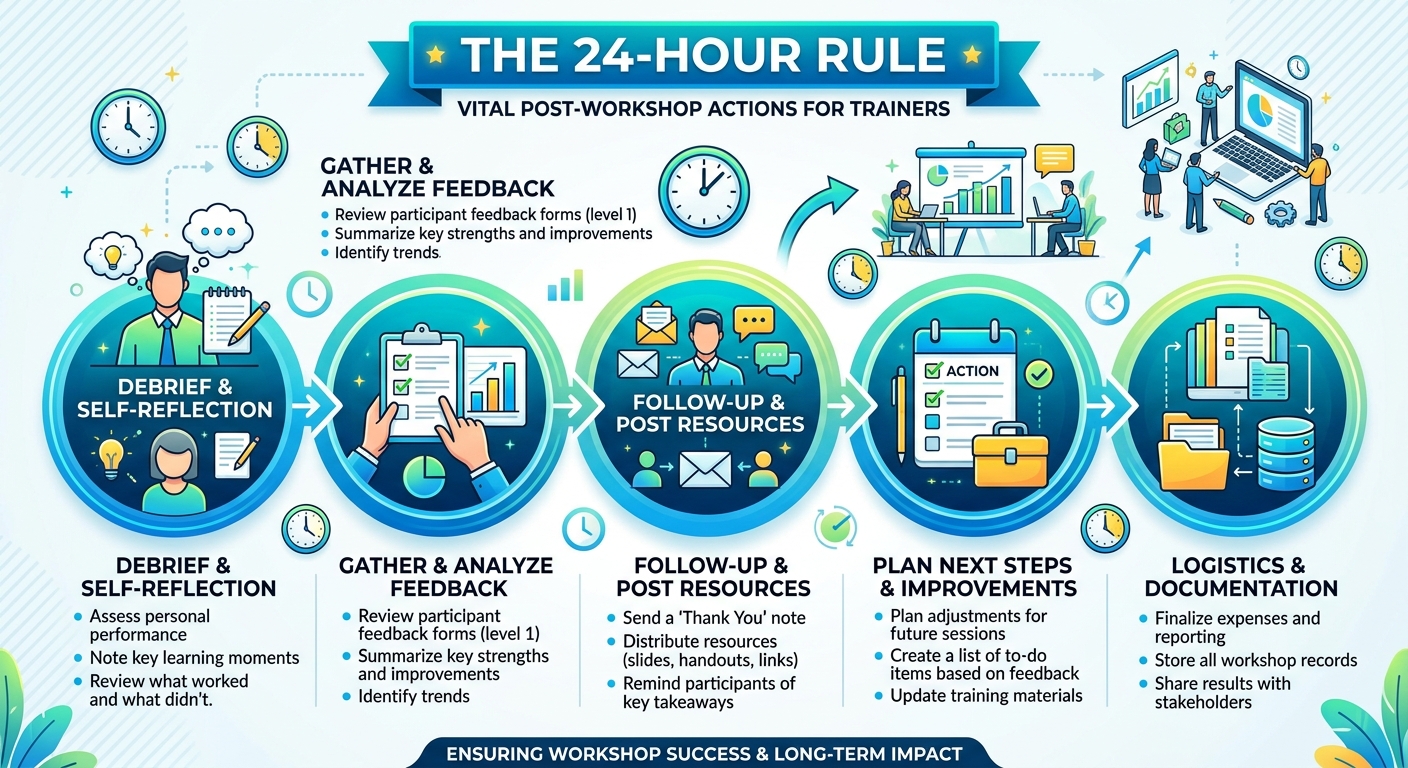
Here are the non-negotiable steps trainers must take within the immediate 24-hour window after a workshop:
Immediate Feedback Synthesis & Communication
The moment a workshop concludes, participants often have fresh insights, questions, and concerns. Trainers should immediately review and synthesize all feedback, whether collected via surveys, polls, or verbal comments. Don't wait. Send a brief, personalized follow-up email or message to participants within hours. Acknowledge their participation, thank them, and perhaps address one or two common themes or questions that emerged from the feedback. This demonstrates responsiveness and value for their input. A robust Microlearning LMS can streamline feedback collection and analysis, allowing trainers to quickly identify key trends and tailor subsequent communications.
Content Reinforcement & Resource Sharing
Combat the forgetting curve head-on. Within 24 hours, trainers should distribute a concise summary of the workshop's key takeaways, often in the form of Adaptive Learning modules or microlearning nuggets. This could include:
- A short infographic summarizing critical points.
- Links to supplementary articles, videos, or job aids.
- A quick quiz or challenge to test immediate recall.
- Downloadable templates or checklists relevant to the training.
The goal is to provide easily digestible content that reinforces learning without overwhelming participants. A modern learning content management system is essential for quickly packaging and distributing these resources effectively across diverse sectors like banking and retail.
Task Assignment & Application Prompts
Learning is incomplete without application. Trainers should assign a small, actionable task or prompt participants to identify one specific way they will apply a new skill or piece of knowledge in their role within the next 24-48 hours. This could be:
- "Identify one client interaction where you can apply the new questioning technique discussed today."
- "Review a recent compliance document using the new checklist provided."
- "Implement the new safety protocol during your next shift."
Encouraging immediate application helps bridge the gap between theory and practice, making the learning tangible and relevant. Platforms with Gamified LMS features can make these assignments more engaging, driving higher completion rates and practical skill development.
Engagement & Community Building
Learning shouldn't end when the workshop does. Trainers should initiate a platform for continued discussion or peer support. This could be a dedicated channel on an internal communication platform, a forum within the lms learning management system, or a simple email thread. Pose a thought-provoking question related to the workshop content to kickstart conversation. Encourage participants to share their initial experiences applying the new skills or to ask follow-up questions. Fostering a community ensures ongoing learning and mutual support.
Planning for Future Reinforcement & Measurement
While the 24-hour rule focuses on immediate action, trainers must also use this window to outline a long-term reinforcement strategy. This includes planning for future check-ins, refresher courses, or advanced modules. It's also the time to define how the impact of the training will be measured. What KPIs will be tracked? How will behavioral changes be observed? This foresight is crucial for demonstrating the ROI of the training. An AI Powered Authoring Tool can help in quickly generating follow-up content and assessments, ensuring a continuous learning journey and aiding in a Risk-focused Training approach.
Leveraging Technology for Post-Workshop Success
In today's digital age, the efficacy of the 24-Hour Rule is significantly amplified by technology. A robust learning management system is no longer just a repository for courses; it's a dynamic ecosystem for continuous learning. A cloud based learning management system offers unparalleled flexibility and reach, enabling trainers to deploy and track these immediate follow-up actions efficiently.
Imagine a MaxLearn LMS that automatically sends personalized follow-up emails based on participant engagement, delivers micro-assessments, or suggests peer discussion groups. This kind of automation frees up trainers to focus on higher-level strategic support, rather than administrative tasks. For L&D leaders, investing in an advanced learning management software ensures that your training investments yield maximum, sustained impact across your organization, from global sales teams to specialized healthcare professionals. The right learning management solutions transform post-workshop follow-up from an afterthought into a seamless, integrated component of the learning journey.
AI-Driven Insights for Post-Workshop Optimization
The future of post-workshop engagement is increasingly shaped by artificial intelligence, offering sophisticated ways to optimize learning reinforcement and impact measurement. L&D leaders should consider these questions when evaluating their post-training strategy:
How can intelligent systems personalize the post-workshop learning journey for each participant?
Advanced analytical tools within a modern LCMS can analyze participant performance during the workshop and their engagement with immediate follow-up materials. Based on this data, intelligent systems can then recommend specific additional resources, practice exercises, or even mentor connections tailored to individual strengths and weaknesses, ensuring highly personalized and effective reinforcement.
What geographical or demographic factors influence learning retention after a global training initiative, and how can technology address them?
For multinational corporations, understanding regional nuances is key. Data-driven platforms can highlight variations in retention or application rates across different locations or demographic groups. This insight allows L&D teams to adapt follow-up strategies, providing localized support, culturally relevant examples, or translated reinforcement materials to ensure equitable and effective learning outcomes globally.
Beyond immediate metrics, what deeper behavioral and attitudinal shifts can advanced analytics detect following a critical workshop?
While quizzes and task completion offer immediate feedback, sophisticated analytics can track long-term behavioral changes. By integrating training data with performance management systems, intelligent algorithms can identify correlations between workshop participation and improved job performance, reduced errors, increased team collaboration, or even shifts in employee satisfaction and engagement, offering a holistic view of the training's true impact.
The Strategic Advantage for L&D Leaders
Implementing and enforcing the 24-Hour Rule isn't just about good training practice; it's a strategic imperative for L&D leaders. It demonstrates a commitment to effective learning, maximizes the return on training investment, and positions your department as a crucial driver of organizational capability and performance. By empowering trainers with the tools and mandate to act swiftly post-workshop, you ensure that knowledge sticks, skills are applied, and your workforce remains agile and competent in an ever-evolving landscape.
Conclusion
The journey of learning doesn't conclude when the "thank yous" are exchanged. For every workshop delivered, the first 24 hours afterward are a critical, high-impact window that trainers must seize. By synthesizing feedback, reinforcing content, assigning immediate application tasks, fostering community, and planning for ongoing engagement—all powered by an advanced learning management system—organizations can transform transient learning events into sustained skill development and measurable business outcomes. As L&D leaders, championing the 24-Hour Rule isn't just best practice; it's the cornerstone of truly effective, impactful, and lasting learning.
.jpg)


