

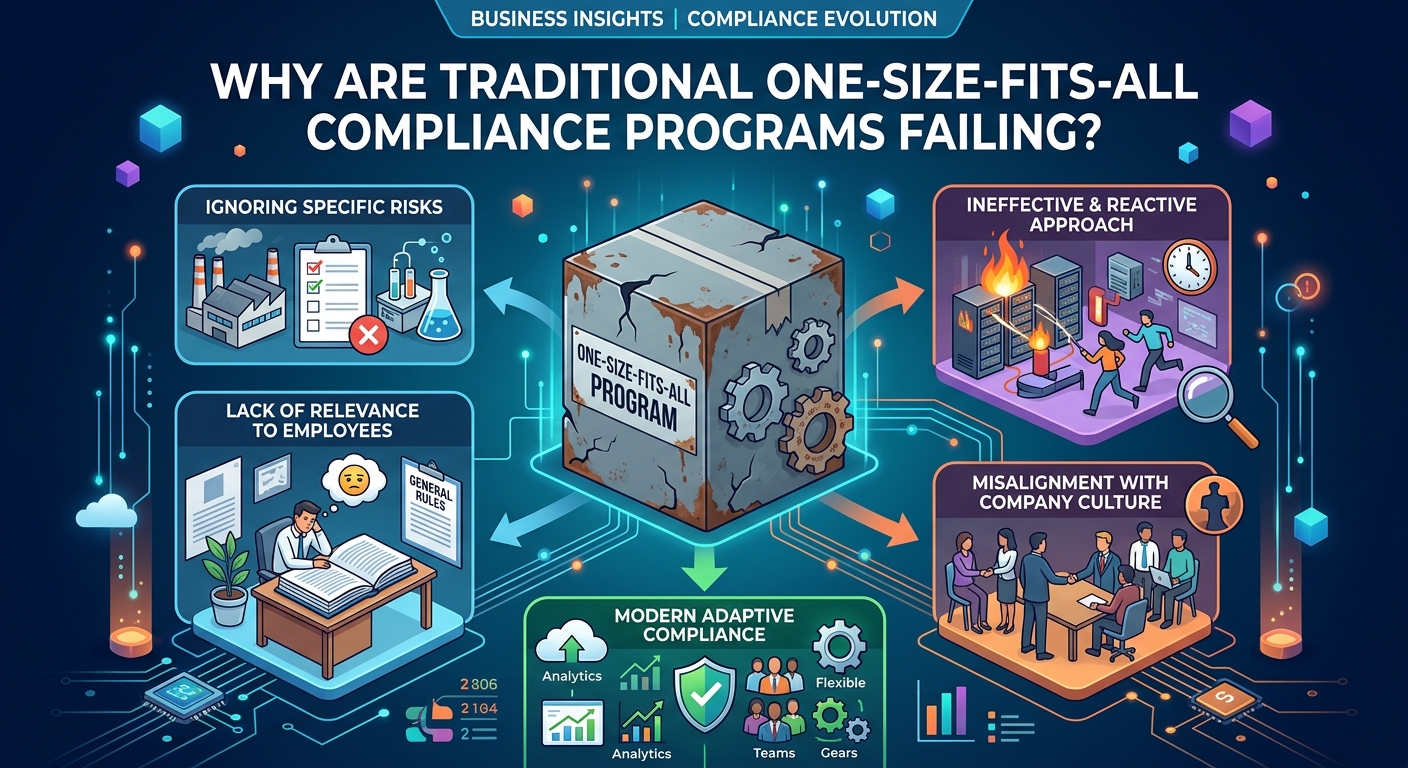
Why Are Traditional One-Size-Fits-All Compliance Programs Failing?
In today's complex regulatory landscape, compliance is no longer a mere tick-box exercise; it's a cornerstone of ethical business practice and operational integrity. Yet, despite significant investment, many organizations find their traditional, 'one-size-fits-all' compliance programs falling short. These outdated methods often fail to engage employees, neglect diverse learning needs, and ultimately leave organizations vulnerable to risk. For VPs, Directors, and Managers in Learning & Development across industries like finance, healthcare, and retail, understanding these shortcomings is the first step toward building a more robust and effective compliance framework. This article explores the critical reasons why conventional approaches are failing and outlines a path toward more intelligent, adaptive, and truly impactful compliance training solutions.
The Cracks in the Conventional Compliance Foundation
Traditional compliance training often relies on lengthy, generic presentations, dense policy documents, and infrequent, mandatory training sessions. While seemingly comprehensive on paper, this approach struggles in practice. Employees, regardless of their role or specific risk exposure, are subjected to the same broad brushstrokes of information. This often leads to information overload, disengagement, and a profound lack of relevance. Imagine a sales professional in a bustling retail environment being forced to sit through an identical 8-hour module on data privacy as a senior executive in corporate finance. The immediate application, the specific risks, and the prior knowledge levels are vastly different, yet the training remains stubbornly uniform. This disconnect doesn't just bore learners; it creates significant legal ramifications and financial costs if non-compliance occurs due to a lack of understanding or application. The traditional learning management system (LMS) used for these programs often tracks completion, but rarely comprehension or behavioral change.
Why "One-Size-Fits-All" Falls Short
The fundamental flaw of generic compliance programs lies in their inability to acknowledge individual differences.
- Lack of Personalization: Every role within an organization carries a unique set of compliance responsibilities and risks. A compliance program that treats an IT specialist, a customer service representative, and a field sales agent identically is inherently inefficient. Crucial information for one role might be irrelevant or secondary for another, leading to cognitive overload and diminishing retention.
- Static Content in a Dynamic World: Regulations are not static; they evolve constantly. Traditional programs, with their fixed content and infrequent updates, struggle to keep pace. By the time a new module is developed and deployed across an entire organization, the regulatory landscape may have already shifted, rendering parts of the training obsolete. A robust learning content management system (LCMS) is essential for agility.
- Engagement Vacuum: The passive nature of many traditional compliance courses — long lectures, text-heavy slides, and multiple-choice quizzes — fails to capture and sustain learner attention. Disengaged employees are unlikely to internalize complex rules or understand their practical implications, turning compliance into a mere performative act rather than genuine learning. The traditional learning management software simply doesn't cut it for engagement.
- Ineffective Measurement: Completion rates are a poor proxy for understanding or behavioral change. Conventional methods rarely delve into why an employee might fail a particular section or how they would apply a rule in a real-world scenario. This leaves significant gaps in an organization's compliance assurance.
The Human Element: Drowning in Data, Starving for Relevance
From an employee's perspective, traditional compliance training often feels like a burdensome interruption rather than a valuable learning experience. The sheer volume of information, coupled with its perceived irrelevance, can lead to frustration and burnout. When compliance is viewed as a "check-the-box" activity, it fosters a culture of resentment rather than responsibility. This negatively impacts company morale and diverts valuable time and resources away from core business activities. The opportunity cost of inefficient training—time lost, productivity reduced, and potential risks unmitigated—is substantial. Modern enterprise learning management solutions recognize this human element.
The Path Forward: Smarter, More Agile Compliance
The good news is that advancements in educational technology offer powerful solutions to these long-standing problems. The shift is towards personalized, adaptive, and engaging compliance experiences that meet learners where they are, offering what they need, exactly when they need it. This is where intelligent systems play a transformative role, leveraging data and advanced algorithms to create truly effective learning environments.
Let's consider some crucial questions L&D leaders are asking about this transformation:
Question: "How can advanced algorithms help us understand why employees struggle with specific compliance topics, moving beyond just knowing that they struggled?"
Answer: Intelligent analytics integrated into a modern learning management system can go far beyond simple scores. They can pinpoint common misconceptions, identify areas where certain roles consistently underperform, and even suggest underlying knowledge gaps. By analyzing patterns in responses, time spent on questions, and learner interactions, these systems provide deep insights into the root causes of non-compliance, allowing for targeted remedial training and content refinement. This empowers L&D teams to focus resources precisely where they are needed most, rather than blanket training.
Question: "What kind of intelligent systems can create personalized learning paths that adapt to individual roles and real-time risk profiles?"
Answer: Dynamic content delivery platforms are revolutionizing personalization. Imagine a system that assesses an employee's role, prior knowledge, department, and even their geographic location, then instantly curates a unique compliance journey for them. These systems utilize rule-based engines and machine learning to recommend modules, scenarios, and resources that are highly relevant to the individual's specific responsibilities and the risks they encounter daily. This ensures that a bank teller receives focused training on AML (Anti-Money Laundering) while a marketing manager receives pertinent privacy regulation updates, all delivered via an intuitive LMS.
Question: "Beyond basic quizzes, how can smart platforms measure actual behavior change and application of compliance knowledge in real-world scenarios?"
Answer: Measuring true behavioral impact requires more than simple recall tests. Next-generation platforms leverage interactive simulations, scenario-based assessments, and even virtual reality to place learners in realistic decision-making situations. By observing how employees apply compliance principles under pressure, these systems provide invaluable feedback on their readiness. Furthermore, integrated performance support tools and contextual nudges within workflows can reinforce learning in the moment of need, tracking actual application and providing ongoing data for continuous improvement. This move towards practical application is key for robust compliance.
Key Strategies for Modern Compliance Training
To overcome the limitations of traditional programs, L&D leaders should explore and adopt innovative learning solutions:
- Embrace Microlearning LMS: Break down complex compliance topics into short, focused, and easily digestible modules. This approach combats information overload, improves retention, and allows employees to learn in the flow of work. A modern learning management system excels at delivering this format.
- Implement Gamified LMS Elements: Incorporate game-like features such as points, badges, leaderboards, and interactive challenges to boost engagement, motivate learners, and make compliance training more enjoyable and memorable. This transforms a chore into an engaging activity.
- Leverage Adaptive Learning: Utilize technologies that personalize the learning journey for each employee. This means content, pace, and assessment methods adjust dynamically based on individual progress, role, and existing knowledge, ensuring relevance and efficiency. This is a core component of effective learning management solutions.
- Utilize an AI Powered Authoring Tool: Streamline the creation and updating of compliance content. AI can help generate initial drafts, suggest relevant examples, and even adapt content for different audiences, significantly reducing development time and ensuring accuracy. For an enterprise learning management system, this is invaluable.
- Focus on Risk-focused Training: Prioritize training based on the specific risks associated with each role or department. This ensures that critical compliance areas receive the attention they deserve, making training more impactful and directly addressing potential vulnerabilities. This focused approach is key to an effective lms learning management system.
A cloud based learning management system like MaxLearn LMS offers the flexibility and scalability required to implement these advanced strategies across diverse industries.
Conclusion
The era of 'one-size-fits-all' compliance training is rapidly drawing to a close. Organizations can no longer afford the risks and inefficiencies associated with outdated, disengaging programs. By embracing intelligent, personalized, and engaging learning methodologies, L&D leaders can transform compliance from a burdensome obligation into a strategic asset. Investing in modern learning management software, particularly solutions that incorporate microlearning, gamification, and adaptive intelligence, will not only safeguard your organization against regulatory pitfalls but also foster a culture of genuine understanding, ethical behavior, and continuous improvement. The future of compliance is smart, relevant, and effective – it's time to make the shift.
.jpg)


