

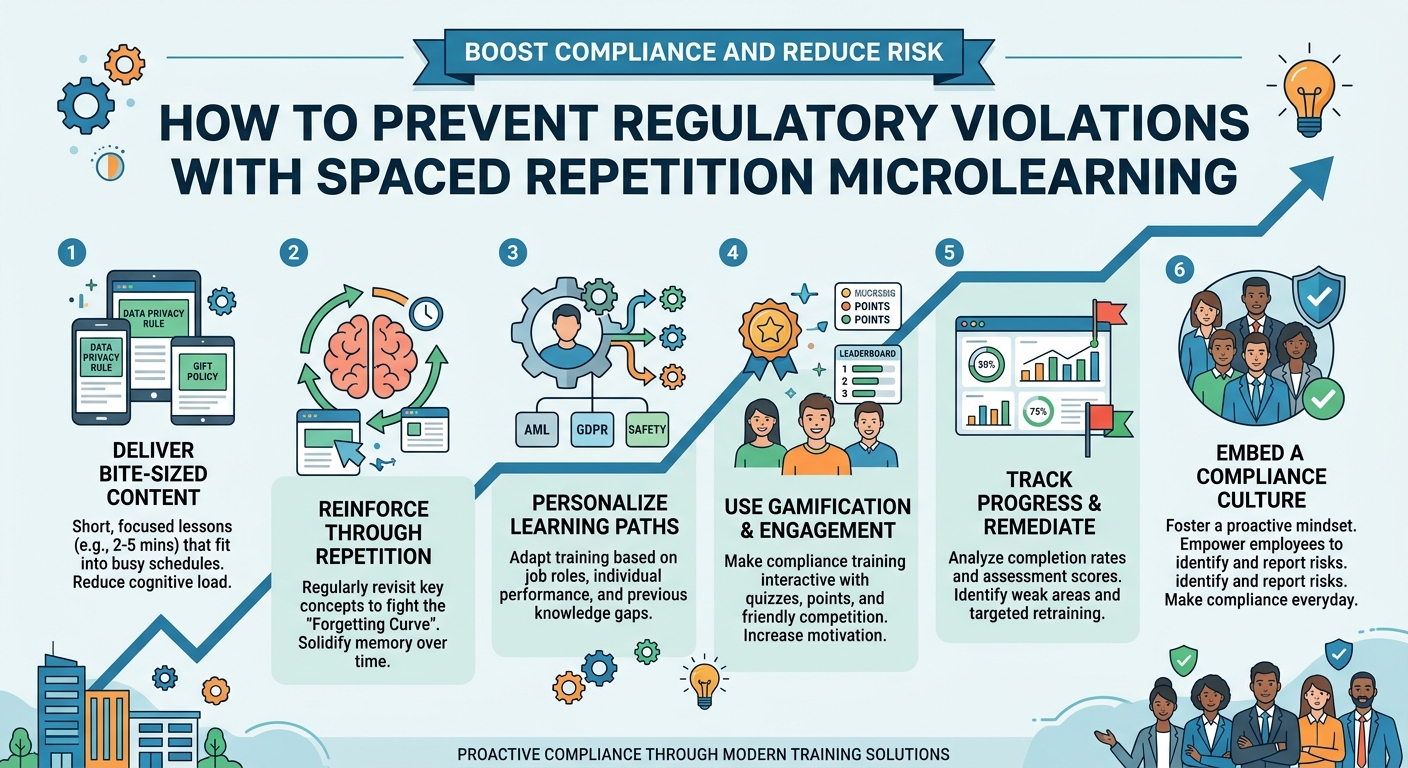
How to Prevent Regulatory Violations with Spaced Repetition Microlearning
For Vice Presidents, Directors, and Senior Managers in Learning & Development across industries like Compliance, Sales, Banking, Finance, Insurance, Retail, Pharma, Health care, Hospitality, Oil and Gas, and Mining, navigating the complex landscape of regulatory compliance is a perpetual challenge. The financial, reputational, and operational repercussions of a single regulatory violation can be staggering, ranging from hefty fines to irreparable damage to public trust. Traditional compliance training, often a yearly, lengthy affair, struggles to keep pace with evolving regulations and, more importantly, to ensure lasting knowledge retention among employees.
The question isn't whether your organization needs compliance training, but how to make it genuinely effective. This article delves into how Microlearning LMS powered by spaced repetition can transform your compliance strategy, significantly reducing the risk of regulatory violations and fostering a culture of continuous learning.
The Escalating Challenge of Compliance
Regulatory frameworks are constantly expanding, becoming more intricate, and demanding greater accountability. From GDPR and HIPAA to industry-specific mandates in finance or healthcare, the sheer volume of information employees must comprehend and recall is immense. The traditional model of annual compliance workshops or lengthy e-learning modules often falls short.
The Cost of Non-Compliance
The penalties for regulatory violations are severe. Beyond direct financial sanctions that can run into millions, companies face increased scrutiny, legal battles, reputational damage, and a decline in employee morale. Preventing even one significant violation can justify a substantial investment in effective compliance training. The goal isn't just to check a box but to embed compliance knowledge deep within your workforce's daily operations.
Traditional Training's Shortcomings
- Information Overload: Long training sessions lead to cognitive overload and poor retention.
- "Forgetting Curve": Much of what's learned is quickly forgotten if not reinforced.
- Lack of Engagement: Monotonous, one-off training struggles to capture and maintain employee attention.
- Static Content: Traditional methods are slow to update, making it difficult to keep pace with dynamic regulatory changes.
Introducing Spaced Repetition Microlearning
Enter spaced repetition microlearning – a powerful pedagogical approach that leverages cognitive science to enhance knowledge retention and recall. It's a strategy perfectly suited for the demands of modern compliance training.
What is Spaced Repetition?
Spaced repetition is an evidence-based learning technique where learners revisit material at increasing intervals over time. Instead of cramming, it presents information just before the learner is about to forget it, moving it from short-term to long-term memory. This intelligent scheduling reinforces learning efficiently.
The Power of Microlearning
Microlearning delivers information in bite-sized, focused chunks, typically 2-10 minutes long. This approach respects learners' time, fits into busy schedules, and is inherently more engaging than lengthy modules. When combined with spaced repetition, microlearning transforms compliance from a burdensome annual event into an ongoing, manageable, and effective process.
How Spaced Repetition Microlearning Prevents Violations
Implementing a compliance program built on spaced repetition microlearning offers several distinct advantages that directly translate into a reduced risk of regulatory violations:
- Enhanced Knowledge Retention: By strategically repeating key compliance concepts, employees move critical information into long-term memory. This means they're more likely to recall specific rules, procedures, and ethical guidelines when faced with real-world scenarios, preventing costly errors.
- Continuous Reinforcement: Compliance isn't a one-time event; it's a continuous practice. Spaced repetition ensures that regulatory knowledge is consistently reinforced, combating the natural "forgetting curve" and keeping compliance top-of-mind. This proactive approach cultivates a sustained culture of vigilance.
- Identification of Knowledge Gaps: Adaptive Learning algorithms, often integrated into modern learning management software, track individual performance. If an employee consistently struggles with a particular compliance topic, the system can automatically re-present that content more frequently or offer additional resources, precisely targeting areas of weakness. This data-driven insight allows L&D leaders to identify broader organizational knowledge gaps and address them proactively.
- Agility in Regulatory Updates: When new regulations emerge or existing ones are updated, microlearning modules can be rapidly created or modified and deployed. Spaced repetition ensures that these critical updates are not just delivered but effectively learned and retained by the entire workforce, significantly reducing the risk of non-compliance due to outdated knowledge.
- Engaging and Accessible Experience: Short, focused microlearning modules, especially when integrated with a Gamified LMS, are far more engaging than traditional training. This increases learner motivation and completion rates. Coupled with accessibility across devices, employees can learn anytime, anywhere, embedding compliance into their daily workflow rather than interrupting it.
- Risk-focused Training: By analyzing past incidents or high-risk areas identified by compliance officers, microlearning content can be specifically designed to address these critical points. Spaced repetition then ensures that these high-priority, risk-mitigating topics are deeply ingrained.
Leveraging Intelligent Platforms for Proactive Compliance
The digital evolution, particularly in the realm of intelligent systems and data analytics, is revolutionizing how we approach compliance training. L&D leaders are increasingly looking for ways to harness these advancements to predict, prevent, and respond to compliance risks more effectively.
Can smart algorithms anticipate compliance risks within an organization?
Yes, advanced analytics embedded within a sophisticated LMS or enterprise learning management system can indeed provide predictive insights. By analyzing employee training data, assessment scores, module completion rates, and even incident reports (anonymized where necessary), these intelligent platforms can identify patterns. For example, consistent low scores on specific regulatory topics across a department might signal a looming risk area. This data can then inform targeted, spaced repetition training interventions, allowing L&D to act proactively rather than reactively. The capabilities of an AI Powered Authoring Tool can further streamline the creation of such targeted content.
How can intelligent platforms optimize compliance training across diverse global operations?
For organizations operating across multiple regions, intelligent platforms are invaluable. A cloud based learning management system can deliver personalized, localized compliance content based on an employee's geographical location and role. Smart systems can automatically adjust spaced repetition schedules to account for local holidays or peak work periods, ensuring consistency and effectiveness across all operations. This adaptability ensures that compliance training is relevant, timely, and culturally appropriate, a crucial factor in preventing global regulatory breaches. A modern learning management software provides the necessary infrastructure for this.
What strategic insights can advanced analytics offer L&D leaders regarding compliance effectiveness?
Intelligent platforms move beyond simple completion rates. They provide deep insights into knowledge mastery, areas of struggle, and the overall impact of training on behavior. L&D leaders can gain a holistic view of their compliance posture, understanding which training modules are most effective, where investment is needed, and how training directly correlates with a reduction in compliance incidents. This data-driven approach allows for continuous optimization of the compliance learning management solutions, ensuring resources are allocated efficiently and effectively to minimize risk.
Implementing Spaced Repetition Microlearning for Compliance
Successfully integrating spaced repetition microlearning into your compliance strategy requires careful planning:
- Content Strategy: Break down complex regulations into discrete, understandable microlearning modules. Focus on scenarios, case studies, and practical application.
- Technology Selection: Choose an LMS or learning content management system that natively supports spaced repetition, microlearning delivery, and robust analytics. Ensure it's user-friendly and accessible across devices. Consider a MaxLearn LMS for its comprehensive features.
- Integration into Workflow: Position compliance training as an integral, manageable part of an employee's day, not an interruption. Use notifications and reminders strategically.
- Continuous Evaluation: Regularly review engagement metrics, knowledge retention scores, and, where possible, correlate with compliance incident rates. Use this data to refine and improve your program.
Choosing the Right Learning Management System
To effectively leverage spaced repetition microlearning for compliance, a robust learning management system is non-negotiable. Look for an LMS that isn't just a content repository but an intelligent platform designed for modern learning. This includes features like:
- Native support for microlearning content and spaced repetition algorithms.
- Gamified LMS elements to boost engagement.
- Adaptive Learning paths that personalize the learning journey.
- Comprehensive analytics for insights into learner performance and compliance readiness.
- An AI Powered Authoring Tool to streamline content creation and updates.
- Capabilities for Risk-focused Training to prioritize critical areas.
Whether you're exploring a learning content management system, learning management software, or comprehensive learning management solutions, the goal is to find an lms learning management system that empowers your organization to minimize compliance risks effectively. A modern, cloud based learning management system, like MaxLearn LMS, provides the scalability and features needed for enterprise learning management.
Conclusion
Preventing regulatory violations is more than just a compliance checkbox; it's a strategic imperative for safeguarding your organization's future. By embracing spaced repetition microlearning, L&D leaders can move beyond traditional, ineffective training methods. This approach not only enhances knowledge retention and engagement but also fosters a proactive, continuous learning culture that significantly reduces the risk of non-compliance. Invest in the right learning management solutions, and empower your workforce to be your first line of defense against regulatory pitfalls.
.jpg)


