

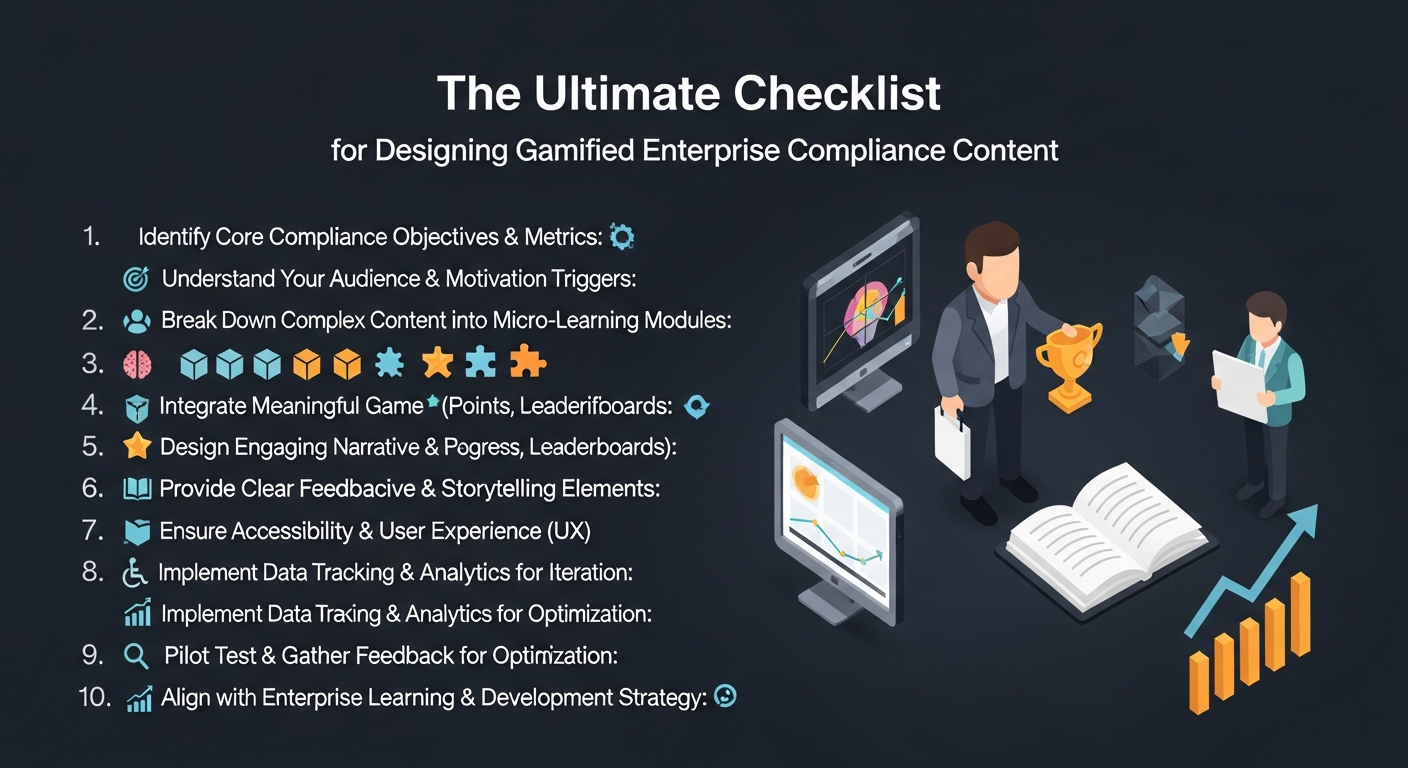
The Ultimate Checklist for Designing Gamified Enterprise Compliance Content
In the complex landscape of modern business, compliance isn't merely a box to tick; it's the bedrock of trust, reputation, and sustained growth. Yet, traditional compliance training often falls short, struggling with low engagement, poor retention, and a perception of being a tedious chore. This is where gamification emerges as a powerful disruptor, transforming mundane mandates into memorable, interactive experiences.
For Vice Presidents, Directors, and Managers in Learning & Development across industries like Sales, Banking, Finance, Insurance, Retail, Pharma, Health care, Hospitality, Oil and Gas, and Mining, the challenge is clear: how do we leverage gamification to make enterprise compliance not just effective, but truly engaging? The answer lies in a strategic, well-thought-out design process. This ultimate checklist provides a roadmap to ensure your gamified compliance content hits the mark, fostering a culture of adherence and learning.
1. Define Your Purpose and Audience: The Foundation of Impact
Before diving into game mechanics, clarity on your "why" and "for whom" is paramount.
- Pinpoint Core Compliance Objectives: What specific regulations, policies, or ethical standards are you addressing? What are the critical behaviors you want to instill or prevent? Clearly defined objectives will guide all subsequent design decisions. This forms the basis for effective Risk-focused Training.
- Understand Your Learners: Who are they? What are their roles, prior knowledge, and daily challenges? A sales team in retail will have different needs and motivations than a finance department in banking or engineers in oil and gas. Tailoring the experience to their context and existing workload is crucial for buy-in.
- Identify Desired Behavioral Outcomes: It's not just about knowing the rules; it's about applying them. Define the specific actions employees should take (or avoid) post-training. This enables a more measurable impact.
- Align with Enterprise Goals: How does enhanced compliance contribute to broader organizational objectives, such as reducing legal risks, improving customer trust, or boosting operational efficiency?
2. Craft Engaging Game Mechanics and Narrative: Beyond Badges
Gamification is more than just points, badges, and leaderboards. It’s about creating a compelling experience.
- Develop a Cohesive Narrative: Frame compliance challenges within a relevant story or scenario. For instance, an insurance company might create a "Claims Detective" game, while a pharma company could build a "Product Integrity Journey." A strong narrative contextualizes the learning and makes it memorable.
- Implement Meaningful Challenges: Design activities that require critical thinking and decision-making relevant to real-world compliance dilemmas. These could be simulations, branching scenarios, or interactive case studies.
- Integrate Progressive Difficulty: Start with foundational concepts and gradually introduce more complex challenges. This approach keeps learners engaged and builds their confidence over time.
- Provide Immediate, Constructive Feedback: Learners need to understand why they succeeded or failed. This feedback loop is essential for learning and encourages improvement.
- Reward System Design: While points and badges have their place, consider rewards that hold intrinsic value or facilitate social recognition within the enterprise. Unlocking new content, gaining "expert" status, or earning team-based accolades can be highly motivating.
- Encourage Collaboration (Where Appropriate): Some compliance topics benefit from team-based challenges, fostering collective responsibility and shared understanding.
3. Content Development and Delivery: Smart, Accessible Learning
The best game mechanics fall flat without high-quality, accessible content delivered efficiently.
- Leverage Microlearning Principles: Break down complex compliance topics into digestible, bite-sized modules. This approach, facilitated by a robust Microlearning LMS, improves retention and fits into busy schedules, making the daunting task of compliance more manageable.
- Prioritize Interactivity: Move beyond passive content. Use quizzes, drag-and-drop activities, decision trees, and interactive infographics to keep learners actively involved.
- Employ Scenario-Based Learning: Present realistic work scenarios where employees must apply compliance knowledge. This bridges the gap between theoretical knowledge and practical application.
- Ensure Content Accuracy and Up-to-dateness: Compliance regulations evolve. Your content must be meticulously accurate and easily updateable to reflect the latest standards. This is where a dynamic learning content management system is indispensable.
- Accessibility and Inclusivity: Design content that is accessible to all employees, including those with disabilities, in line with company and regulatory standards.
- Leverage a Powerful Learning Platform: A sophisticated learning management system (LMS) is critical. MaxLearn offers an advanced enterprise learning management solution that can host and track your gamified content, ensuring seamless delivery and robust analytics. For comprehensive needs, considering a full LCMS can also be beneficial.
4. Technology and Platform: The Backbone of Your Gamified Experience
The right technology amplifies the impact of your design and content.
- Choose a Gamified LMS: Your learning management software must support gamification features natively, offering functionalities like progress tracking, leaderboards, custom badges, and certificates. A dedicated lms learning management system designed for such features is non-negotiable.
- Mobile Responsiveness: Employees need to access training anytime, anywhere. Ensure your platform and content are fully optimized for mobile devices. A cloud based learning management system provides this flexibility.
- Integration Capabilities: Can your chosen learning management solutions integrate with other HR systems (e.g., HRIS, performance management systems) for a unified employee experience?
- Utilize Advanced Authoring Tools: For creating rich, interactive content, an AI Powered Authoring Tool can significantly streamline content creation and enhance engagement by suggesting personalization and adaptive pathways.
Intelligent Insights: Addressing Key Questions with AI
The integration of advanced analytics and machine learning offers unprecedented opportunities for optimizing compliance training.
- How can artificial intelligence personalize learning paths for diverse employee roles within an organization?
AI algorithms can analyze individual learner data—their roles, prior knowledge assessments, performance on past modules, and even learning styles—to recommend highly personalized content, challenges, and remedial actions. This ensures that a new hire in finance receives foundational compliance training tailored to their specific regulatory environment, while a seasoned sales manager focuses on updates relevant to their market, optimizing engagement and efficiency for every user. - What role does AI play in ensuring consistent compliance understanding across globally distributed teams?
AI can be instrumental in standardizing compliance knowledge globally. It can identify common knowledge gaps across different regions and languages, flag areas where localized content might be needed, and even facilitate translation and cultural adaptation of training modules. By tracking engagement and performance across diverse geographical locations, AI helps ensure a unified understanding of core compliance principles while respecting regional nuances and providing robust data for global learning management. - Beyond engagement, how can AI help identify and address critical compliance knowledge gaps effectively?
AI-driven analytics moves beyond simple quiz scores. It can detect patterns in learner behavior, identify specific types of errors, and even predict potential areas of non-compliance risk based on performance data. By highlighting these critical knowledge gaps, AI allows L&D teams to proactively deploy targeted Adaptive Learning modules or interventions, ensuring resources are directed where they are most needed to bolster compliance and mitigate future risks, making the training more preventative than reactive.
5. Measurement, Iteration, and Continuous Improvement: The Growth Cycle
Gamification isn't a one-and-done solution; it's an ongoing process of optimization.
- Define Clear KPIs: How will you measure success? Beyond completion rates, look at knowledge retention scores, behavioral changes (e.g., reduction in compliance breaches), learner feedback, and time to competency.
- Collect and Analyze Data: Use the analytics features of your MaxLearn LMS or other learning management system to track learner progress, engagement levels, and areas of difficulty. This data is invaluable for iterative improvements.
- Gather Learner Feedback: Conduct surveys, focus groups, and informal check-ins to understand what resonates with employees and where improvements can be made.
- Iterate and Refine: Based on data and feedback, continuously update and improve your gamified compliance content. This might involve adjusting game mechanics, refreshing content, or introducing new challenges. The goal is continuous enhancement of learning management solutions.
- Tie to Performance: Where appropriate and ethically sound, explore ways to link compliance performance in gamified training to broader employee development and recognition programs.
Designing effective gamified enterprise compliance content is a strategic endeavor. It requires a deep understanding of your organization's needs, a creative approach to instructional design, and a robust technological backbone. By following this ultimate checklist, L&D leaders can transform compliance training from a dreaded obligation into an engaging, impactful experience that genuinely protects and empowers their workforce. The journey to a more compliant, knowledgeable, and engaged workforce begins here.


