

The Step-by-Step Guide to Reducing Corporate Risk Through Spaced Repetition
In today's complex and rapidly evolving corporate landscape, managing risk isn't just a compliance checkbox; it's a strategic imperative for sustained growth and reputation. Vice Presidents, Directors, and Senior Managers in Learning & Development (L&D) are increasingly tasked with finding innovative solutions to mitigate everything from regulatory non-compliance to operational inefficiencies and cybersecurity threats. The answer, often overlooked yet powerfully effective, lies in how we learn and retain critical information: through the science-backed methodology of spaced repetition.
This comprehensive guide will walk you through a practical, step-by-step approach to integrate spaced repetition into your corporate training strategy, specifically targeting risk reduction. We'll explore how this cognitive science principle, coupled with modern eLearning tools, can transform your organization's resilience across diverse sectors like Banking, Finance, Insurance, Retail, Pharma, Healthcare, Hospitality, Oil and Gas, and Mining.
Understanding Corporate Risk and The Power of Spaced Repetition
What is Corporate Risk?
Corporate risk encompasses any event or action that could adversely affect an organization's ability to achieve its objectives. These risks are multi-faceted, ranging from financial fraud and data breaches to product quality issues and workplace safety incidents. The common thread among many of these risks is a human element – a lack of knowledge, a procedural misstep, or a failure to recall critical information at the decisive moment. Traditional "one-and-done" training often falls short in embedding this crucial knowledge long-term.
Introducing Spaced Repetition
Spaced repetition is an evidence-based learning technique that involves reviewing previously learned material at increasing intervals over time. Instead of cramming, this method strategically challenges the learner's memory just before they are about to forget, thereby strengthening neural pathways and transferring information from short-term to long-term memory. Originating from Hermann Ebbinghaus's studies on the forgetting curve, it's a highly effective way to ensure lasting retention of complex information.
Why Spaced Repetition is a Game-Changer for L&D in Risk Mitigation
For L&D professionals, embracing spaced repetition offers a paradigm shift in how we approach risk-focused training. Its benefits are profound:
- Superior Knowledge Retention: Critical compliance procedures, security protocols, or safety guidelines are not just taught; they are solidified in employees' long-term memory, significantly reducing the likelihood of human error.
- Proactive Risk Management: By ensuring employees continuously recall vital information, organizations move from a reactive "fix the problem" stance to a proactive "prevent the problem" approach. This is particularly vital in high-stakes industries where the cost of error is immense.
- Scalability and Efficiency: Modern Microlearning LMS platforms, designed with spaced repetition in mind, can deliver tailored, continuous learning to thousands of employees efficiently, often with less direct oversight than traditional methods. This makes enterprise learning management far more manageable.
- Enhanced Engagement: When combined with other effective eLearning strategies, such as gamification, spaced repetition transforms mundane compliance training into an engaging, self-reinforcing learning experience. A Gamified LMS can further boost participation and motivation.
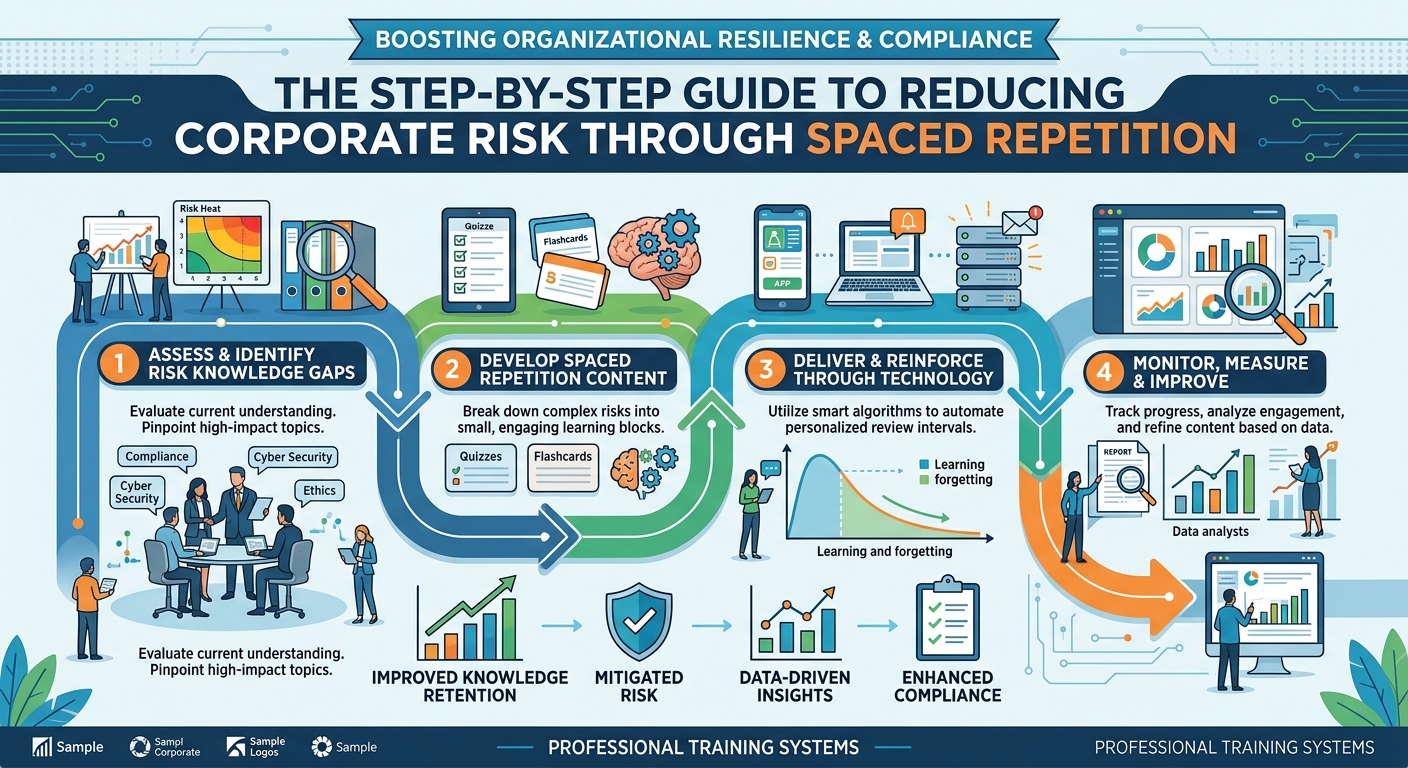
The Step-by-Step Guide to Implementing Spaced Repetition for Corporate Risk Reduction
Step 1: Identify Critical Risk Areas and Knowledge Gaps
The first step is to pinpoint exactly where your organizational risks lie and what knowledge gaps contribute to them. This isn't just about general compliance; it's about granular analysis. For instance, in banking, it could be specific anti-money laundering (AML) protocols; in healthcare, it might be patient data privacy (HIPAA) details; in manufacturing, it could be precise safety equipment operation. How can an intelligent system detect emerging risk patterns in operational data, helping us to identify critical knowledge gaps in our workforce with greater precision? By leveraging internal incident reports, audit findings, performance data, and even exit interviews, you can create a comprehensive map of your organization's unique vulnerability points. This data-driven approach ensures your training efforts are focused where they matter most.
Step 2: Develop Bite-Sized, Targeted Content (Microlearning)
Spaced repetition thrives on concise, focused content. Overwhelming employees with lengthy modules won't work. Instead, break down complex topics into Microlearning LMS units – short videos, interactive quizzes, infographics, or simulations that can be consumed in minutes. These small, digestible chunks are perfect for reinforcing specific points related to risk. What is the methodology for creating dynamic learning paths based on individual risk profiles and content interactions? An Adaptive Learning approach, supported by an AI Powered Authoring Tool, can help you create this content efficiently and ensure it's precisely what each learner needs for Risk-focused Training. This approach makes your learning content management system a powerful tool.
Step 3: Integrate into a Robust Learning Platform
Implementing spaced repetition effectively requires a sophisticated LMS. Look for a learning management system that inherently supports spaced repetition algorithms, Adaptive Learning paths, and personalized content delivery. What are the best learning management solutions for continuous compliance education that can dynamically adjust to individual learning speeds and retention needs? A robust MaxLearn LMS, or a similar cloud based learning management system, is essential. These platforms, often functioning as an advanced learning content management system or LCMS, automate the scheduling of content reviews, track individual performance, and provide analytics on knowledge retention. An enterprise learning management solution ensures consistent application across all departments and geographies.
Step 4: Design the Spaced Repetition Schedule
The "spacing" is critical. While specific intervals can vary based on content complexity and learner profile, a common pattern involves reviews at 1 day, 3 days, 7 days, 30 days, 90 days, and 180 days after initial exposure. Your chosen learning management software should ideally automate this. How can machine learning personalize a spaced repetition schedule for optimal knowledge retention across diverse teams, considering their prior knowledge and learning styles? An intelligent lms learning management system will adapt these intervals based on a learner's performance, challenging those who struggle more frequently and giving confident learners longer intervals. This personalization is key to maximizing efficiency and engagement, making it a truly smart learning management system.
Step 5: Monitor, Analyze, and Optimize
The journey doesn't end after implementation. Continuous monitoring and analysis are vital. Track key metrics such as completion rates, knowledge retention scores, and, crucially, a correlation with actual risk incidents or audit findings. Can a sophisticated analytical framework predict training efficacy for risk reduction by analyzing learner performance against real-world operational data? Absolutely. Leveraging the analytics capabilities of your LMS, you can identify areas where knowledge retention is still weak, adjust content, refine schedules, and even identify individuals who might need additional support. This iterative process ensures your risk mitigation strategy is continuously improving and adapting.
Benefits Beyond Compliance
While reducing corporate risk is the primary driver, implementing spaced repetition yields broader organizational benefits:
- Enhanced Employee Engagement: Employees appreciate training that is efficient, relevant, and helps them perform better, leading to higher morale and engagement.
- Improved Decision-Making: When critical information is readily accessible in long-term memory, employees can make faster, more informed decisions, especially in high-pressure situations.
- Culture of Continuous Learning: Spaced repetition fosters a mindset where learning is an ongoing process, not a one-time event, contributing to a dynamic and adaptable workforce.
- Better ROI on Training: By ensuring knowledge sticks, organizations get a much higher return on their training investment, transforming it from a cost center into a strategic asset.
Conclusion
Reducing corporate risk is a multi-faceted challenge, but L&D leaders have a powerful, scientifically proven tool at their disposal: spaced repetition. By meticulously identifying risk areas, developing targeted microlearning content, leveraging a robust learning management software, and continuously optimizing the process, organizations can build a resilient, knowledgeable workforce. This isn't just about avoiding penalties; it's about fostering a culture of excellence, empowering employees, and safeguarding your organization's future. Embrace spaced repetition, and elevate your risk mitigation strategy from reactive to revolutionary with an effective LMS.
.jpg)


