

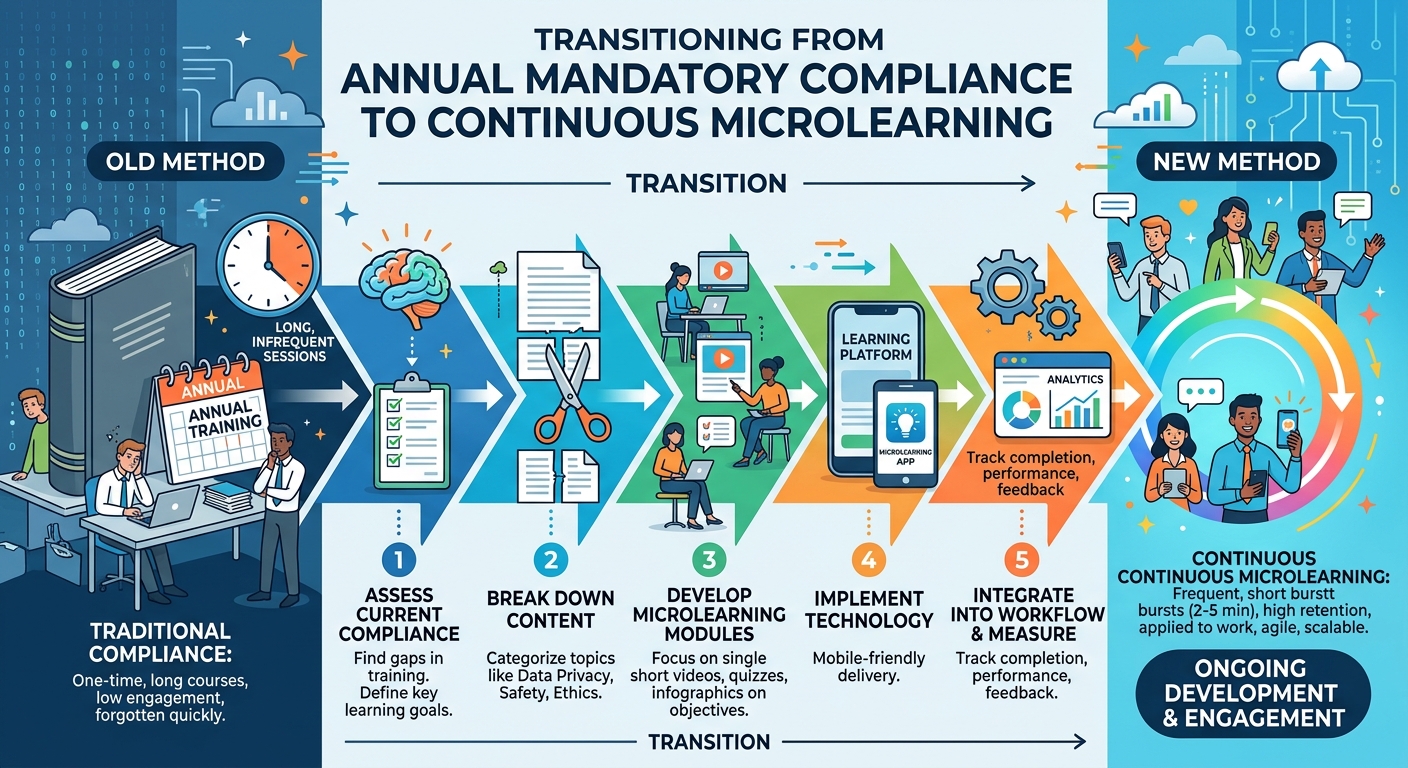
How to Transition from Annual Mandatory Compliance to Continuous Microlearning
For L&D Vice Presidents, Directors, Senior Managers, and Managers, the annual compliance training ritual is a familiar, often dreaded, cycle. It’s a box-ticking exercise that rarely excites employees, frequently consumes significant resources, and often falls short of genuinely mitigating risk. In today's dynamic business environment—spanning industries from Banking and Finance to Pharma, Retail, and Oil and Gas—regulations evolve rapidly, and the old "set it and forget it" approach to compliance is no longer viable. The solution lies in a paradigm shift: moving from episodic, mandatory events to a continuous, engaging, and effective Microlearning LMS framework.
This article will explore why traditional annual compliance is failing, the compelling case for continuous microlearning, and how your organization can successfully navigate this vital transition. We'll delve into the technology that underpins this transformation, helping you cultivate a culture of ongoing compliance and risk awareness.
The Inadequacy of Annual Compliance Training
Traditional annual compliance training, typically a lengthy module or a full-day seminar, is fundamentally at odds with how adults learn and retain information. The forgetting curve demonstrates that a significant portion of learned material is forgotten within days, let alone a full year. This model creates a knowledge gap that persists for months, leaving organizations vulnerable to non-compliance, human error, and reputational damage. Employees often view it as an interruption, something to endure rather than engage with, leading to low retention and minimal behavioral change.
The Cost of Compliance Stagnation
- Increased Risk Exposure: Gaps in knowledge due to infrequent training heighten the risk of regulatory breaches, fines, and legal repercussions across sectors like Healthcare, Insurance, and Mining.
- Employee Disengagement: Monotonous, lengthy sessions lead to boredom, reducing the perceived value of compliance and eroding morale.
- Inefficient Resource Allocation: Developing, delivering, and tracking complex annual training packages is time-consuming and expensive, often yielding poor ROI.
- Lack of Agility: Annual cycles struggle to keep pace with rapid legislative changes, leaving employees untrained on the latest requirements.
Embracing Continuous Microlearning for Compliance Excellence
Imagine a world where compliance training isn't a burden, but an integral, manageable part of an employee's daily workflow. This is the promise of continuous microlearning. By breaking down complex compliance topics into bite-sized, digestible modules, organizations can deliver relevant information precisely when and where it's needed.
What is Microlearning and Why is it Essential Now?
- Bite-sized Content: Modules typically last 3-7 minutes, focusing on a single learning objective, making them easy to consume.
- Accessibility: Available on demand, across multiple devices, allowing employees to learn at their convenience, during natural breaks or moments of need.
- Targeted and Relevant: Content can be personalized to an individual's role, department, or specific risks, ensuring higher relevance and engagement.
- Increased Retention: Regular, short bursts of learning combat the forgetting curve, reinforcing key concepts over time.
Implementing a comprehensive learning content management system that supports microlearning is the cornerstone of this transition. It enables L&D teams to manage, deliver, and track these focused learning experiences effectively, transforming compliance into an active, continuous process.
The Transformative Power of a Modern Learning Platform
To successfully shift to continuous microlearning for compliance, a robust LMS is not just helpful; it's essential. A modern learning management software acts as the central hub for all compliance training activities, offering features that elevate the learning experience and streamline management for L&D professionals.
Key Features for a Seamless Transition
- Personalized Learning Paths: A sophisticated learning management system can leverage data to create tailored learning journeys. This means employees receive training specific to their roles, past performance, and identified knowledge gaps. Adaptive Learning capabilities ensure that content adjusts in real-time based on learner interactions, maximizing relevance and efficiency.
- Engagement through Novelty: Dull compliance training leads to disinterest. A Gamified LMS introduces elements like points, badges, leaderboards, and interactive challenges, transforming routine compliance into an engaging competition. This not only boosts participation but also improves knowledge retention.
- Agile Content Creation and Curation: Rapid regulatory changes demand rapid content updates. An AI Powered Authoring Tool significantly reduces the time and effort required to create new microlearning modules or update existing ones. It can assist in generating content, quizzes, and scenarios, ensuring that compliance materials are always current and relevant. This empowers L&D teams to respond to new mandates with unprecedented speed.
- Data-Driven Insights and Reporting: A state-of-the-art lms learning management system provides powerful analytics. L&D leaders can track completion rates, performance on assessments, knowledge retention over time, and identify areas of common weakness. This data is invaluable for refining training strategies and demonstrating compliance effectiveness to regulators.
- Unrestricted Accessibility: Whether your employees are in a corporate office, on a retail floor, or at an oil rig, a cloud based learning management system ensures compliance training is always available. Mobile-first design and offline access capabilities mean learning can happen anytime, anywhere, fitting seamlessly into diverse operational environments. This global reach is crucial for large enterprises across various segments like Hospitality or Sales.
An enterprise learning management system like MaxLearn LMS offers a complete suite of learning management solutions, providing the infrastructure for this transformative shift.
Navigating the Transition: A Strategic Roadmap
Moving from annual to continuous compliance microlearning requires careful planning and execution. Here’s a strategic roadmap for L&D leaders:
Step 1: Assess Current State and Identify Gaps
Conduct a thorough audit of your existing compliance training programs. Pinpoint areas of high risk, common violations, and where current training falls short. Prioritize regulations that are frequently updated or have significant penalty implications. This Risk-focused Training approach ensures your efforts are aligned with critical business needs.
Step 2: Pilot and Scale Microlearning Modules
Start small. Select one high-impact compliance area (e.g., data privacy, anti-money laundering, workplace safety) and convert it into microlearning modules. Pilot these with a specific department or team. Gather feedback, iterate, and refine. Once proven effective, scale up to other areas, leveraging your LCMS to manage the growing content library.
Step 3: Integrate with Daily Workflows
The goal is to make compliance learning feel less like a separate task and more like an embedded part of the job. Integrate microlearning modules into onboarding processes, alongside policy updates, or as refreshers before critical tasks. Use nudges and reminders to encourage consistent engagement.
Step 4: Leverage Technology for Continuous Improvement
Regularly review the analytics provided by your learning management system. Identify learning trends, areas where employees struggle, and content that performs well. Use these insights to continuously update and improve your microlearning library, ensuring it remains relevant, engaging, and effective in mitigating risk.
AI and the Future of Compliance Microlearning
The integration of advanced technologies, especially artificial intelligence, is set to revolutionize compliance training even further. For L&D leaders, understanding these capabilities is crucial for future-proofing their strategies.
Enhancing Learning with Intelligent Systems
How can intelligent systems personalize the compliance journey for each employee? By analyzing an individual's role, past training performance, and even their current job tasks, AI can recommend precisely the right microlearning modules at the optimal time. This creates an experience where compliance education is dynamically tailored, focusing on specific weaknesses and enhancing strengths, ensuring every learner gets a uniquely optimized path to proficiency.
How can automated content generation tools quickly adapt learning modules to new regulations across different regions? With the rapid pace of regulatory change, especially in global industries like Pharma and Finance, AI-driven tools can ingest new legal texts and automatically generate or update microlearning content. This dramatically reduces the time it takes for L&D teams to push out compliant training, ensuring that employees are always informed of the latest rules pertinent to their geographical location or operational segment.
What impact do data-driven recommendations have on proactively addressing compliance vulnerabilities before they escalate? By continuously monitoring learning patterns and performance data, intelligent algorithms can identify emerging trends or common areas of misunderstanding within the workforce. These insights allow L&D to intervene proactively, deploying targeted microlearning refreshers or additional resources to specific groups, effectively neutralizing potential compliance risks before they translate into incidents or violations.
Conclusion
The transition from annual mandatory compliance to continuous microlearning is not merely an upgrade; it's a strategic imperative for organizations aiming for true compliance excellence and sustainable growth. By adopting a modern learning management software that supports microlearning, gamification, adaptive paths, and AI-powered content creation, L&D leaders can transform compliance from a dreaded obligation into an engaging, effective, and continuous learning experience.
Embrace this shift with a robust learning content management system. Equip your workforce with the knowledge they need, when they need it, mitigating risk and fostering a culture of continuous learning and accountability. The future of compliance is continuous, and it's powered by intelligent, bite-sized learning.
.jpg)


