

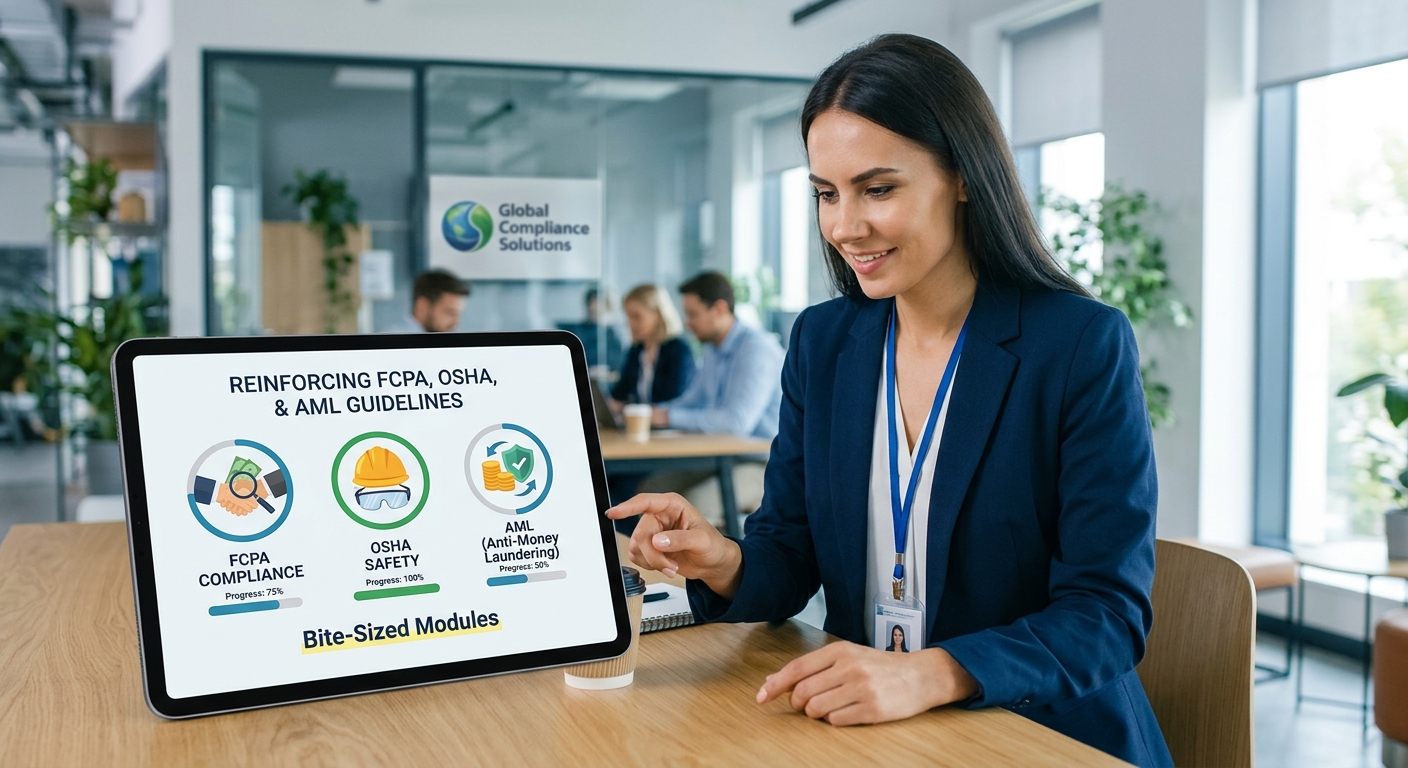
Reinforcing FCPA, OSHA, and AML Guidelines with Bite-Sized Compliance Modules
In today's complex regulatory landscape, ensuring comprehensive employee understanding and adherence to critical guidelines like the Foreign Corrupt Practices Act (FCPA), Occupational Safety and Health Administration (OSHA) regulations, and Anti-Money Laundering (AML) directives is paramount. For Vice Presidents, Directors, and Senior Managers in Learning & Development across diverse sectors—from banking and finance to healthcare and oil & gas—the challenge isn't just delivering training, but making it stick. Traditional, lengthy compliance training sessions often fall short, leading to disengagement, poor retention, and ultimately, increased risk for the organization. The solution lies in a modern, agile approach: bite-sized compliance modules, powered by advanced learning technologies.
The Undeniable Imperative for Robust Compliance Training
The stakes couldn't be higher. Violations of FCPA, OSHA, or AML guidelines can result in colossal fines, severe reputational damage, legal prosecution, and even imprisonment. Beyond punitive measures, non-compliance erodes trust, compromises operational integrity, and can significantly disrupt business continuity. This makes effective compliance training not merely a checkbox exercise, but a strategic imperative for every enterprise. Yet, many organizations struggle to move beyond the conventional. Hour-long webinars, dense policy documents, and annual classroom sessions often overwhelm learners, turning vital information into forgettable data points.
Transforming Compliance with Bite-Sized Learning
This is where the paradigm shift to bite-sized compliance modules, often referred to as microlearning, becomes a game-changer. Imagine breaking down complex FCPA scenarios, critical OSHA safety protocols, or intricate AML red flags into concise, digestible modules—each focusing on a single learning objective, completable in minutes. This approach aligns perfectly with modern learning behaviors, catering to busy professionals who need information on demand, whenever and wherever they need it.
For L&D leaders, leveraging a specialized Microlearning LMS allows for the rapid creation, deployment, and management of these targeted modules. It transforms the daunting task of compliance education into an engaging and continuous learning journey. This isn't just about making training shorter; it's about making it smarter, more impactful, and inherently more memorable.
Key Advantages of Bite-Sized Compliance Modules:
- Enhanced Retention & Engagement: Short, focused bursts of information prevent cognitive overload, leading to better recall. Interactive elements, quizzes, and scenarios keep learners actively engaged.
- Improved Accessibility & Flexibility: Employees can access modules on any device, at their convenience, fitting training seamlessly into their workdays. This is crucial for global teams and those with varied schedules.
- Real-time Reinforcement & Updates: Compliance regulations evolve. Bite-sized modules facilitate rapid updates and allow for continuous reinforcement, ensuring employees are always aware of the latest requirements.
- Measurable Impact & Risk Reduction: With detailed analytics offered by a robust LMS, L&D teams can track completion rates, performance metrics, and identify knowledge gaps, directly linking training effectiveness to risk mitigation. This risk-focused training ensures resources are allocated where they're most needed.
Integrating Advanced Technologies for Smarter Compliance
The true power of bite-sized compliance is unleashed when combined with cutting-edge learning technologies, particularly artificial intelligence. L&D departments are increasingly looking to AI to optimize how compliance training is delivered and consumed.
AI's Role in Optimizing Compliance Training:
Q: How can AI ensure our compliance training truly resonates with every employee, making it relevant and memorable?
A: AI can analyze individual learning patterns, job roles, and past performance data to tailor the learning path. For instance, an employee in the procurement department might receive more specific FCPA modules related to vendor interactions, while a finance professional receives deeper AML training. This personalized delivery, often facilitated by an Adaptive Learning system, ensures that content is maximally relevant to the learner's daily responsibilities, driving higher engagement and retention.
Q: In a global enterprise, how can we deliver compliance training that respects local cultures and diverse regulatory landscapes, making it equally effective everywhere?
A: AI can help localize content by identifying cultural nuances and specific regional regulatory requirements. Beyond simple translation, AI-driven tools can suggest relevant case studies or scenarios that resonate with local contexts, ensuring compliance training feels pertinent to employees in different geographies. This capability is critical for large, multinational corporations navigating the complexities of FCPA across various jurisdictions or tailoring OSHA guidelines to specific national workplace safety standards.
Q: Beyond creation, how can AI help us maximize the actual uptake, completion rates, and real-world application of our compliance modules across the organization?
A: AI can predict potential knowledge gaps before they become critical issues by analyzing assessment results and behavior within the learning management software. It can then automatically suggest remedial modules or provide timely nudges. Furthermore, AI can help identify content that is underperforming and provide insights for improvements, ensuring continuous optimization of the learning content management system. A Gamified LMS, coupled with AI, can also boost adoption by introducing healthy competition and rewards, making the learning process more enjoyable and less like a chore.
Implementing Your Bite-Sized Compliance Strategy
To successfully implement a bite-sized compliance program, L&D leaders need to consider a robust learning management system that supports microlearning principles. Look for a solution that offers not just content delivery but also powerful authoring capabilities, detailed analytics, and integration with AI. An AI Powered Authoring Tool can dramatically speed up the creation of engaging, high-quality bite-sized modules, even for complex topics like FCPA, OSHA, and AML.
Choosing the right enterprise learning management system, whether it’s a cloud based learning management system or a dedicated MaxLearn LMS, is crucial. It should function as a comprehensive learning content management system (LCMS), allowing for easy updates, version control, and seamless deployment across various platforms. The goal is to move beyond simply delivering content to creating a dynamic ecosystem for continuous compliance education. MaxLearn LMS offers cutting-edge features that empower L&D teams to deliver effective compliance training at scale, leveraging the power of microlearning and intelligent insights.
Conclusion
The days of annual, exhaustive compliance training are fading. The future of reinforcing FCPA, OSHA, and AML guidelines lies in intelligent, bite-sized compliance modules delivered through advanced learning management solutions. By embracing microlearning, adaptive learning, and the strategic application of AI, L&D leaders can transform compliance from a necessary burden into an integral part of an organization's culture—fostering a workforce that is not only knowledgeable but also genuinely committed to ethical conduct and safety. The investment in such a modern lms learning management system is an investment in your company's resilience, reputation, and long-term success.
.jpg)


