

How to Link Employee Compensation to Compliance Training Outcomes
In today's complex regulatory landscape, compliance is no longer a mere checkbox exercise; it's a strategic imperative. Organizations across industries like Banking, Finance, Insurance, Retail, Pharma, Healthcare, Hospitality, Oil and Gas, and Mining face ever-increasing scrutiny and potential penalties for non-compliance. While traditional compliance training aims to educate employees, often it falls short in truly embedding compliant behaviors. The question many L&D Vice Presidents, Directors, and Senior Managers grapple with is: how do we move beyond completion rates to tangible behavioral change, and can compensation play a role?
This article explores a powerful, yet often underutilized, strategy: directly linking employee compensation to the successful outcomes of compliance training. By doing so, organizations can significantly elevate engagement, reinforce critical behaviors, and ultimately build a more robust, compliant, and ethical workforce.
The Unseen Cost of Non-Compliance
The ramifications of non-compliance extend far beyond direct fines. They include reputational damage, loss of customer trust, decreased employee morale, operational disruptions, and legal fees. For example, a data breach in the Healthcare sector due to non-adherence to privacy protocols can cost millions. Similarly, a misstep in financial regulations in the Banking sector can lead to severe penalties and a plummeting stock price. These scenarios underscore the urgent need for compliance training that truly sticks.
Traditional approaches, often relying on annual, generic training modules, frequently fail to achieve the desired impact. Employees might complete the training without fully grasping its implications or internalizing the correct actions. The absence of a direct, personal incentive often contributes to this disconnect.
The Power of Performance-Based Incentives in Compliance
Humans are inherently motivated by incentives. When compensation, whether in the form of bonuses, raises, or other financial rewards, is tied to specific, measurable outcomes from compliance training, it fundamentally shifts employee perception. It transforms compliance from a passive requirement into an active goal, fostering greater personal accountability and a deeper commitment to understanding and applying compliance principles.
This approach elevates compliance to the same strategic level as sales targets or project deadlines, where performance directly impacts personal reward. It signals to employees that their adherence to regulations is not just a company mandate, but a critical component of their individual contribution and professional growth.
Strategies for Linking Compensation to Compliance Training Outcomes
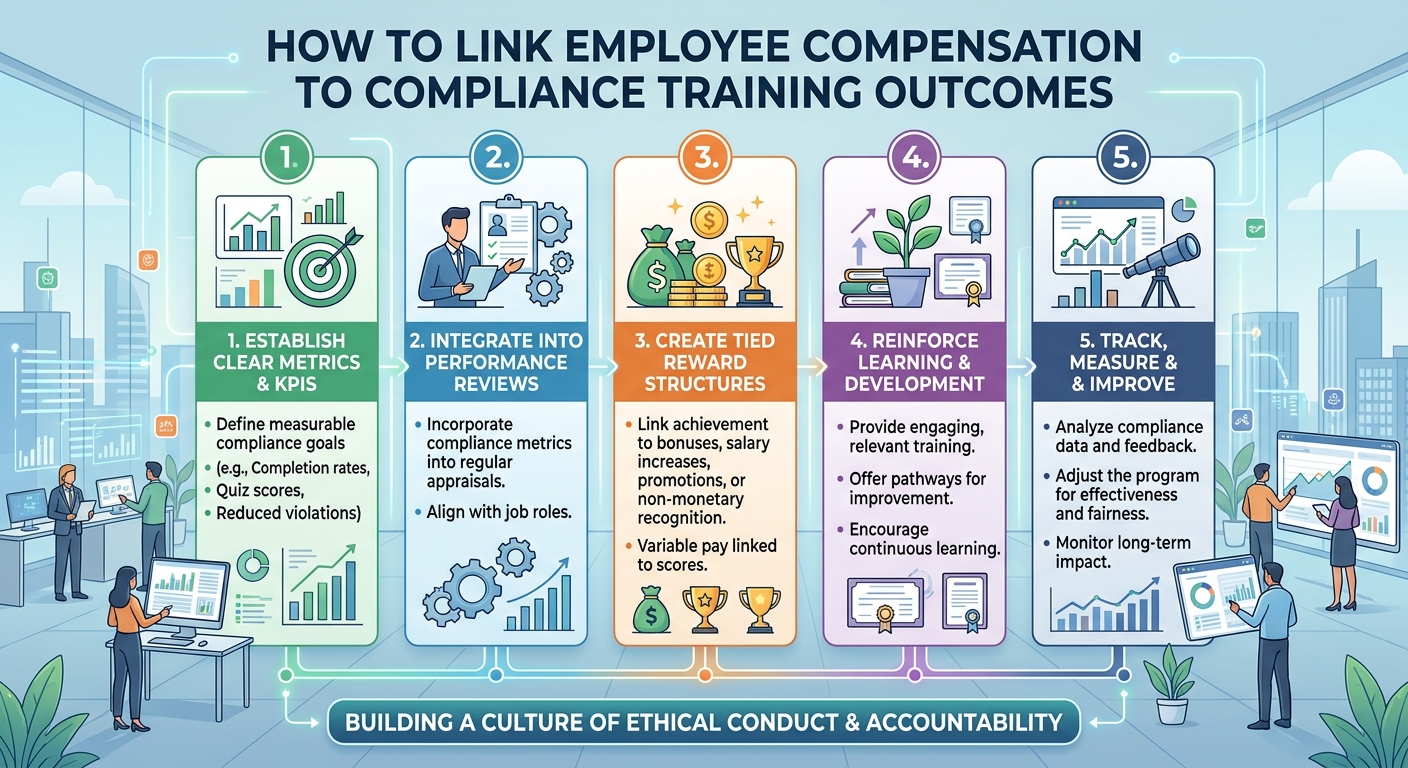
1. Define Clear, Measurable KPIs Beyond Completion
The first step is to move beyond simply tracking whether an employee finished a course. Effective linking requires defining Key Performance Indicators (KPIs) that demonstrate true understanding and application:
- Knowledge Retention Scores: Post-training assessments that measure long-term recall and comprehension, not just immediate recall.
- Scenario-Based Performance: The ability to correctly navigate simulated real-world compliance dilemmas.
- Behavioral Observations: Documented instances of compliant behavior in daily tasks, or the absence of non-compliant incidents.
- Audit Readiness Scores: Performance in internal or external audits related to an employee's area of responsibility.
- Contribution to Compliance Culture: Active participation in compliance discussions, reporting potential issues, or acting as a peer mentor.
2. Leverage Advanced Learning Technologies for Tracking and Engagement
Modern learning platforms are essential for implementing and tracking these sophisticated links. A robust Microlearning LMS or a comprehensive Gamified LMS can provide the necessary infrastructure:
- Granular Tracking: An advanced LMS or learning management system can track not just completion, but also assessment scores, time spent on specific modules, interaction with content, and progression through Adaptive Learning paths.
- Personalized Learning Journeys: An enterprise learning management solution can offer tailored content based on roles, risks, and previous performance, ensuring employees focus on areas where they need improvement. This is crucial for Risk-focused Training.
- Dynamic Content Creation: An AI Powered Authoring Tool can help L&D teams rapidly develop engaging, relevant, and updated compliance modules, ensuring the learning content management system always contains the latest information.
- Accessibility and Scalability: A cloud based learning management system ensures that all employees, regardless of location (critical for global operations in Oil and Gas or Pharma), have consistent access to training and their performance data. Solutions like a comprehensive MaxLearn LMS provide the necessary tools for this.
- Performance Reporting: An integrated learning management software can generate detailed reports that clearly link individual and team training outcomes to defined compensation tiers. The LCMS functionality ensures all compliance training assets are well-organized and accessible for performance review.
3. Implement Tiered Incentive Structures
Compensation links don't have to be an all-or-nothing proposition. Tiered structures can effectively motivate:
- Bonus Tiers: Employees achieving certain compliance scores or behavioral benchmarks receive escalating bonus percentages.
- Salary Adjustments: Demonstrating consistent high-level compliance performance could be a factor in annual salary reviews or promotions.
- Recognition & Rewards: Beyond direct financial links, public recognition, professional development opportunities, or additional PTO can serve as powerful motivators.
4. Foster a Culture of Continuous Learning and Feedback
Linking compensation to outcomes should be part of a broader strategy that encourages ongoing learning, not just a one-time event. Regular feedback loops, opportunities for remediation, and clear communication about why compliance matters are crucial. This reinforces the idea that compensation is tied to sustained understanding and compliant behavior, not just passing a test.
Overcoming Implementation Challenges
Implementing such a system requires careful planning. Concerns about fairness, the objectivity of measurement, and potential for undue stress must be addressed. Transparent communication, clear guidelines, and a robust appeal process can mitigate these challenges. Phased rollouts, starting with specific departments or compliance areas, can also help refine the process before full organizational adoption.
Insights from Intelligent Learning Systems
How can intelligent learning platforms ensure employees truly understand complex compliance mandates, not just pass tests?
Modern learning platforms leverage artificial intelligence to move beyond rote memorization. They provide adaptive learning paths, presenting content tailored to an individual's existing knowledge and learning style. AI can power interactive simulations, allowing employees to practice compliance procedures in a safe environment and receive immediate, personalized feedback. Chatbots can answer specific regulatory questions, while AI-driven analytics can identify knowledge gaps before they become critical, offering targeted remedial training. This ensures a deeper, experiential understanding rather than mere surface-level recall, directly improving the efficacy of a learning management system.
What considerations are paramount for multinational corporations aiming to standardize compliance education and compensation links across diverse regulatory landscapes?
For global entities, standardization must be balanced with localization. A flexible global learning management software is critical, offering multi-language support and the ability to customize modules for regional legal and cultural nuances. Compensation structures must also account for varying economic conditions and local labor laws. Centralized reporting from the LMS learning management system allows for global oversight, while decentralized content adaptation ensures relevance. Strong collaboration between global L&D, legal, and HR teams is essential to navigate these complexities and create a harmonized yet adaptive framework.
What measurable benefits can organizations expect from strategically aligning financial incentives with successful compliance learning journeys?
The benefits are multi-faceted. Organizations can anticipate a significant reduction in regulatory fines and legal costs due to fewer compliance breaches. Enhanced employee engagement in training leads to improved audit readiness and a stronger, more proactive compliance culture. This alignment fosters greater accountability and a more ethical workforce, mitigating reputational risks. Ultimately, it translates into a stronger competitive advantage, as a compliant and trustworthy organization can operate more efficiently and attract better talent, offering a clear ROI on investment in a sophisticated learning management system.
Conclusion
Linking employee compensation to compliance training outcomes is a bold, forward-thinking strategy that can transform compliance from a cost center into a strategic advantage. By defining clear KPIs, leveraging cutting-edge learning technologies, implementing tiered incentives, and fostering a culture of continuous learning, organizations can drive genuine behavioral change and significantly reduce their risk exposure. While not without its challenges, the proactive embrace of this approach can lead to a more engaged, knowledgeable, and compliant workforce, future-proofing the organization against an ever-evolving regulatory environment.
.jpg)


