

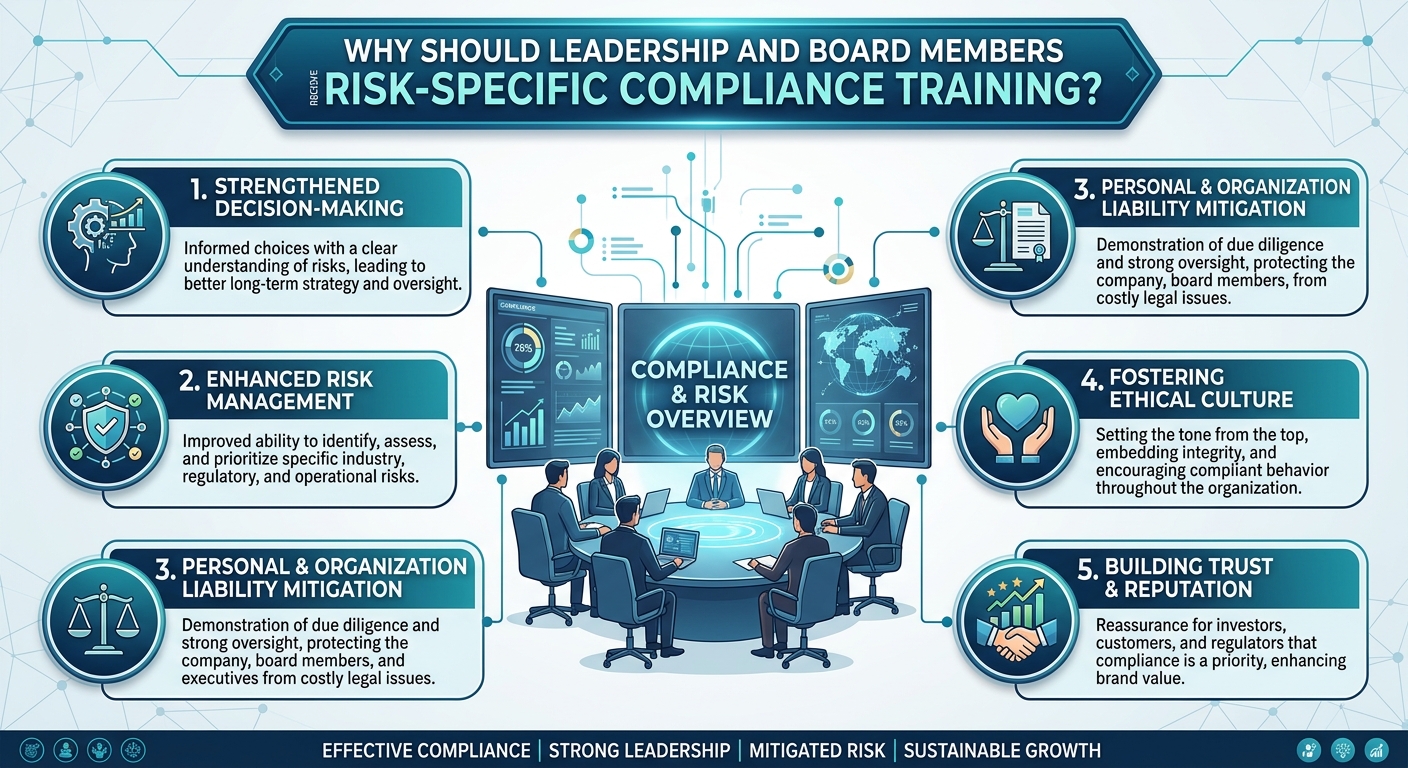
Elevating Governance: Why Leadership and Board Members Need Risk-Specific Compliance Training
In today's intricate and rapidly evolving business landscape, the burden of compliance falls heavily on an organization's leadership and board members. For Vice Presidents, Directors, and Senior Managers in Learning & Development, understanding the critical need for specialized risk-specific compliance training for this elite group is paramount. It’s no longer enough for executive teams to merely grasp general compliance principles; they require deep, nuanced insights into the specific risks pertinent to their roles, industry, and strategic decisions.
From banking and finance to healthcare, pharma, retail, and even oil and gas or mining, every industry faces a unique tapestry of regulatory demands. A robust learning management system is essential, but the content delivered to the boardroom must be bespoke, impactful, and continuous. This article explores why Risk-focused Training for leadership is not just a best practice, but a strategic imperative for sustainable growth and reputation management.
The Unique Compliance Landscape for Leadership
Leadership and board members operate at the highest echelons of corporate governance, making decisions that ripple throughout the entire organization. Their unique position comes with distinct responsibilities and liabilities that demand a level of compliance understanding far beyond what is expected of general employees. They are fiduciaries, stewards of shareholder value, and ultimately accountable for the company’s adherence to laws and ethical standards.
Consider the potential ramifications of a compliance failure at the top. Reputational damage, significant financial penalties, legal prosecution, and a loss of market trust are just a few of the severe consequences. A standard LMS or general compliance modules, while foundational for the broader workforce, often lack the strategic depth, crisis management scenarios, and governance nuances required for leadership. These individuals need training that addresses conflicts of interest, insider trading regulations, data privacy laws (like GDPR or CCPA), anti-bribery statutes (FCPA, UK Bribery Act), and environmental regulations specific to industries like oil and gas or mining.
Navigating an Increasingly Complex Regulatory Environment
The regulatory environment is a moving target, constantly shifting and expanding. What was compliant last year may not be today. Industries like finance, healthcare, and pharmaceuticals are particularly susceptible to frequent updates, but even retail and hospitality face evolving standards in areas like labor laws, consumer protection, and supply chain ethics.
How do organizations ensure their leadership remains agile and informed amidst this flux? A traditional annual compliance refresher simply doesn't cut it. What specific compliance obligations face our board in new global markets? Leadership needs a dynamic approach, often delivered through a modern Microlearning LMS, that provides timely updates and targeted insights. This ensures they are not just reactive but proactive in anticipating and addressing compliance challenges.
An effective learning content management system must be able to deploy rapid, relevant content that addresses these shifts. This continuous learning approach is vital for maintaining an up-to-date understanding of risks, whether they pertain to new sustainability mandates in manufacturing or evolving data security protocols in banking.
Strategic Advantages of a Risk-Aware Leadership Team
Investing in risk-specific compliance training for leadership yields significant strategic advantages beyond mere avoidance of penalties. An executive team deeply schooled in risk identification and mitigation is better equipped to make informed decisions that drive growth while safeguarding the organization.
- Enhanced Decision-Making: Leaders who understand compliance intricacies can integrate risk considerations into strategic planning, product development, and market expansion efforts. This proactive stance minimizes potential pitfalls.
- Stronger Corporate Governance: A well-trained board fosters a culture of integrity and accountability, which enhances investor confidence and strengthens the company’s ethical foundation. This is a hallmark of effective enterprise learning management.
- Improved Crisis Preparedness: When risks materialize, a leadership team with specific training can respond more effectively, mitigating damage and demonstrating due diligence to regulators and stakeholders.
- Competitive Edge: Companies known for their robust compliance posture often gain a competitive advantage, attracting top talent, ethical partners, and discerning customers.
For L&D professionals, this means selecting a learning management software that can support this high-level, continuous learning. A cloud based learning management system offers the flexibility and accessibility needed for busy executives, allowing them to engage with critical content on their schedules.
Leveraging Modern eLearning for Executive Training
How can technology transform executive compliance training from a tedious obligation into an engaging and effective learning experience? Modern eLearning platforms, particularly those incorporating advanced AI capabilities, are revolutionizing how leadership acquires and retains critical risk knowledge.
The Role of Artificial Intelligence
Artificial intelligence is no longer a futuristic concept; it's a practical tool for optimizing executive learning. What personalized compliance training should our executives receive based on their roles and past performance? An AI Powered Authoring Tool can analyze vast amounts of regulatory data, identify emerging risks, and even suggest custom learning pathways for individual board members based on their specific responsibilities and geographical reach. For instance, an executive overseeing operations in EMEA might receive modules on EU data privacy laws and sanctions compliance, while a counterpart in APAC focuses on local anti-corruption statutes.
Beyond content creation, AI in a learning management system can enable Adaptive Learning. This means the system assesses a learner's existing knowledge and tailors the training experience, focusing on areas where improvement is needed. This personalized approach ensures efficient learning, respecting the limited time of senior leadership.
Engaging Executive Learners with Modern Features
Engagement is key, even for executives. While formal lectures have their place, modern lms learning management system solutions offer more dynamic alternatives. How do global regulations impact our leadership's compliance needs, and how can training be made more impactful across diverse teams? A Gamified LMS can introduce elements of competition, scenario-based simulations, and progress tracking, making complex compliance topics more interactive and memorable. Think of board members engaging in a simulated crisis scenario where their decisions directly impact the organization's legal standing and reputation.
A robust LCMS (Learning Content Management System) or MaxLearn LMS, allows L&D teams to create, manage, and deliver highly specific content relevant to different leadership roles and industries. This ensures that a hospital administrator receives training on HIPAA and patient data security, while an executive in the mining sector focuses on environmental compliance and safety regulations.
Implementing Effective Risk-Specific Training for Leadership
For L&D professionals tasked with designing and implementing this crucial training, several best practices emerge:
- Customization is King: Generic training will not suffice. Content must be highly tailored to the specific risks, regulatory environment, and strategic goals of the organization and the individual roles within leadership.
- Continuous Learning: Compliance is not a one-time event. Implement a continuous learning strategy, leveraging a Microlearning LMS to deliver short, impactful modules as regulations change or new risks emerge.
- Scenario-Based Learning: Use real-world case studies and simulations to challenge leaders to apply their knowledge in practical, high-stakes situations.
- Expert-Led Content: Partner with legal and compliance experts to develop the most accurate and insightful training materials.
- Measurable Outcomes: Implement robust analytics within your learning management solutions to track completion rates, comprehension levels, and the overall impact of the training on leadership awareness and behavior. What are the core compliance risks for a board member, and how can we measure their understanding and mitigation strategies?
Conclusion
The call for risk-specific compliance training for leadership and board members is clear and urgent. In an era where regulatory scrutiny is intensifying across all sectors—from Banking and Finance to Pharma and Oil & Gas—organizations cannot afford to leave their top decision-makers unprepared. Equipping them with tailored, continuous, and engaging compliance education is a strategic investment that protects reputation, ensures legal adherence, and ultimately drives sustainable business success.
For L&D leaders, this presents an opportunity to champion organizational resilience by implementing advanced MaxLearn LMS solutions that provide targeted, impactful learning experiences. Embrace the power of modern eLearning, from an AI Powered Authoring Tool to a Gamified LMS, to ensure your leadership is not just compliant, but confidently steering the organization through an ever-complex world of risk.
.jpg)


